
The Pirate Empire Blocks Iran and China
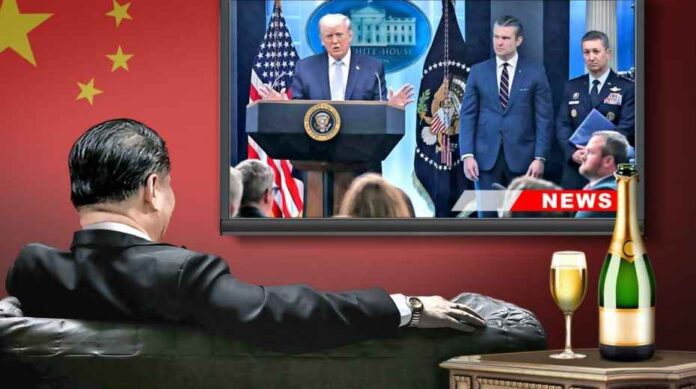
Greet the almighty return of Pirates of the Caribbean, now upgraded to Pirates of the Persian Gulf.
The spectacular collapse of the Islamabad dictates – Barbaria came to dictate, never to negotiate – was followed by a psychological operation of coercion on steroids: Jesus! (literally, as he posted it on Truth Social) that threatens every ship currently paying tolls at the Strait of Hormuz toll gate, writes Pepe Escobar .
As every grain of sand from the Gobi to the Sahara already knows, this is all about China.
So the question must be asked again. CENTCOM has now merged into INDOPACOM, a new pirate hydra. Will INDOPACOM have the guts to harass a Chinese supertanker sailing through the Strait of Hormuz after it has paid the toll in yuan?
In his characteristic insane supremacy mode, US Treasury Secretary Bessent said that China will no longer be able to extract oil from Iran.
This ‘Baboon of Barbaria’ gimmick essentially amounts to economic warfare against not only China, but a series of predominantly Asian countries, disrupting global energy flows, trade, and major shipping of all kinds of goods from the West to the East and from the East to the West. An oil blockade aimed not only at China, but also at a large part of the multipolar world.
Before the start of the American blockade, ships from only five countries could sail through the Strait of Hormuz: China, Russia, India, Iraq, and Pakistan. Once again: will INDOPACOM dare to seize or sink ships from four nuclear powers?
South Korea went a step further and sent a special envoy for direct negotiations with Tehran to guarantee safe passage through Hormuz and to buy more cheaper oil and gas. At this moment, at least 26 South Korean tankers are stranded.
Now compare Bessent with Russian Foreign Minister Sergei Lavrov in Beijing, after a conversation with Chinese Foreign Minister Wang Yi and a personal meeting with President Xi:
Russia can undoubtedly compensate for the resulting shortage of raw materials.
Approximately 13% of Chinese oil imports come from Iran – about 1.38 million barrels per day. At the same time, Power of Siberia-1 – which is operating at full capacity – supplies 38 billion cubic meters of gas per year, and the ESPO oil pipeline is reaching record levels.
Power of Siberia-2 may not become operational until next year. Russia already supplies no less than 20% of Chinese oil. In Lavrov’s words, “compensating” means utilizing reserve capacity to the fullest. But that is feasible.
For its part, Iran can count on an alternative pipeline and the Yask oil terminal, with a capacity of 1 million barrels per day, which completely bypasses the Strait of Hormuz.
So far, eight Chinese tankers have sailed through Hormuz since the blockade was announced. Moreover, China has no less than 1.3 billion barrels in stock, enough to absorb losses from Iran for several months. And China will – in theory – continue to receive oil from tankers departing from other, non-Iranian ports in the Persian Gulf (they will still have to pay the toll).
The big question is how long Iran – and China, for that matter – will tolerate the shadow fleet being intercepted by INDOPACOM without a ballistic response.
Waiting for the Al Aqsa Triangle blockade
A blockade of all Iranian ports – and not of the Strait of Hormuz itself – could soon find its equal: the emerging Al Aqsa Triangle blockade (Bab al-Mandeb, the port of Yanbu in Saudi Arabia, Suez, in connection with Hormuz), as announced by Ansarallah in Yemen. The Houthis are merely waiting for the highly strategic moment to enter the game. That will inevitably lead to an oil price of more than 200 dollars per barrel – and that amount is still rising.
Which means: an irreparable, system-wide supply shock.
The cowardly Baboon or Barbaria government certainly hasn’t thought this through properly – since it is obsessed with starving China of oil and US dollars, while theoretically destroying the key hubs of the New Silk Road/BRI.
What everyone is also paying attention to is how the blockade enforced by INDOPACOM will devastate countless countries outside China.
That brings us to a commonplace but very feasible calculation – in line with figures like Bessent: let’s starve everyone of oil and US dollars, so that they will desperately sell their US government bonds back to the US far below face value, as long as they get oil and/or US dollars in return.
This is Grifter Central: the Americans are taking their debt out of circulation – at a massive discount – and simply scrapping those gigantic interest payments on the debt they cannot afford.
There is no guarantee that the government of the Barbary Baboon will get what it wants. Tehran is not dependent on maritime routes. After decades of sanctions, they have developed a range of alternative land corridors, trade channels, and exchange mechanisms, for example via Turkmenistan.
China is, once again, no longer a prisoner of the Malacca dilemma – between Malaysia and Sumatra in Indonesia – because it has carefully diversified its sources, starting with the Sino-Russian pipelines.
Moreover, the pipeline between China and Myanmar bypasses Malacca completely.
The long gas pipeline between China and Central Asia, which crosses Turkmenistan, Uzbekistan, and Kazakhstan—paid for by China and bypassing the American thalassocracy—has been in operation since the early 2010s.
Then there is the deep-sea port of Gwadar in the Arabian Sea, the main hub of the China-Pakistan Economic Corridor (CPEC) and a pillar of the BRI. Gwadar lies only 80 km east of the port of Chabahar in Sistan-Balochistan in Iran: thus far from the Persian Gulf. This translates into a land route from the Arabian Sea to Xinjiang.
China will not starve if it stops receiving Iranian oil. China is at the forefront of virtually every sector of energy and power production. The country possesses the industrial capacity—talk about productive capitalism—the raw materials, the supply chains, and sufficient skilled labor to produce the technology and infrastructure needed for any relevant energy system: solar panels, turbines, batteries, transmission lines, everything related to next-generation solar, wind, hydropower, and nuclear energy. That is exactly what I saw when I traveled through Xinjiang successively last year while filming a documentary.
It is clear that the shortsighted followers of Baboon or Barbaria cannot possibly understand how China’s strategy of total dominance in EVs, solar batteries, and electricity exports protects the Middle Kingdom from artificial oil and gas shocks such as the blockade.
As it stands, the Invincible Armada remains on the outer edge of the Gulf of Oman, beyond the range of many – but not all – Iranian missiles and drones, but certainly a target for long-range missiles and hypersonic weapons. The Americans will continue to use their ISR to track ships; subsequently, small boats and helicopters will carry out the “interdiction” procedure.
So far, nothing has happened. Well, actually, something big did happen: a sanctioned, non-Iranian supertanker capable of carrying 2 million barrels of oil sailed through the Strait of Hormuz to Iran with its AIS system enabled, so that any tracker could see it. INDOPACOM didn’t dare touch it.
Meanwhile, the Iranians are simply waiting. Asymmetrical. But make no mistake: they are eager to fight – just in case the ceasefire fails.
In that case, we are plunged straight into the Mother of all Cliffhangers. Iran only needs to sink one American destroyer; and/or “eliminate” one of those multi-billion dollar targets with a salvo of missiles/drones, guided by Chinese intelligence.
The entire planet will then see what it is: the definitive, graphic strategic defeat of the Empire of Chaos, Lies, Plundering, Piracy, and “If I don’t like you, I’ll kill you”.
Bring it on.
https://www.frontnieuws.com/het-piratenrijk-blokkeert-iran-en-china