
The Reorganization of the World
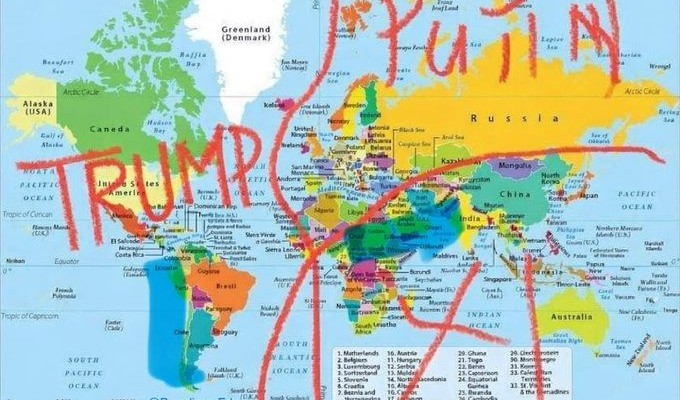
The world is changing very quickly. The year 2026 should be marked by the return of spheres of influence and the end of colonial empires. Above all, it will see the return of international law to the rules we have known until now. Only those who are able to understand these developments and adapt to them quickly will continue to thrive.
We are witnessing a reorganization of the world following the Anchorage summit (August 15, 2025), the ceasefire in Gaza (October 10, 2025), and Operation Absolute Resolve in Venezuela (January 3, 2026). It is now clear that Presidents Donald Trump and Vladimir Putin divided the world between them in Alaska. The validation of this arrangement will take place at the next Trump-Xi summit.
The only information we have is the map from the Russian General Staff, published by Andrei Martyanov. It divides the world into three zones of influence, which does not contradict the principle of a multipolar world. Primitive international law—I mean pre-Cold War—only resolves a few problems. It grants states complete freedom to do as they please within the limits they themselves have set.
I explained in my last column that, contrary to popular belief, while the United States may have committed a crime by abducting President Maduro, according to previous rules, they were within their rights to do so, based solely on their commitments. Whether one finds this reality shocking changes nothing. This is now how we must operate.
Until now, the world was governed by the G5/6/7/8/7, formerly composed of Germany, Canada, France, the United States, Italy, Japan, the United Kingdom, and the European Union.
Its demise marks the end of the British and French empires. We must acknowledge that France will have to decolonize New Caledonia and French Polynesia; the United States will have to decolonize Samoa, Guam, and the Virgin Islands; New Zealand will have to decolonize Tokelau; and the United Kingdom will have to decolonize Angilla, Bermuda, the Virgin Islands, the Cayman and Falkland Islands, Gibraltar, Montserrat, Saint Helena, and the Turks and Caicos Islands. This will have to be done very quickly if France, the United Kingdom, New Zealand, and the United Kingdom wish to maintain a presence in their former colonies.
It is likely that the Commonwealth will disintegrate. Its member states will, at the very least, abandon their shared citizenship.
The G7 will be replaced by a C4/5 composed of China, the United States, India, and Russia, to which President Trump hopes to add Japan. However, it is likely that Japan will not be admitted, given its belligerent statements. China remains furious about the rise of Japanese imperial militarism, the denialism of the Sanae Takaichi government, its views on Taiwanese microprocessors, and its rare earth exploration.
Given their respective power, the four major world powers will be able to do as they please in all cases not governed by international law—as the United States did in Venezuela.
Several regional alliances will allow secondary powers to play a significant role.
I won’t discuss NATO, which will be dissolved by mid-2027, or sooner if the transfer of Greenland from Denmark to the US allows. The admonitions of a few Europeans will change nothing: they will wage war on the United States no more than they will on Russia.
The AUKUS Alliance (Australia, the United States, and the United Kingdom) will also not survive the partitioning of the world.
The EU is also expected to disappear. Ursula von der Leyen’s appearance at the signing ceremony of the EU/Mercosur free trade agreement only hastened its downfall: the people of France, Poland, Austria, Ireland, and Hungary have just realized that this bureaucracy is not defending their interests, but sacrificing their farmers to the needs of German industry.
Several organizations will take over: the Joint Expeditionary Force (JEF), a British mini-NATO, already includes Estonia, Lithuania, Latvia, Denmark, Norway, Iceland, Sweden, Finland, and the Netherlands, all centered around the United Kingdom. Ukraine will join, while Iceland will join the United States (after the cession of Greenland). Indeed, Canada and Greenland are located on the American continental shelf, as is part of Iceland, which understandably gives the United States an appetite for it. For their part, Bulgaria, Finland, Latvia, Lithuania, Poland, and Sweden have already formed an “Eastern Front Alliance.” It is uncertain whether this new organization will be sustainable, as it currently lacks both a budget and a secretariat.
These military alliances will be complemented by political coalitions, much like the EU has complemented NATO. The Three Seas Initiative is the most significant of these. It brings together Austria, Bulgaria, Croatia, Estonia, Greece, Hungary, Latvia, Lithuania, Poland, and Romania, Slovakia, Slovenia, and the Czech Republic. It aims to reform the medieval Polish-Lithuanian Commonwealth or Marshal Józef Piłsudski’s Międzymorze Federation project: creating a federation between Germany and Russia.
This is a Polish project, championed by President Karol Nawrocki (Law and Justice), while the Eastern Front Alliance is a project led by Prime Minister Donald Tusk (Civic Coalition).
In the Middle East, the Saudi Arabia/Iran rivalry ended with the Chinese mediation of 2023. It has been replaced by a Saudi Arabia/United Arab Emirates rivalry. This rivalry has already manifested itself in Yemen and Sudan. Those who, just four years ago, were the best of friends, are now bitter rivals.
Riyadh is attempting to rally support behind it, along with Pakistan, Turkey, Egypt, and Somalia. For its part, Abu Dhabi, which has already forged military alliances with Sudanese, Libyan, and Somali factions, is expected to move closer to Israel and bring Ethiopia into its fold.
In Africa, the Alliance of Sahel States, composed of Burkina Faso, Mali, and Niger, is the only regional military alliance. It is expected to be encouraged by China and Russia. In Latin America, the Bolivarian Alliance of the Peoples of Our America (ALBA) is no longer functioning. On the contrary, a coalition is forming around Argentina and Chile with the approval of the United States.
China, India, and Russia want to preserve the United Nations. Consequently, President Trump has abandoned his plans to leave the UN headquarters. It is crucial to understand that much of what the UN has built will be dismantled to bring it into line with international law. Because, contrary to what we have convinced ourselves, the United Nations is not international law.