
The Sad and Sterile World of Tinder
Walk the streets of any major metropolitan area and pay attention to what is communicated in the public sphere. Look especially at advertising, signage, and other messages that bombard you in public spaces. You can learn a good deal about the mindset of the people who run that society by observing such things.
More specifically, a culture that is insane, or in the process of going insane, will give it away in what it features in privileged public spaces. These are its most essential values.
On a recent visit to New York City, I did a little research in this vein.
Since it had been a while since I had been to New York, and still longer since I had thought about the public advertising in the city, I found much there of interest, and much that was jarring. But I had not remembered previously seeing anything quite so jarring.
In particular, while riding the subway, I stumbled upon a series of posters for the dating app Tinder that struck me as clear evidence of our growing cultural insanity.
If one wanted to get a crash course in the deterioration of the contemporary American urban collective consciousness, this visual sociology lesson would be a good place to start. The images reveal, in stark and unmistakable terms, how far the assault on our normative standards of good and evil has advanced in our cities. They depict a world in which reproductive heterosexuality is extinct, and all expressions of sexuality deviate from established baselines of biological and cultural patterns. The basic theme is the hatred for and desired destruction of everything normal or wholesome and the embrace of the freakish to replace these things.
One immediately notes in these images the complete absence of any normal-looking people. Everyone appears to be from a distant planet on which garish plumage, like something you’d see on the monstrous birds of a nightmare, is standard. In the dream world of Tinder, everyone has orange hair and is gender-nonspecific. Similarly, they dress as though they are either attending a rave or are working as extras on a science-fiction movie set in a post-apocalyptic megacity.
In addition to the images, each ad was adorned with a trite phrase. These bits of text say much about the culture of the people who are the target consumer group for this service.
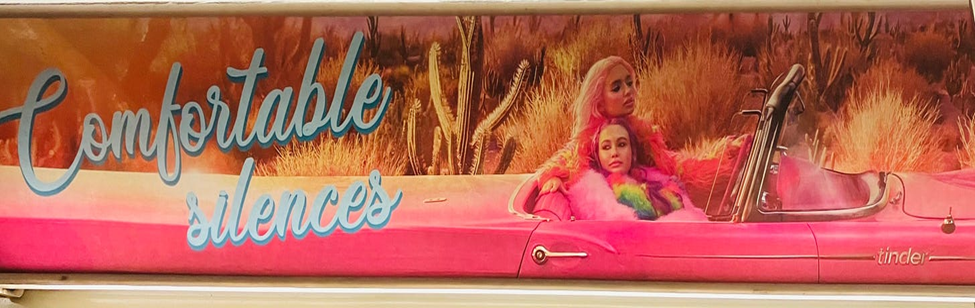
Consider “Comfortable Silences.” In this image two (apparently) women are driving in a pink convertible through a desert. Silence. The desert. Cactuses and shrub grass. These are supposed to be the images of “love” in our culture. Warm, human, and verbal communication is apparently no longer the goal. No, the perfect relationship is one in which you are not required to interact in a substantive way with your “partner,” but can instead continue to live an alienated life, but now alone “together” with another alienated alone person to whom you do not speak or even look at. Desolation and emotional isolation, all while sitting in physical contact with another human being, is the message of the image.
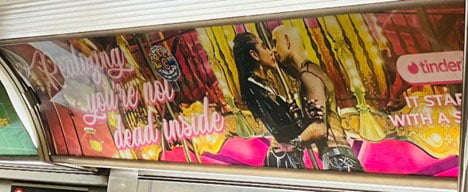
The next image tells us to aspire to “Realizing you’re not dead inside.” The presumption here is that some significant number of those on Tinder have entertained the possibility that they are, in fact, dead inside. It is hard to read such advertising copy and avoid imagining a consumer base of the emotionally desperate people who are on the verge of mental breakdown. The couple in this ad are dressed as players in a sadomasochistic scenario, all leather and chains, and bearing razor-sharp claws. “Love” as constant preparation for combat and the spilling of blood, to escape the gnawing psychic void one feels inside. How appealing!
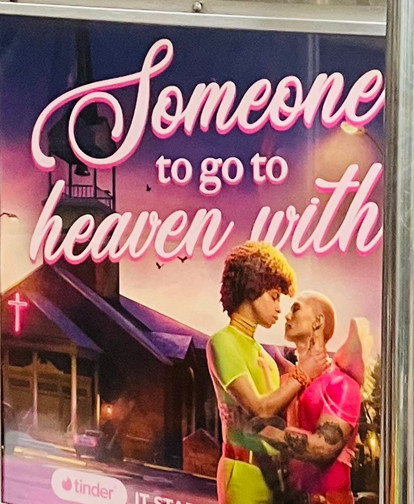
One might be excused for wondering how many people using Tinder have any beliefs at all in heaven or hell or any other aspect of traditional religious belief. It is doubtless a very small number. This doesn’t prevent the app from subverting the language, however, and promoting their services in helping us find “Someone to go to heaven with.” Whatever Tinder imagines heaven might be, it is a paradise in which Adam and Eve have no place. The couple in this ad are homosexual, or perhaps transsexual. The viewer has no clear idea of how to identify these two, by their features or their bodies or their dress. All sexual identity and pairing consist of chaos and confusion. It is neon-colored and heavily tattooed. One also imagines that observers of this poster who actually do believe in heaven and hell would have no difficulty discerning which of those two places this scene more closely resembles.
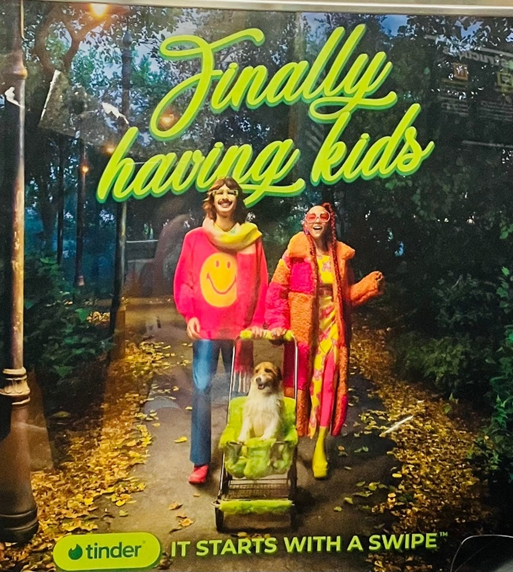
The Tinder audience is almost certainly heavily anti-natalist, for all the typically nihilistic, anti-human reasons. People are a blight on the planet, and the fewer of them, the better. The world offers nothing but suffering (see the empty voids alienation, internal death and desire to avoid communication supported in the other ads), and it would be a travesty to bring innocent children into this mess. These planet-saving activists will avoid with all their being admitting that what is really driving their supposedly moral project is their childish refusal to enter the world of responsibility of traditional adulthood.
So why the ad with “Finally having kids,” then? Don’t panic. The Tinder world is still committed to the decrease and disappearance of humankind. The couple in the ad are certainly not going to commit the atrocity of having a human child. Their “kid” is a dog.
https://chroniclesmagazine.org/web/the-sad-and-sterile-world-of-tinder