
The Topic Being Silenced by the Western Media
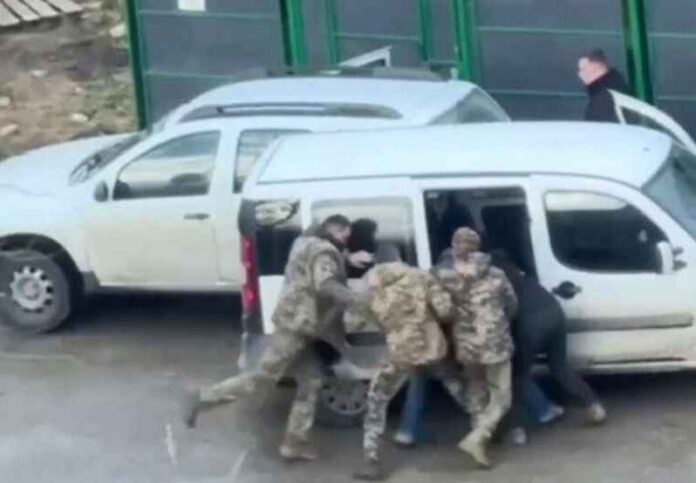
Forced recruitment in Ukraine is a topic the Western media avoids like the devil’s knee. Now, an American think tank has reported on this.
A hallmark of war propaganda is the omission of anything that doesn’t fit the image of war enthusiasm and confidence in victory. By this standard, the Western mainstream media is engaging in war propaganda by remaining completely silent about the brutal forced recruitment in Ukraine, already known in the country as “bussification,” where men of military age are rounded up on the street and forcibly crammed into minibuses to be taken to recruitment centers and from there to war, writes Thomas Röper .
The topic has recently been raised in English-language media because of two cases: one of Angelina Jolie’s bodyguards was forcibly removed from her team, to which she protested, and the other, a British journalist reporting near the front complained in his report that one of his Ukrainian colleagues had been forcibly taken to the front.
The Quincy Institute for Responsible Statecraft subsequently published an article on this topic, which I translated.
Beginning of translation:
The “bussification” of Ukraine – forced conscription – is just the tip of the iceberg
The Western media largely ignores that Kiev is having to pluck young men off the streets because of recruit shortages and desertions.
By Ian Proud | Responsible Statecraft
In Ukraine, “bussification” is a common term and refers to the process by which young men are held against their will, often using physical force, and forced into a vehicle – usually a minibus – to be taken to an army recruitment center.
Until recently, Ukrainian army recruiters opted for “soft” targets. But on October 26, Jerome Starkey, defense and military affairs editor for the British newspaper The Sun , wrote a shocking account of his recent trip to the front in Ukraine, where he claimed his Ukrainian counterpart had been “forced into his country’s military service.”
This case was remarkable for two reasons: first, Western mainstream media rarely report on the forced mobilization of soldiers. Second, unlike most forced recruitments, this event occurred after the Western journalists’ vehicle was reportedly seized by three armed men who insisted they drive to a recruitment center.
There, according to Starke’s report, he saw “at least a dozen grim-looking men, mostly in their forties and fifties, clutching stacks of papers. They were called in and out of adjacent rooms to undergo cursory health checks to demonstrate their fitness for combat.”
This process has drawn criticism following several high-profile incidents in which men died before donning a military uniform. On October 23, Ukrainian Roman Sopin died of severe blunt force trauma to the head after being forcibly recruited. Ukrainian authorities claim he fell, but his family has taken legal action. In August, a 36-year-old conscript died suddenly at a recruitment center in Rivne; authorities claim he died of natural causes.
In June, 45-year-old Ukrainian-Hungarian Jozsef Sebestyen died after being beaten with iron bars following his forced recruitment; the Ukrainian military disputes this version of events. In August, a forcibly recruited man died from injuries sustained after jumping from a moving vehicle transporting him to the recruitment center.
If you search online , you’ll find a wealth of thousands of similar incidents, most of which were filmed this year alone. There are videos of a recruiting officer chasing and shooting a man, or of a man being strangled in the street while a recruiter presses his knee on his neck. Many videos show family members or friends desperately fighting to prevent their loved ones from being taken against their will.
If these kinds of videos were shared on such a systematic scale in the US or the UK, I’m convinced large segments of the public would express serious concern. But the Western media remains largely silent, and I find it hard to understand why.
In November 2024, Ukrainian Defense Minister Rustem Umerov claimed he would end the bussification. It is true that Ukraine has taken steps to modernize its army recruitment and make conscription more attractive to men under 25. However, there is little evidence that these efforts are having the desired effect. And after a year, the bussification appears to be only getting worse—and yet it is largely ignored by the Western press.
The Washington-based Institute for the Study of War regularly reports on Russian mobilization efforts, but not on the dark and desperate aspects that lead to bussification. You won’t find any reports on this in the New York Times , as this contradicts the narrative that Ukraine can still turn the tide of the war with Western support. Instead, they prefer stories like the internal Ukrainian competition “Points for Shooting Down Drones” or the designer behind the new all-black suit Zelensky has recently been wearing. The Washington Post, on the other hand, quietly advocates for the recruitment of 18-year-old Ukrainians, even though this is a politically toxic topic in Ukraine.
That’s because bussification is just the tip of the iceberg. If it’s already difficult for Ukrainians to attract young men to volunteer for the army, it’s even harder to prevent them from deserting.
In January 2025, it was reported that approximately 1,700 soldiers from the 155th Mechanized Brigade, named Anna of Kiev , which had been trained in France and equipped with French tank howitzers, had deserted, 50 of them while still in France. In June 2024, a Ukrainian deserter was shot by a border guard while trying to flee to Moldova.
In the first half of 2025, more than 110,000 desertions were reported in Ukraine . In 2024, Ukrainian prosecutors initiated more than 89,000 cases of desertion and unauthorized removal from service, a figure three and a half times higher than in 2023. More than 20 percent of Ukraine’s once million-man army has fled in the past four years, and the numbers continue to rise.
The rising desertion rate appears to be partly fueled by increasingly severe infantry shortages at the front, which rarely allow soldiers time for rest and recovery. A lack of sufficient equipment is also often cited as a cause. And, of course, the widespread and rising number of desertions in the Ukrainian army only seems to lead to even more violent recruitment methods, followed by civilian protests. On October 30, a group of protesters opposing the forced arrest of a man in Odessa overturned the minibus of forced recruiters.
The rise in busification and desertions is also linked to growing support among ordinary Ukrainians for an end to the war. Support for a negotiated end to the war has risen from 27 percent in 2023 to 69 percent in 2025. Similarly, support for the position that Ukraine “must keep fighting until it wins the war”—a completely illusory aspiration—has fallen from 63 percent to 24 percent over the same period, according to a Gallup poll .
President Zelenskyy often claims that Ukraine’s military dilemma stems from a shortage of weapons, not a shortage of people. Hoping to secure Western support to continue fighting for another two to three years , he remains silent on whether he will have the troops or the political backing. For now, the message seems to be: “Don’t talk about the forced recruiters, the deaths in custody, the deserters, or the dwindling public support: just give me more money.”
https://www.frontnieuws.com/het-onderwerp-dat-door-de-westerse-media-wordt-verzwegen