
The Two Swords of Christ
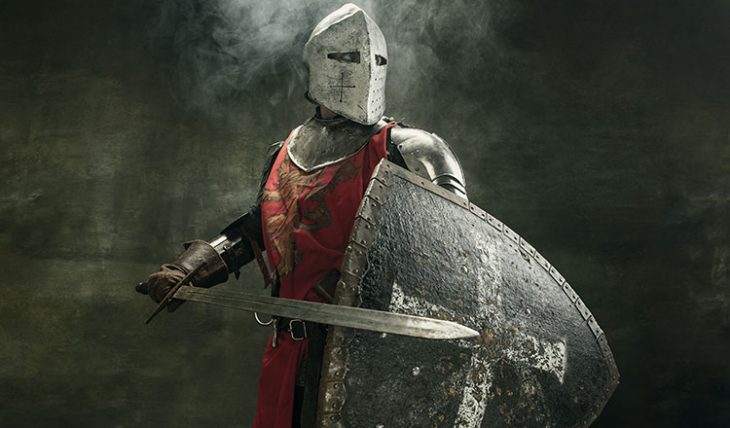
If I had to pick the best way to describe the recent works of Raymond Ibrahim—Sword and Scimitar (2018) and Defenders of the West (2022)—I’d call them no-going-back books. The equally chilling and invigorating experience of his histories cannot be undone and you cannot see the world the same way afterwards—especially since it’s not just history, but a forgotten prelude to what we’re living with today. Reality looks different post-Ibrahim.
Sword and Scimitar takes the reader through fourteen centuries of warfare between Islam and the West, with emphasis on eight great battles within that conflict. Better than any book I know, it dynamites the old public school narrative about the Crusades as a brutal act of Christian aggression against those poor, peaceful, tolerant Muslims. Ibrahim tells a much darker story about our ancient adversaries, documenting the scale of their conquests and the horrors that followed pretty much everywhere the armies of the prophet went. What we call “the West,” he writes, is but “the last and most redoubtable bastion of Christendom not to be conquered by Islam. Simply put, the West is actually the westernmost remnant of what was a much more extensive civilizational block that Islam permanently severed.” Three-quarters of the formerly Christian world was conquered by these people. It is both chilling and invigorating, like I noted, to think about how much danger we were in—and what kind of virtue was required to meet that danger and triumph over it, at least for a time.
Defenders of the West is an even more important book. It’s personal and compelling, and it reverses a long trend of hiding Christian heroes from those of us who need to learn about them. Thanks to Enlightenment propagandists, a vague narrative persists that heroism basically died out after the assassination of Julius Caesar and wasn’t revived again until Napoleon and George Washington walked the earth. The intent is a broadside against the Faith, leaving you with the vague impression that the teachings of Christ and his Church effectively snuff out all martial virtue, as though heroics cannot co-exist with the Gospel. Ibrahim shows this to be absolute nonsense. With his chronicles of Godfrey of Bouillon, El Cid, Richard the Lionheart, Fernando III, Louis IX, John Hunyadi, Scanderbeg, and Vlad Dracula, he brings to life eight legends whose deeds rival or exceed those of any heroes of any age.
These works are, in my humble opinion, on the shortlist for books of the century. So it was with special interest that I anticipated his follow-up effort. The Two Swords of Christ (published November ’25) continues with his major theme but looks at a different aspect of the conflict: the crucial work done by the Templars and the Hospitallers, basically the special forces of Christendom.
Ibrahim’s title comes from Luke 22, in which Jesus tells his disciples to buy a sword. When they reply, “Look, there are two swords here,” Jesus says, “It is enough!” What’s fascinating is his use of the singular pronoun it rather than the plural they. It suggests not the swords, but a way of life that employs “a spiritual sword against spiritual enemies, and a physical sword against physical enemies.” If your religious education was anything like mine, your teachers blithely passed over this and similar passages in favor of all the nicer-sounding directives about loving everybody and just being nice, along with never fighting—because fighting is unchristian. For those looking for simplistic formulas for life, it’s far easier to reduce the character of the Lord to that of a harmless meditation instructor, rather than wrestling with the much more challenging and dynamic truth.
The two swords also work as a metonymy for the knightly orders, filled with men whose particular way of serving God and their neighbors was with weapons.
The History
After Jerusalem was conquered by the Crusaders in 1099, a “mass resurgence” of pilgrims from Europe came to the Holy City to see the “tomb which has no body.” But though the Saracens had been defeated, they were hardly eliminated. They continued harassing, beating, enslaving Christian pilgrims, just as they had been doing before Jerusalem fell. Ibrahim writes: “Because the pilgrimage routes still had to cross through Muslim regions—the Crusader Kingdom of Jerusalem was, in fact, a Christian island surrounded by a hostile Muslim sea—attacks on Christian pilgrims not only continued but were marked with a special cruelty by vengeful Muslims still smarting over the Christian victory.” To give just one example: during Holy Week of 1119 a group of 700 pilgrims was ambushed by Muslims, resulting in 300 Christians killed and sixty taken as slaves.
So in late 1119 or early 1120, Hugh and Payns and Godfrey of St Omer, along with seven others, decided to “dedicate their lives to escorting and guarding pilgrims along the roads to and from Jerusalem,” and formed The Poor Fellow-Soldiers of Jesus Christ, later known as the Knights of the Temple, or Templars. Ibrahim quotes a monk of St Bertin on what this commitment entailed:
On the advice of the princes of God’s army they vowed themselves to God’s Temple under this rule: they would renounce the world, give up personal goods, free themselves to pursue chastity, and lead a communal life wearing a poor habit, only using weapons to defend the land against the attacks of the insurgent pagans when necessity demanded.
For about ten years, the Poor-Fellow Soldiers of Jesus Christ continued with this humble and limited service, until one of the great men of the age championed their cause. In response to a Cistercian monk who proposed the building of a monastery in the Holy Land, St Bernard of Clairvaux asked, “Who cannot see that the necessities there are fighting knights not singing and wailing monks?” Thanks to Bernard’s influence and efforts, the Templars were formally recognized as an order at the Council of Troyes in 1129. Soon much of Christendom became rightly enamored with the new order—fighting men sought to join and others donated funds—and with the new resources and manpower the Templars were able to expand their operations beyond merely protecting pilgrims.
At this point the order fully militarized. “If it was axiomatic,” Ibrahim writes, “that Muslims would always in everywhere prey on Christians, pilgrims and otherwise—and it was—and if the Temple’s entire purpose was to protect Christians, then by default the Temple was at war with surrounding Islam.”
Like the Temple, the Order of the Hospital of St John of Jerusalem was founded for the humble service of Christian pilgrims. What began as a hospice to “receive and refresh weary pilgrims” ultimately became another knightly order, and these Hospitallers eventually decided, like the Templars, that protecting Christians in the area necessitated making war on their attackers.
However much it will confuse modern peacenik Christians, this was not a decision either order made lightly. It was of the utmost importance for countless souls that these marauders be battled down—because Muslims were going to continue causing weaker Christians to apostatize in order to avoid punishment or death. They had to be dealt with severely, or souls would be lost by the thousands, maybe by the millions. James of Vitry argued against the naysayers of his day:
They, lying, assert that it is not permissible for you to take up a physical sword, nor to fight bodily against the enemies of the Church. They abuse the authority of the Scriptures and present petty reasons … And if we did not resist the Church’s enemies, the Saracens and heretics would have already devastated the whole Church … In fact knighthood was set up in order to repel violence, repulse injuries and exercise justice on evildoers.
These devoutly Christian military orders were serving the weakest and most vulnerable of their brethren and laying down their lives for their friends.
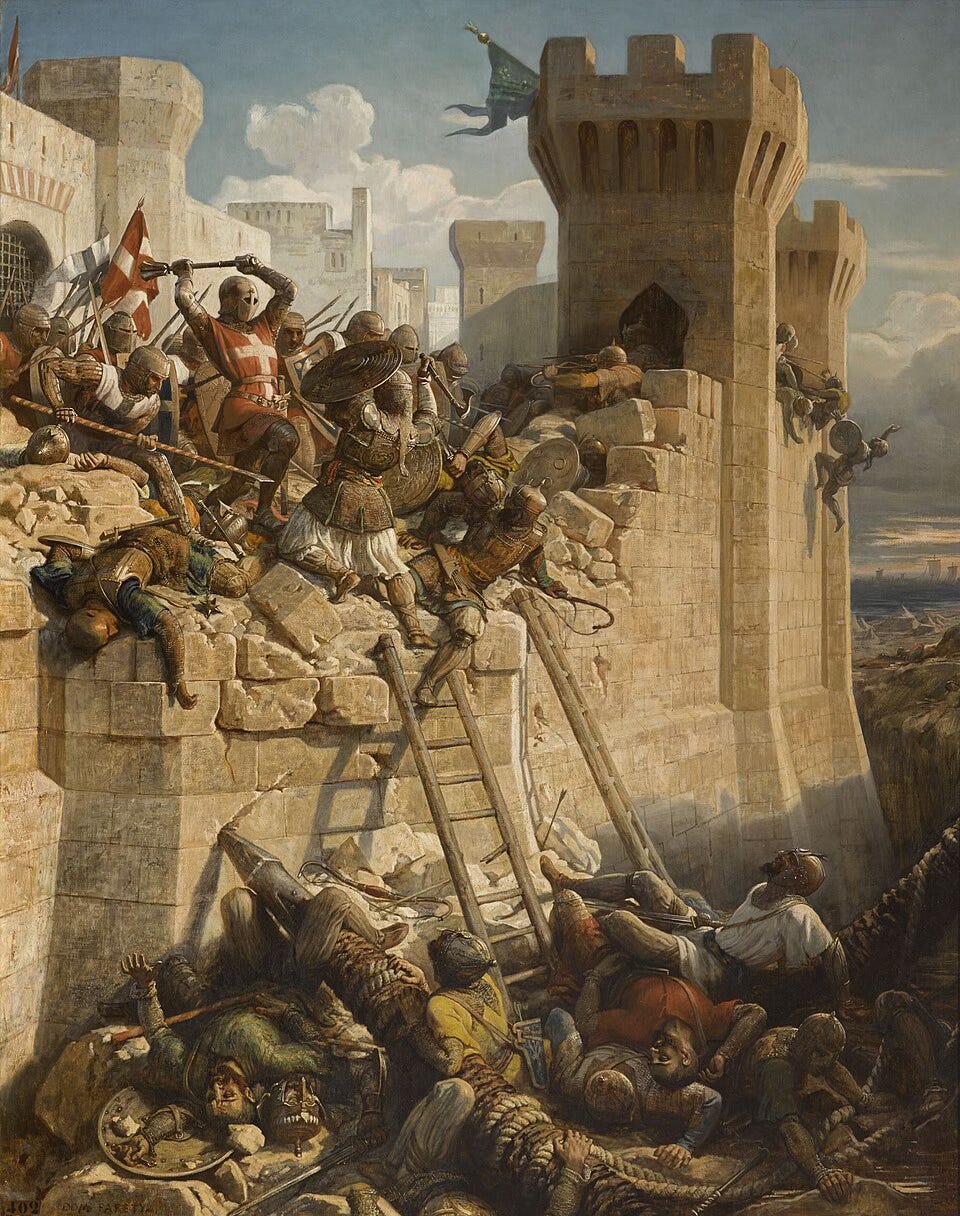
Ibrahim proceeds to the famous battles and sieges of Crusade history in which the Templars and Hospitallers always took on the heaviest fighting: Edessa, Ascalon, Montgisard, Hattin, Acre, Arsuf, and more. Saladin and Richard the Lionheart make grand appearances, as does St Louis IX. Though the orders rarely failed to display conspicuous valor and prowess in battle, slowly the difficulty of winning and keeping territory in the Middle East became too much; European Christians had lost interest in Outremer, and the orders did not have enough men to hold off the enemies that surrounded them and could draw upon endless numbers. It was one of the greatest adventures in human history, but the entire Crusading project culminated in the Siege of Acre in 1291 in which the Muslim forces finally expelled the knightly orders from the Holy Lands.
The Next Chapter
Shortly after 1291, the Templars found themselves on the receiving end of accusations of heresy, denial of Christ, desecration of crosses, homosexuality, sorcery, and demonic worship, and on Friday, October 13, 1307, all Knights of the Temple in France were arrested by the king’s forces and thrown in dungeons. There under the pain of torture many confessed to the charges.
It’s worth noting that King Philip IV had a history of arresting people and seizing their assets: in 1291 he targeted Italian bankers; in 1306 it was Jews within France; and in 1311 Italian bankers again were in his sights. This is the same king who had attempted to tax the Church and had leveled charges against Pope Boniface VIII that were nearly “identical to those leveled against the Templars—including heresy, blasphemy, sorcery, and sodomy.” He even attempted to have the pope arrested. It’s also worth noting that Philip owed a lot of money to the Temple.
After 600 Templars recanted their forced confessions. Phillip responded by burning Templars at the stake and pressuring a weak pope to dissolve the order, which he did.
As the Templars came to an inglorious end, the Hospitallers regrouped and began a new and greater chapter of heroics. Driven from the Holy Land, they eventually established headquarters on the Mediterranean island of Rhodes and became knights of the sea, “scourg[ing] the coasts of Egypt and Syria with comando-style raids.” Ibrahim quotes Augusta Drain:
[The knights] may be said to have become the protectors of all Christendom. The numbers they rescued from captivity, or saved from falling into a bondage often worse than death, are beyond calculation; and if the crusades, though failing in their primary object, yet kept the Muslims at bay during two centuries, and thus saved Europe from that inundation of infidelity which overwhelmed the eastern nations, the maritime power of the Knights of St. John contributed in no small degree to the same end, when the old crusading enthusiasm had faded and died away.
The order also stayed true to its original mission by building a massive hospital for the care of the sick whom they referred to as their lords.
This new era for the Hospitallers, now the Knights of Rhodes, also coincides with the rise of the Ottoman Turks, and one 18th century historian noted that it was “as if providence had directed [the knights] thither to serve as a barrier against Ottoman and his successors, and stop the progress of the Turkish arms by their valor.” For almost 220 years, the Knights of Rhodes terrorized the rising empire and withstood Ottoman efforts to drive them from the island, but finally they were overwhelmed and left their home on New Year’s Day 1523.
The knights were homeless again until 1530, when the Holy Roman Emperor Charles V granted them the island of Malta, just north of the Barbary states from which issued the raids of famous Muslim pirates. It was here that the knights, led by Jean Parisot de Valette, would beat back one of history’s greatest sieges in 1565, as the forces of Suleiman came to finish them off once and for all. Ibrahim’s book climaxes with this legendary defense, and the author shines in the extended narration of these scenes.
Characters
One of the difficulties of this book, which the author acknowledges in the beginning, is the lack of larger-than-life personalities that strode through the pages of his previous books, especially Defenders of the West. This is necessarily the case: the discipline and obedience required for a military order discourages the singular greatness and color of a Richard the Lionheart. Individual greatness is subsumed into the greatness of the order.
Ibrahim tells the story of a colorful exception that proves the point. In the late 1330s, after the Hospitaller had established their new home on the island of Rhodes, a dragon appears in the historical chronicles. “Livestock disappeared, as did shepherds who ventured too close to the beast’s lair. Several knights tried to flush it out and slay it, only to be killed and devoured to a man. The situation got so bad that, on pain of expulsion, the master of the order forbade them from ‘attempting anymore an enterprise that seemed above all human strength,’ and bade the populace to refrain from going anywhere near the marsh.”
But a knight named Dieudonne of Gozon had other plans. He took an extended leave, returned to his family’s home in France, and trained two dogs to attack the monster with him. With the help of his trusty canines, Dieudonne slayed the beast and was hailed as a hero and a dragon-slayer by his brother knights. The master knight was less impressed with the young man’s violation of a direct order, though. To convey to his knights the importance of obedience, he had Dieudonne the dragon-slayer imprisoned and then expelled from the order. Having made his point—that knights of a military order cannot pursue individual glory in defiance of orders—the master eventually relented and restored the hero, and Dieudonne would later be elected master of the Knights of Rhodes.
(Important note for dragon-debunkers: Ibrahim makes the case that this tale of dragon-slaying might not be as fanciful as it sounds. This chronicle does not come from the 8th, when fabulous tales abounded, but from the much more skeptical 14th century. The order also took great care to verify information in their records. Ibrahim adds that other sources reference “the skull of the dragon, which was nailed to one of Rhode’s castles and witnessed by visitors over the centuries as late as 1837.” One French visitor in the 17th century noted that the skull was “much bigger and larger than that of an horse, its mouth reaching from ear to ear, big teeth, large eyes, the holes of the nostrils round, and the skin of a whitish grey, occasioned perhaps by the dust which it gathered in course of time.” Finally, Ibrahim argues, Rhodes had long been known as “a haunt of large serpentine creatures,” attested by Greek and Latin sources.)
That said, great figures emerge still, most notably St Bernard and de Valette. The Crusading ideal has had few advocates as compelling as Bernard. It was thanks to him that the Templars got the opportunity to truly become the Templars: his eloquence and admiration of the order brought them opportunities that might not have existed otherwise. Of the knights he said: “When battle is imminent, they protect themselves inwardly by their faith and outwardly by iron, not gold, so that, armed and not adorned, they strike fear into the enemy rather than arousing his greed. They seek to have strong and swift horses, not ones decked out in many colors. They are intent on fighting, not pomp; victory, not glory; and they strive to inspire terror, not admiration.”
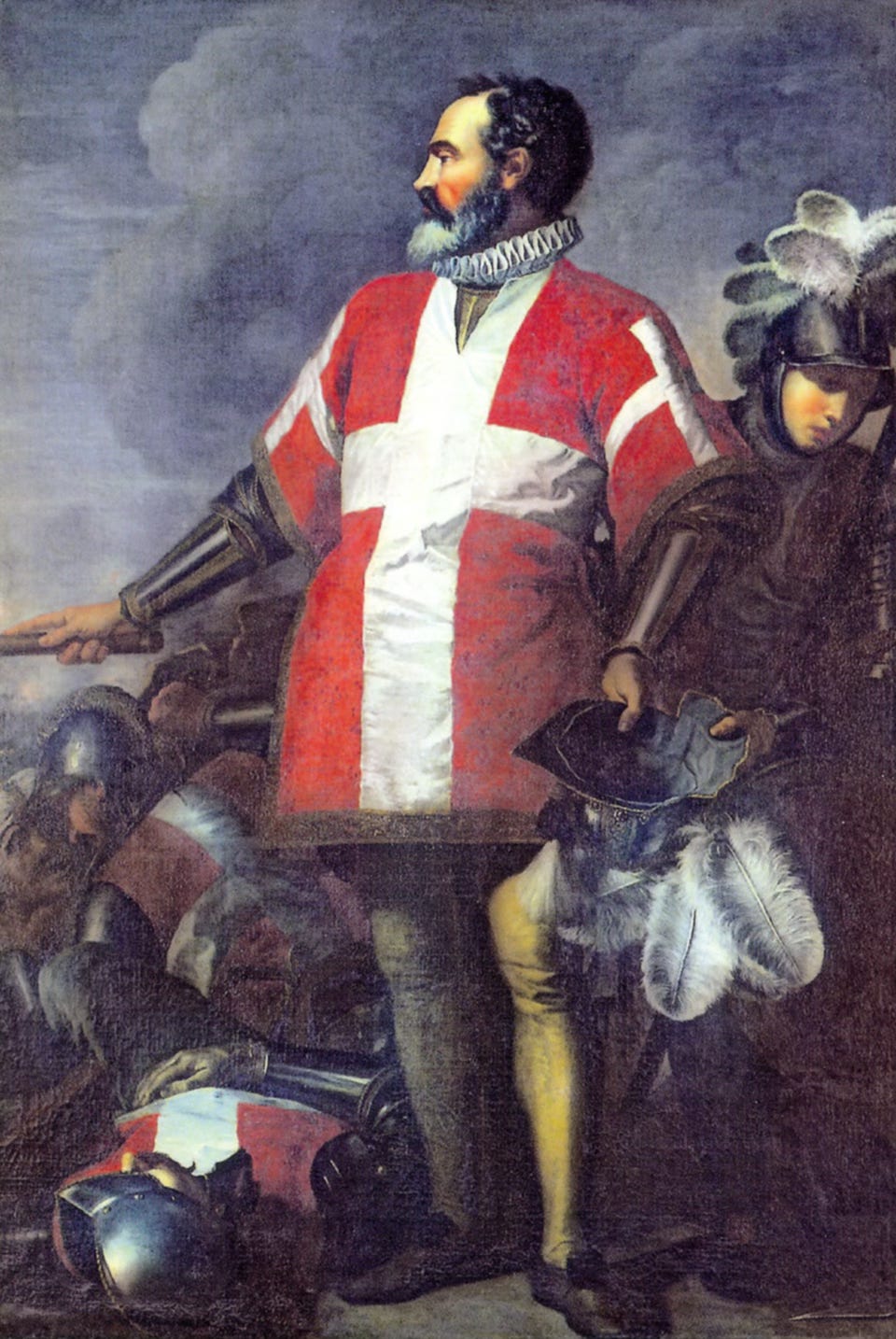
De Valette gets about as much coverage as any man in the book. He was seventy-one years old when the Ottomans showed up to take Malta. Ibrahim notes: “Everything about this man made him the ideal commander for the upcoming siege—down to his very lineage (his knightly ancestors had crusaded alongside St. Louis). He took his vows in 1515, at age twenty, and never once looked back or even visited his native France. Over the following half century, John had seen and experienced every aspect of war. He was there as a twenty-seven-year-old fighting knight when the Order was ejected from Rhodes and remembered the bitter years of exile and wandering. He had been severely wounded in several battles and knew what it meant to be a galley slave. After a sea battle with the Muslims in 1541, he was captured, chained to an oar, whipped, and made to toil for a year until an exchange between prisoners was made.”
Having been at Rhodes on that day, de Valette knew better than anyone that “this time there would be no coming back,” and it was he who delivered the famous speech before the battle:
A formidable army, composed of audacious barbarians, is descending on this island; these persons, my brothers, are the enemies of Jesus Christ. Today it is a question of the defense of our faith, as to whether the book of the Evangelist is to be superseded by that of the Koran? God on this occasion demands of us our lives, already vowed to His service. Happy will those be who first consummate this sacrifice. But that we may indeed be worthy to render it, come, my dear brothers, to the foot of the altar, where we may renew our vows.
De Valette and his knights performed a great service to all of Christendom with that victory.
Conclusion
Ibrahim’s books succeed as engrossing, dramatic, harrowing chronicles of the past. They succeed even more resoundingly as chronicles of a past that isn’t dead and isn’t even really past, to borrow a line from William Faulkner: “All of us labor in webs spun long before we were born, webs of heredity and environment, of desire and consequence, of history and eternity.” So here we are now, 460 years after the Siege of Malta, hearing calls for tolerance and multiculturalism from globalized elite, who seem desperate not only to welcome the descendants of Saladin and Suleiman into Western countries (and to give them all sorts of goodies in the process), but also to blithely look away when they commit outrages just as their ancestors did. So the fight of the Templars and Hospitallers might, depending on where you live, already be on your doorstep.
The Two Swords of Christ is a very worthy follow-up to Sword and Scimitar and Defenders of the West—perhaps not quite as absolutely necessary as those books, but excellent nevertheless and important as a companion piece.
And, now that I think of it, the virtues of the knightly orders might be more relevant to us than the virtues of Richard the Lionheart and El Cid, if only because our democratic times are not made for spectacular talents of great kings and warlords like them. It seems more possible to approximate the excellence of the Templars and Hospitallers—discipline, prowess, devotion, and so. The point is not to strictly imitate warrior-monks whose situations were far removed from our own, but to take inspiration from them for the challenges before us.
https://thechivalryguild.substack.com/p/the-two-swords-of-christ