
The U.S. War Machine Underwhelms
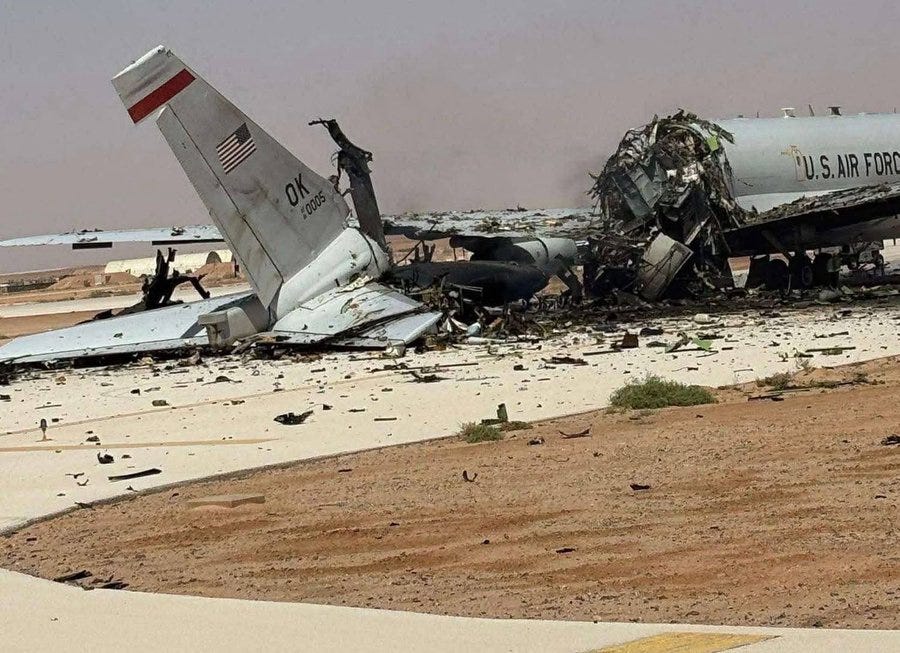
High-cost low-density weapon systems with outdated technology and low magazine depth fail to deliver.
In my mid-March essay Iran Has Already Won, I discussed the strategic failure suffered by the US barely a month into the war. The simple fact the US war goal has changed from “regime change” to “keep the Strait of Hormuz open” already points to the strategic defeat of the US, since the strait was open to all before the war.
In this piece, I’ll dig into the failure at a granular tactical level to show how the US military performance underwhelms. Due to the amount of data for my thesis, I have split the analysis into two parts.
To start out, let’s first call out the complete cognitive dissonance of the US ruling elite which has been the real shock and awe of this war of choice.
The Commander-in-Chief (more accurately, Liar-in-Chief) daily boasts of unparalleled military success and threatens escalation of violence, echoed by his sycophant bootlicker Secretary of War Crimes.
If they are to be believed, the US military is better than the Wehrmacht in 1940, who wiped out France and the Low Countries in 6 weeks. Or the Soviet Red Army who killed about 140,000 Japanese Kwantung Army and captured another 640,000 in the Far East in exactly 23 days in August 1945.
In his deranged mind, Trump probably imagines himself a greater military malice to the world than the Mongol Golden Hordes.
On the other hand, there is the cold battlefield realities that contradict the “winning” narrative –
- Operation Epic Fury (Epstein Files is a more fitting moniker) have killed more Iranian civilians than military.
The single deadliest attack of the war was not on some IRGC garrison, but on the Shajareh Tayyebeh Girls’ Elementary School in Minab, which was hit by a “triple-tap” strike by Tomahawk cruise missiles on the war’s opening day.
Three separate Tomahawks hit the compound in rapid succession between 10:23 and 10:45 a.m. while classes were in session, causing the death of at least 175 people – mostly girls between age 7 and 12.
The targeting data was provided by Project Maven, a Palantir military AI model designed to maximize casualty. The war is supposed to be Palantir AI’s grand coming-out party. First stop – war crime-ville.
Incidentally, the CEO of Palantir, Alex Karp, is an Israel-loving Zionist Jew. The original investor is Peter Thiel, the neo-Nazi Silicon Valley anti-Christ. You already can guess what kind of outfit Palantir is.
Trump, the lying thug of a “president”, had the indecency to falsely accuse Iran for attacking the school instead of apologizing like a human being.
- Israel and US vassal states in the Gulf are pummelled since the start of the war in Iran’s tit-for-tat retaliation strikes on military and energy targets
- The US has lost billions worth of high value assets and weapons such as radar batteries, AWACS, tankers, and fighter jets to cheap Iranian drones and short-range missiles
- USS Gerald Ford, the most advanced carrier in the US fleet, withdrew from combat to Europe due to “laundry room fires” and clogged toilets before seeing any action.
The lone USS Lincoln carrier in the theatre is forced to retreat over 1,000 km away from Iranian coast to avoid strikes.
As a result, any air attacks launched from the Lincoln have to be supported by ariel refuelling tankers. The US has lost at least 7 so far.
- A large number of US jets have been shot down or destroyed on the ground by Iran, including F-35 Lightening II, F-15E Strike Eagle, A-10 Warthog, E-3 Sentry, MQ-4C Triton, MQ-9 Reaper, KC-135 tanker, MC-130J transporter, HH-60G Pave Hawk, MH-60M Black Hawk helicopters, and more.
This represents nearly every type of air assets the US has deployed to the Gulf.
Amazingly, these aircraft were downed by an Iranian air defense that was “totally obliterated” according to Trump, Pete Hegseth and Centcom since the second week of the war.
Compared with the 1991 Desert Storm where the US indeed shock-and-awed the world with precision strikes and integrated air ground assaults, the war on Iran has been lacklustre.
This is certainly not due to the lack of trying. The US has taken the full might of its military to the Iran war.
Pentagon has literally deployed all its prime air and naval assets to the war from the Gerald Ford and Lincoln carrier strike groups to F-22 and F-35 stealth fighters to B-2 and B-52 bombers as well as its most advanced THAAD, Aegis, and Patriot air defense systems.
It has also deployed all the main precision stand-off munitions in its offensive and defensive arsenal.
These include Tomahawk, AGM-158A/AGM-158B (JASSM/JASSM-ER) missiles, SM-3 interceptors, THAAD interceptors, Patriot PAC-3 interceptors, GBU-31 and GBU-57 bunker-busters, ATACMS, and long-range Precision Strike Missiles (PrSM).
They are quite literally the best weapons the US has in its entire conventional arsenal.
The Pentagon has laid all its cards on the table. In any other conflict scenario such as Taiwan, the US has no additional “miracle weapons” to take to the fight.
Even against the very limited Iranian air defense which lags China or Russia by 2 to 3 generations, the massed US firepower has failed to significantly degrade Iran’s military power or suppress its counter-offensive.
Iran didn’t have a real navy or air force at the start of the war, either. For example, the backbone of its air force was F-4 Phantom, made in the 1950s and 60s. And the main battleship, IRIS Makran, was a converted crude oil tanker.
Apart from the opening act of sneaky assassinations, most of the “accomplishments” by the US seem to be the destruction of Iran’s energy and civilian infrastructures such as power plants, bridges, hospitals, desalination plants, and universities.
By the time of the April 8 ceasefire, 67,000 civilian targets in Iran were hit. Over 3,000 civilians were killed.
However, Iran’s military power remain largely intact, especially its missile and drone stockpiles as they are in hardened shelters, often dug into the mountains.
Furthermore, its “mosaic” decentralized operational structure proves resilient, enabling Iran to organize effective counterattacks.
Trump and Hegseth have repeatedly claimed the Iranian air defenses are “completely obliterated” – only to be contradicted by facts on the ground like the downing of a F-35 on March 19 as well as 2 F-15E and an A-10 Warthog on April 3.
In the subsequent rescue mission for the ejected weapons officer in one of the F-15s, two MC-130J transport planes, each costing $120 million, and several HH-60G Pave Hawks (the search and rescue variant of Black Hawk) were destroyed as well.
The US lost half a billion dollar worth of air assets in the space of 48 hours on April 3 and 4.
Hegseth and Centcom also falsely claimed that over 90% of Iran’s offensive missile and drone launchers were destroyed as early as the second week of the war.
What we have seen instead is a steady stream of increasingly sophisticated missiles as well as the low-cost Shahed 136 suicide drones that have penetrated US/Israel defense and hit numerous targets in Israel and Gulf vassal states, especially US bases.
Iranian attacks successfully took out some extremely high-value and irreplaceable military assets like strategic radar batteries (AN/FPS-132 and AN/TPY-2). Iran wipes out US-Israeli radars & sensors, changing course of war | Responsible Statecraft
March 27 became the Black Friday for the US air force when Iran successfully attacked the Prince Sultan Air Base in Saudi Arabia with drone swarms and ballistic missiles during its 84th wave of attacks.
One E-3G Sentry ($600 to 700 mil) and 3 KC-135 Stratotankers ($100 mil each) were destroyed on the ground.
The E-3G Sentry AWACS (Airborne Warning and Control System) is the most advanced version of the E-3 platform, serving as a high-altitude “eye in the sky” for the US air force. It acts as an airborne command and control (C2) hub and air battle manager (ABM).
The US has a total global fleet of 16 E-3 Sentry and only 7 or 8 in operational condition. Any loss is basically irreplaceable as the production has long stopped and the new E-7 Wedgetail is expected to enter service no earlier than 2028.
Until March 31, Iran has destroyed or damaged 8 to 12 Patriot missile launchers and radar vehicles in Qatar, Saudi Arabia, Bahrain, and the UAE. Each Patriot system costs $1 to 1.2 billion.
Apart from unrestrained and barbarous commitment of war crimes openly, we have to wonder – where is the almighty US military power? What is the war telling us about the true capabilities of the US war machine?
And, from China’s perspective, what to learn from the Iran war to prepare for future direct conflict with the US?
Chinese military observers have been watching the Iran war with intense interest. Their conclusion is the US war machine, the very best it can assemble, has come out short.
While it has inflicted vast damages to Iranian targets, most of which undefended civilian sites, real military achievements are quite underwhelming.
On the other hand, the US losses have been nothing short of breathtaking. Despite the killing of the Ayatollah, a soft target, nothing the US has taken out in Iranian military assets can remotely compare with the losses suffered by itself.
High-value US platforms destroyed or damaged by Iran include the AN/FPS-132 PAVE PAWS phased array strategic early warning radar ($1.1 billion), 3 THAAD AN/TPY-2 radars ($400 to 700 mil per), E-3 Sentry AWACS (original cost $300 to 400 mil, replacement cost $700 mil), 7 KC-135 Stratotanker ($100 mil per), at least 4 F-15E heavy fighters ($100 mil+ per), 2 A-10 Warthog attack jets ($20 to 30 mil per), one MQ-4C Triton ($180 to 220 mil), 17 to 19 MQ-9 Reaper ($30 mil), and one F-35A Lightening II stealth fighter ($83 to 95 mil).
For the bombing campaign, the US fired at least 850 Tomahawk cruise missiles (unit cost $2.5 to 3.6 mil), its complete stock of the latest Precision Strike Missile (PrSM) ($1.8 to 2.7 mil), over 1,000 AGM-158 JASSM-ER standoff cruise missiles ($1.2 mil), and unknown amount of the older ATACMS ($1.5 mil). U.S. Army depletes Precision Strike Missile stock early in Iran conflict
To defend against Iranian drones and missiles, the US has fired 100 to 150 upper-tier THAAD interceptors ($12-15 mil), 90 SM-3 missiles ($24 mil), over 1,000 Patriot-PAC3 interceptors ($4 mil), an unknown amount of AIM-120D air-to-air missiles ($1.2 – 1.8 mil), and 4% of its AGM-88Gs ($2.3 mil) missile stockpile for Suppression of Enemy Air Defenses (SEAD) on Iranian radar sites.
I used to think $1 million is a lot of money but you won’t get a single one of the various missiles fired with abandon and paid for by the US taxpayers.
No wonder the US is the richest country with the largest GDP in the world (the benefit of overinflated cost for everything).
Unfortunately for the US, printing missiles will be significantly more difficult than printing greenbacks.
The cost exchange, in monetary terms, between US weapon consumption and losses versus Iran, is easily 50 or 100 to 1. Note the main Iranian counterattacks compose of ballistic missiles costing a few hundred thousand and drones costing under $30,000.
Conservative estimates of US costs (excluding unreported asset loss) in munitions and destroyed weaponry alone range between $30 billion and $40 billion in the first 40 days of war, according to CSIS.
In addition, some lost weapon systems are not replaceable (e.g. E-3 Sentry AWACS and KC-135 Stratotanker) since production has already stopped. Others such as THAAD or the PAVE PAWS radars will take 5-8 years to build, assuming the US has access to the rare earth elements needed for their production.
CSIS has highlighted that the US is running short of certain rare earth elements (REE) and critical minerals needed to build these high-tech weapons, including neodymium, samarium, terbium, yttrium, antimony, gallium, germanium, and tungsten.
It is reported the US stockpile of rare earth minerals is less than 2 months.
The weapon systems affected, according to CSIS, include THAAD radar (AN/TPY-2), F-35 Lightening II, Arleigh Burke destroyer, Virginia-class submarine, all supersonic missile and interceptors, and even small rockets like the Stinger and Javelin.
All above REEs and critical minerals are effectively monopolized by China (over 95% global production) and on strict export ban to the US military.
If China maintains its export embargo (can anyone think of a reason for it not to), US war production will come to a halt until it can miraculously find sufficient replacement.
Perhaps even more shocking than the losses suffered by the US is the depth of magazine for the US war machine.
It is so low that you have to question whether the US can fight any modern industrialized war.
The US military has been exposed to be a boutique military with high-cost low-density weaponry, completely insufficient for modern high-tech wars where weapons are consumed in prodigious quantities defined by drone swarms and saturation missile salvos.
Let’s look at some numbers –
- The US has 11 carrier strike groups. Currently only one, USS Lincoln, is on combat duty. USS Gerald Ford suffered humiliating toilet clogging and a 33-hour “laundry-room fire” before it saw any action and had to retreat for repair.
Despite having been on assignment for 297 days by April 15, breaking the record for longest post-Vietnam carrier deployment, it is being rushed back to the Middle Eastern theatre since no spare backup is available. No rest for the wicked:)
Another carrier, USS George H. W. Bush, is sailing through the Atlantic towards the Persian Gulf, avoiding the Red Sea for fear of Houthis attack.
At best, the US can assemble 3 carriers for a major war. One, the USS George Washington, is holding up “Pacific defense” in its home port in Yokosuka, Japan. The rest is being serviced at docks at home or waiting in queue to be serviced.
- The US has 6 PAVE PAWS strategic radars globally; 3 are deployed in the US; and the most advanced one (AN/FPS-132) was destroyed in Al Udeid Air Base, Qatar, by a kamikaze drone;
- The US has 11 THAAD air defense systems globally; at least 3 have been destroyed in Saudi Arabia, Jordan, and UAE; the US fired over 150 THAAD interceptors ($12 to 15 mil per) during the 12-day war in June 2025, approximately 25% of total US stockpile then; it fired another 198 interceptors during the first 16 days of the more recent war, representing roughly 40% of the inventory available at the start
- The US pre-war inventory of SM-3 interceptors is 414 missiles; 80 to 92 have been used, roughly 22% of total global inventory in the first month of the war; annual output = 60 to 72 units per year (SM-3 Block IB at 36 to 48 units, SM-3 IIA at 24 units)
- The pre-war inventory of AGM-158 JASSM-ER is 2,300; the US used over 1, 000 in the first month; as of mid April, only 425 operational JASSM missiles remain for use outside the Middle East – enough for one mission by 17 B-1B bombers, according to Bloomberg; annual production = 396 units per year
- The latest US munition, unveiled in the Iran war, is the Precision Strike Missile (PrSM) which is launched by HIMARS and designed to replace the ATACMS tactical ballistic missile.
It has been hailed as the next “miracle weapon” for the Pacific theater with its 500 km range (we’ll discuss how it stacks up against China’s PCL-191, also known as PHL-16, in the second part. Spoiler alert – it is no match).
Regardless of the hoopla, the US ran out of its entire stockpile of PrSM in a couple of weeks in Iran. U.S. Army depletes Precision Strike Missile stock early in Iran conflict
With such a low magazine depth, the US has failed to prevail over a much weaker power.
In any high-end conflict with China over Taiwan or in the South China Sea, the US will run out of ammo, lose, and capitulate in less than a few weeks.
Even we charitably assume the US is not defeated outright (as per Pentagon’s own Overmatch Brief 2026 report), the country will be bankrupt in no time.
Simply put, the US doesn’t have the muscle to coerce Iran, let alone be the “world police”.
Another key takeaway of the war is the dated technology that is used by the US military. Chinese military observers have noticed the majority of the weapon systems relied on by the US forces are relics from the first Cold War. Many are 5 decades or older.
In the next instalment, I’ll dive into the outdated US weapon platforms and compare them with their Chinese counterparts. I’ll discuss how China can defeat the US military with overwhelming firepower and modern technology.
https://huabinoliver.substack.com/p/the-us-war-machine-underwhelms-part