
The Unchecked Rise of Crazy Race Theory in Academia

Expressing support for a loony housing appointee, New York City Mayor Zohran Mamdani became the latest politician to ratify a truly evil set of academic race theories
Last Thursday, a longtime tenant advocate named Cea Weaver was tabbed by new New York City Mayor Zohran Mamdani to head a new “Office to Protect Tenants.” Mamdani had made holding bad landlords accountable a priority, and the appointment of his confidante Weaver along with a publicized visit to crumbling rental property underscored the commitment.
Then Weaver’s social media history became an issue. While the Bryn Mawr and NYU-educated Weaver disabled her X account, she didn’t act fast enough, as “Notes From the Front” author and Substacker Michelle Tandler grabbed screenshots. Tandler, a business world vet turned aggressive citizen journalist who cut her teeth documenting corruption and decay in San Francisco, wrote she “had a hunch” this summer that Weaver might get a position in Mamdani’s government, and set about archiving her statements. “She’s Chesa Boudin times a thousand,” an incredulous Tandler said today, referencing the oft-mocked former San Francisco District Attorney.
In one clip, Weaver talked about how “we” can “take over a lot of distressed housing,” and use legal processes to tell “scofflaw” landlords, “We’re gonna take this building away from you.” A video short that went viral showed Weaver talked about moving home ownership from an “individualized good” to a “collective good,” saying that “especially white families, but some POC families” are going to have to embrace a “different relationship to property” than “the one that we currently have”:
There aren’t many things more obnoxious than a housing official threatening to take your home for the crime of owning it. But she’s one person, and merely “controversial,” according to the New York Times. Gotham’s paper of record, which has seemed split internally on how to cover Mamdani, quoted former Deputy Mayor for Housing Vicki Been as saying Weaver is “very savvy, strategic. Ideologically driven, of course, but also practical.” Even the outgoing head of the “probusiness” Partnership for New York City, Kathleen Wylde, said Weaver was “not a lunatic” and “actually quite smart.”
After blowing off reporters for days, Mamdani issued a statement doubling down on Weaver:
We made the decision to have Cea Weaver serve as our executive director for the mayor’s office to protect tenants, to build on the work that she has done to protect tenants across the city, and we were already seeing the results of that work.
Mamdani continues to ignore media requests to clarify whether or not his office is opposed to home ownership. Mamdani said in the past his goal is to “move away from a situation where most people access housing by purchasing it” toward one in which the “state guarantees high-quality housing for all.”
That’s fine. The more serious issue is the continued employment of someone with abjectly racist ideas. Weaver has a spectacular, tinfoil-level fixation on white people. Among her deleted posts is a long list of racialist lunacies, from a call to “impoverish the white middle class” to claiming “homeownership is a weapon of white supremacy.”
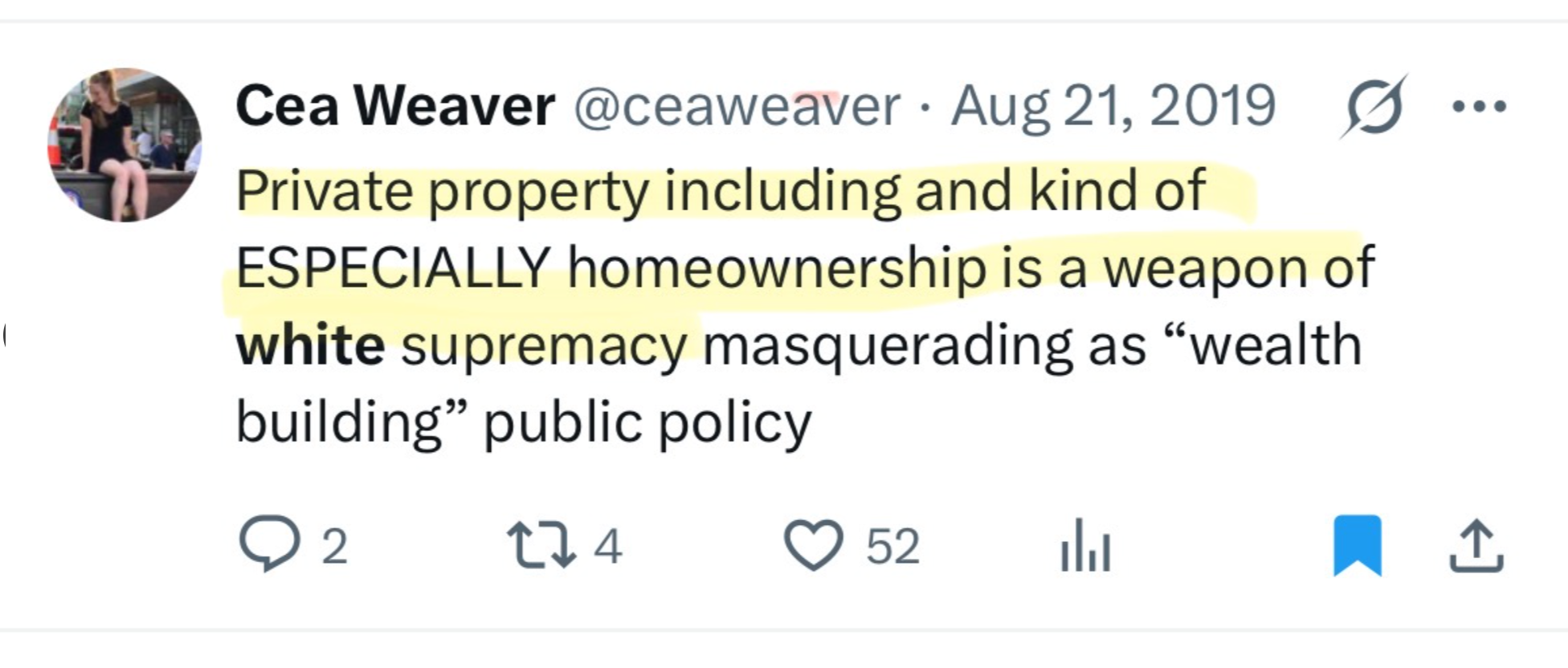
The story is less about one housing official and more about a booming movement of sanctioned intellectual racism, as dangerous as anything a Nick Fuentes could cook up, because this race theory has so much institutional backing. It’s not the old conservative trope of “reverse racism,” but something much more ambitious, and worse, to say nothing of likely being illegal where publicly funded. It already has the attention of federal authorities.
“We are attacking it where we find it and it’s federally funded,” Assistant Attorney General for Civil Rights Harmeet Dhillon told us Wednesday.
What’s it? What ghoulish belief system inhabits the brains of people like Weaver and Zohran Mamdani? One can already hear the objections of the online left (“Really? This is what you focus on?”), but I’d be anxious to hear a defense of this open race theory, which would also be humorously nuts, if not for the fact that so many young people on the cusp of leadership believe it. Meet Whiteness as Property:
Weaver hasn’t said where she got her ideas, but both she and Mamdani echo the same familiar language.
Some older Americans were surprised to learn after the Summer of Floyd in 2020 that “Whiteness Studies” had begun to be taught in Universities, and that its ideas were spreading thanks to books like White Fragility by onetime Whiteness Studies professor Robin DiAngelo.
DiAngelo and White Fragility have since been reduced to punchlines, but a more relevant text to the Weaver/Mamdani story is the 1993 Harvard Law Review essay “Whiteness as Property” by UCLA’s Cheryl Harris. In the reigning campus pseudo-religion this is still a sacred screed, if not the sacred screed, whose publication at the start of the Bill Clinton presidency is understood as a seminal event in the Great Awokening.
As you’ll hear below, activists and advocates for marginalized peoples faced a conundrum following the sixties liberation movements. Freedom from racist laws had been won at enormous cost in effort, money, and bloodshed, and with full legal desegregation came the demand that America live up to its Constitutional promises to all. As Martin Luther King put it, “All we say to America is, ‘Be true to what you said on paper.” This was in the before-times, when the idea that people are people was still considered a progressive conviction.
However, when the laws changed and progress did not come fast enough, activists now had to ask if all that effort in taking race out of the law didn’t perhaps need to be undone, so that goals could be achieved. In the video below Kimberle Crenshaw, the hallowed black feminist academic largely credited with the invention of intersectionality, describes the “contradiction” that paralyzed activists in the early nineties. If we need to take race into account, the thinking went, we’d have to navigate a path somewhere between white and black nationalism, the Klan or the Panthers:
In Crenshaw’s telling, the problem was activists asking the wrong questions. Forget small goals like desegregating schools and hospitals and the military, creating hiring incentives, eliminating barriers. If none of it dismantled “white racial power,” what was the point? It had to be considered that the Constitution itself, the very “paper” whose promises Martin Luther King so wanted to access, was itself a racial weapon, and needed to be “interrogated.”
How, though? It was going to be tough sledding to argue the American system was inherently racist after so many people sacrificed for so long with the professed aim of gaining entry to it. Unbeknownst to Crenshaw and other activist scholars, who “didn’t know Cheryl Harris yet,” the rhetorical solution was a “twinkle” in the eye of the Assistant Professor from the Chicago-Kent School of Law. It was called whiteness.
Most Americans, particularly liberal Americans, breeze by concepts like “whiteness studies” because they assume (in part because cynical politicians and pundits reassure them of it) that these disciplines are the merely necessary teaching of harsh historical reality, about everything from slavery to colonial conquest to Jim Crow, redlining, and race-based scams like the “contract mortgage.” But Whiteness Studies isn’t that, nor is Whiteness as Property.
Whiteness as Property is an amazingly creative document. It posits an elaborate Bible-like theology, with a story that traces a slice of history (but only a slice, as Harris was careful to point out when I contacted her) to tell of mankind’s journey from innocence to domination. While the world might once have been a raceless Eden, Americans ate of an apple called whiteness, after which its citizens discovered slavery, and in turn property — after which whiteness and property became synonymous with each other, and both with the “right to exclude.” An evil trinity, if you will.
Harris wrote that although the early American settlers were “cognizant” of race, the “racial lines were neither consistently nor sharply delineated among or within all social groups” in those early prerevolutionary days. However, the divisions soon became more defined, and “the construction of white identity” became “intimately tied to the evolution and expansion of the system of chattel slavery.” With slavery came that “merger of white identity and property.” Property remained whiteness and whiteness remained property, even after the Civil Rights movement:
After legalized segregation was overturned, whiteness as property evolved into a more modern form through the law’s ratification of the settled expectations of relative white privilege as a legitimate and natural baseline.
The Harris essay is a lot of window dressing on one idea, namely that America’s history of slavery and apartheid and other horrors is tied inextricably to the skin color of the perpetrators. The academic-sounding rhetorical device is that whiteness is synonymous with property. The simpler translation is that “whiteness” is just a stand-in for “white.” There’s no question that by “whiteness” Harris means white people. Harris even writes that “differential treatment of whites is not beyond constitutional concern” (thanks!) but to seek for them “an equivalent right to a level of review designed to protect groups and peoples subordinated by white supremacy” is to seek an “usurpation.”
I wrote to Harris, trying to frame things delicately. I couldn’t be the first person, I said, to have read her paper and wondered about the fact that people were property all over the world long before America existed, in almost every racial configuration: “whites enslaving whites, Indians enslaving Indians, Africans enslaving Africans, whites enslaving Africans, whites enslaving Native Americans, Romans enslaving pirates, pirates enslaving Romans, etc.”
Even during the time period in question, a white person in Russia could not only buy another white person but mortgage him. Property rights meanwhile went back thousands of years, beginning in nonwhite societies in Mesopotamia and Egypt, and then in white societies that both did and did not include slavery. How could whiteness, slavery, and property correlate, unless you excluded all that history?
By excluding all that history, naturally.
“I’m not able to really engage at the level you ask on this timeline, as I’m traveling out of the country,” Professor Harris wrote. “What I can say is that I was not making a global, trans-historic claim about race and property; I was writing about its formation in the context of US history and American law.”
Someone might want to tell Cea Weaver that texts like Whiteness is Property are not a “claim about race.” She and a hell of a lot of other people seem to be operating under the impression that whiteness means white.
Here’s what happens when something like Whiteness is Property becomes sacred writ on liberal arts campuses. It gets gobbled up by mentally ill white intellectuals, who can’t get enough of being told how inescapably guilty they are. The Harris essay in arguing against the idea of requiring proof of present-day discrimination even puts the term “innocent” in quotes, saying: “The inability to see affirmative action as more than a search for the ‘blameworthy’ among ‘innocent’ individuals is tied to the inability to see the property interest in whiteness.” For those slow on the draw, “the property interest in whiteness” is jargon for “the inherent guilt of white people.” This is irritation with the burden of proving bigotry in individual cases, when the important concept is collective racial guilt.
All racial movements devolve into caricatures, and this one has been no different, painting both white and nonwhite people with the broadest and dumbest of brushes. The racial justice theorist Tema Okun made a “white supremacy culture” poster that warns against “breathing in” those “poisons” of white culture like the written word, objectivity, individualism, and my favorite, perfectionism. Is there a nonwhite person alive who enjoys the implication of being a half-literate, biased communitarian with an increased tolerance for mediocrity?
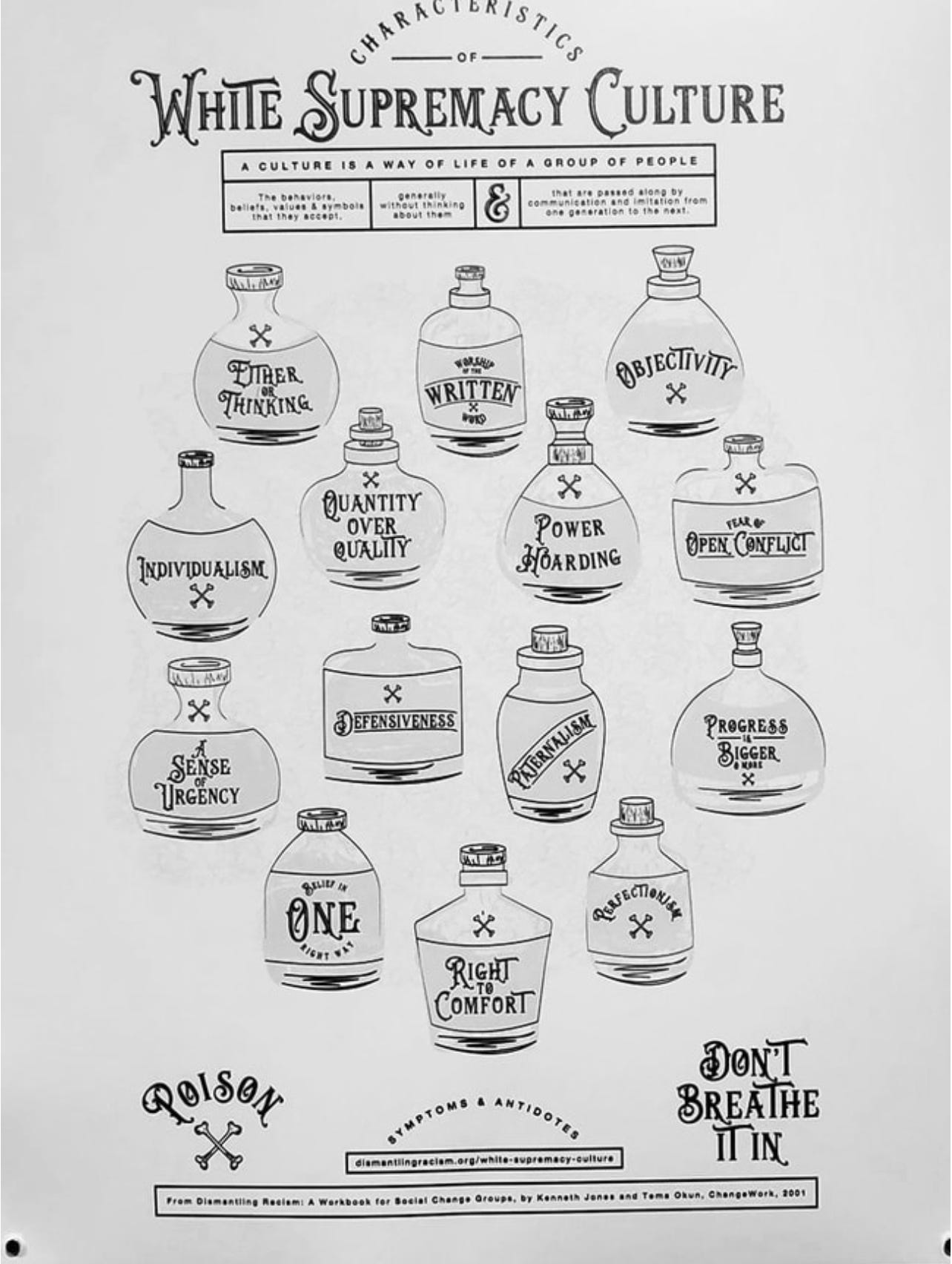
All this goes back to the problems expressed by Crenshaw: how to justify using bias “for good,” and how to “interrogate” the Constitution as racist? If one can argue that private property is just white dominion, it’s not a big leap to indicting the whole catalogue of Englightenment virtues, from Mamdani’s denunciation of “rugged individualism” (the first entry on an infamous Smithsonian exhibit on “White Culture”) to puncutality to “family structure” to the “Protestant work ethic” and so on. No need to worry about expropriating homes of “innocent” people, since nobody’s innocent, except maybe Weaver’s “POC families,” who’ll of course eventually welcome the “different relationship to property,” nonwhites having less of a belief in “one right way.” Oops, is that a racist caricature? It is! And you can learn it in almost any federally-subsidized school.
Dhillon notes that many of the problems at taxpayer-funded universities that drummed up “whiteness” mania were presided over by the Department of Education. “When it closes down my department will have their civil rights investigation function,” she said. “We need to end this nonsense!”
What’s depressing is that all this fundamentally misunderstands how the Founders viewed “property.” Obviously, many were rich landowners and didn’t think much beyond that. But to James Madison, the idea of government existing to protect the “property” of even the non-wealthy was essential, and symbolic of the idea that government existed to respect and safeguard private rights to opinion or religious belief. “Conscience is the most sacred of all property,” he wrote.
I understand the tragic fact that so many Americans were long denied such protections, but what sane person sees taking them away now as a solution?