
The Woke Left is Far From Defeated
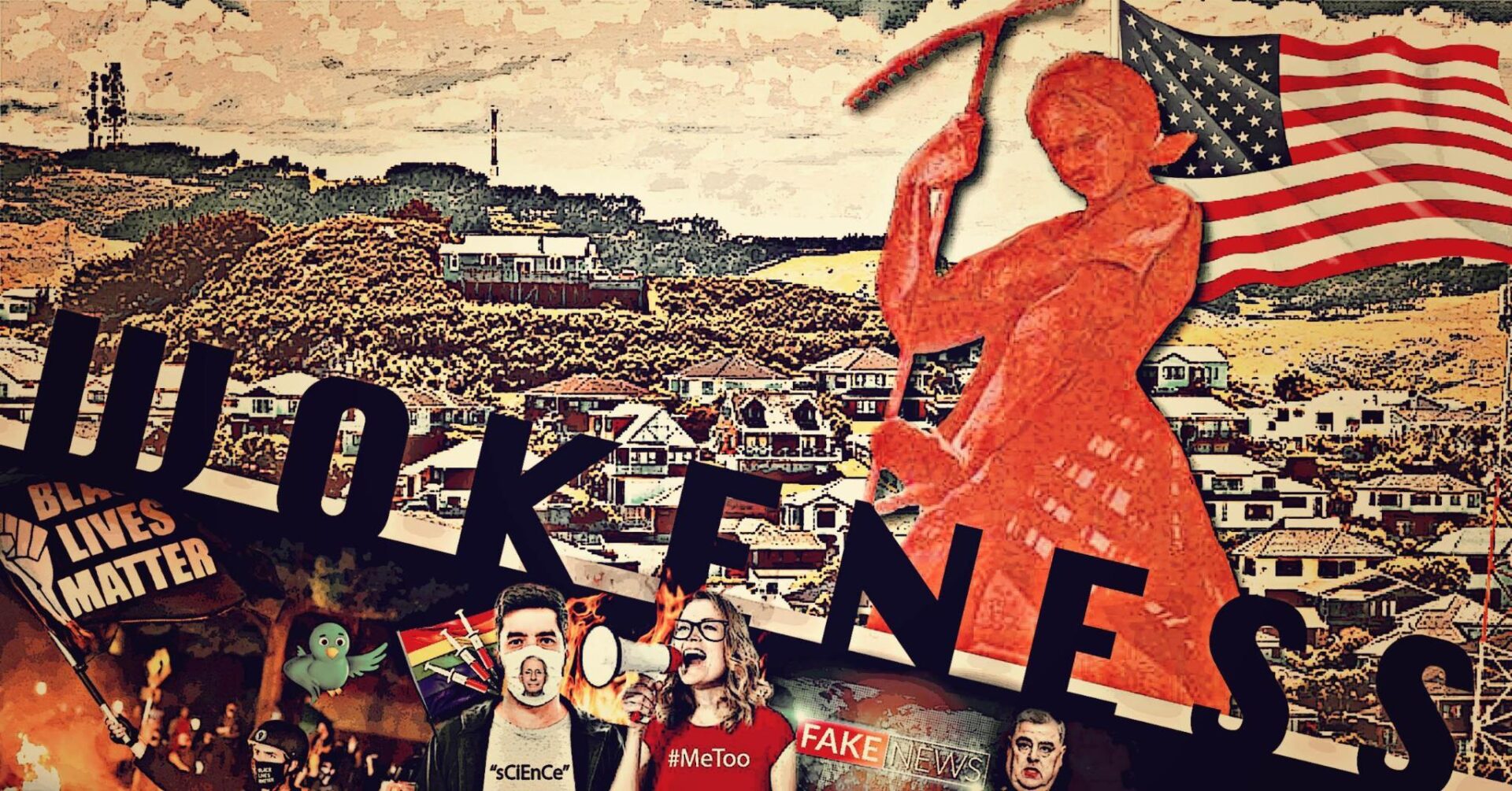
The Con Inc. commentariat celebrates the good news of Jonathan Butcher’s latest book, The Polarization Myth: America’s Consensus on Race, Schools, and Sex. Innumerable blurbs from respectable conservatives adorn the book jacket with endorsements of Butcher’s view that America’s cultural and social polarization is merely a left-wing “myth.”
Americans must “stand united,” writes Butcher in a recent New York Post op-ed. “The left and its media allies say we’re polarized, we’re not.”
Any right-winger who has sounded the alarm on the modern woke ideology and the way it has torn apart American culture should be eager to examine Butcher’s findings. Perhaps Butcher—the Will Skillman Senior Research Fellow in Educational Policy at the Heritage Foundation—got it right, and the alarmists (yours truly among them) got it wrong.
Most of the research in Butcher’s book concerns survey questions administered to over 2,000 American citizens. They investigate attitudes toward education, the closures of public schools during the COVID-19 pandemic, and DEI. Butcher shows that teachers’ unions and the parents of students often differ in their views about controversial issues, such as having biological men in women’s locker rooms or whether education should feature woke themes. Teachers’ unions and school boards are obviously more enthusiastic than parents about supporting an approach to education that stressed historical victims and the need to provide them with redress. Further, Democrats are usually but not always significantly more eager (according to the surveys quoted) to stand with unions and school boards.
On the question of whether state or local policies should allow transgender males (or those who describe themselves as such) to access private spaces reserved for those of the opposite sex, 42 percent of the general population oppose this policy, according to Butcher’s data. Almost as many respondents claim to be neutral on this issue. Forty-nine percent of parents are either in favor of or neutral about students being allowed to participate in sports events, when the gender they assign themselves is contrary to their biological one. Thirty-seven percent of parents apparently favor granting students “unfettered access” to bathrooms, locker rooms, and changing facilities “aligned with their professed gender identities.” This figure rises to 50 percent when the question is put to school boards. Fifty-five percent of parents surveyed agree that they should be told by school authorities if their child identifies with a gender other than the one that he or she was born with.
Moreover, thirty-one percent of Republicans, 37 percent of independents, and 52 percent of Democrats are in favor of teaching critical race theory in schools, according to the survey results. Twenty-six percent of parents and 45 percent of school board members favor the use of racial preferences for college admission.
Butcher tells us repeatedly that Americans are “against racial discrimination.” This may be true for discrimination against nonwhites, but for lots of Americans, it’s morally fashionable to dump on white people, providing (we might assume) that it’s not their own kids who are being disadvantaged. The fact that as many as 31 percent of Republicans favor teaching critical race theory in schools suggests that even our more “conservative” national party may be less of what it’s supposed to be than some of us would hope.
I’m struck by the contradiction between Butcher’s data and what the conservative establishment wants us to believe about the absence of polarization in American society.
Butcher’s research should lead us to conclude that the woke policies promoted by our managerial state, the mainstream media, educational institutions, and the culture industry have been frighteningly successful. If there is consensus among most Americans, it may be that wokeness is here to stay, and that opposing it would be futile in the long run or even immoral. I see no reason to conclude, particularly after looking at Butcher’s data, that the Alphabet People are losing their hold on American society.
Moreover, my conclusion aligns entirely with the electoral results we’re now witnessing in this country. Our large cities are voting in record numbers for leftist candidates promising to give out “free stuff.” But this is not the only thing happening in these contests. Elections are taking place in a culture and society in which 37 percent of parents, if Butcher’s figures are right, are perfectly fine with having transgender men go into girls’ locker rooms. It pains me to think that so many Americans aren’t disgusted by the idea of having girls and young women put in a vulnerable situation in which they’re exposed to a group that suffers disproportionately from mental disorders and a propensity for violence.
The extent of our electoral radicalization can be seen in runaway victories by feminist gubernatorial candidates in New Jersey and Virginia and by the record number of votes obtained by an LGBTQ radical, Aftyn Behn, in the once heavily Republican 7th congressional district of Tennessee.
These Republican setbacks cannot be entirely ascribed to the affordability issue that the Trump administration is now trying to neutralize. Economic problems were significantly more severe during the Biden midterm elections. Despite galloping inflation, much higher energy prices, and a country overrun by as many as 20 million indigent illegals whom Biden’s handlers let into the country, the Democrats did unexpectedly well during those midterm elections. If the Trump administration is beset by public discontent and huge Democratic election turnouts, the affordability issue may explain less than an easily mobilized, culturally radical voting bloc.
The Democrats have done well appealing to cultural radicals and siding with illegals, including criminal ones, against Immigration and Customs Enforcement (ICE). Behn pursued this strategy with promising results in deeply red Tennessee. An enraged feminist and advocate of keeping illegals from being deported, she expressed hatred for the presumably reactionary inhabitants of her Nashville district and maintained that men can give birth to babies. Such opinions certainly didn’t turn off her base, who came out in multitudes to support her. Flaunting a woke agenda in urban areas, particularly in large cities, wins more voters than it drives away.
Moreover, if the Republican “warning signs” were only owing to economic problems, then Democratic candidates haven’t shown how they would make living more affordable for most Americans, for example, by promising cheaper energy, reduced mortgage rates, or lower taxes. Nor have Democratic politicians been silent about their cultural views. Mikie Sherrill in New Jersey, Abigail Spanberger in Virginia, and all the other victorious Democrats did not conceal their unmistakably woke positions, and these candidates ran away with their races.
Laura Ingraham’s recent sheepish admission that “we can’t win any longer by showing how far to the left the Democrats have gone” is transparently true. The cultural left occupies too many command positions to be turned back in a few election cycles. Even with Trump’s victory last year, culturally leftist Democrats keep advancing in more of the country, most recently in the Miami mayoral race on Dec. 9.
It is also ridiculous to pretend that the voting public, which is seemingly riveted by cost-of-living issues, would not react if our current victim-based social policy were suddenly turned around, and some politicians called for discriminating in favor of white males rather than against them. Would it really make no difference to voters, who I am supposed to believe only care about “affordability,” if a reversal of social policies took place? How would voters react if those who spoke about pocketbook issues also advocated repealing gay marriage? Would that retreat from wokeness have no effect on voting behavior, even among voters claiming (perhaps disingenuously) to care only about the economy?
Tens of millions of Americans happily view TV and cinematic presentations that depict white men as silly and stupid. These same narratives also glorify self-proclaimed feminists and outspoken gays and nonwhites. No deafening public outcry has sounded against such “entertainment,” although Jeremy Carl in The Unprotected Class offers multiple examples of anti-white racism in our popular culture. Would I be right to assume that those Americans who view such fare and are not repelled by it are already habituated to woke indoctrination? For me, it is hard to watch and listen to such undisguised brainwashing without screaming back at the TV.
As Antonio Gramsci explained in those notebooks he kept while in exile on the island of Ustica (Quaderni del Carcere), willful, unified social groups can achieve cultural hegemony in the modern West if they work together purposefully. Intellectuals, said Gramsci, can reshape the consciousness of the mostly inert masses by occupying critical cultural centers, starting with educational institutions. Progressive intellectuals can thereby become a ruling class, even without resorting to physical force.
Although Gramsci hoped his tactic would be employed to achieve Marxist socialist change, it has been applied throughout the West during the last 60 years to establish woke ideological control. Those who have resisted this transformation in most first-world countries have been disempowered and even persecuted. Although in the U.S., the Trump administration continues to stand against these forces of upheaval, they are fighting well-organized enemies who have already breezed through our institutions.
It would be naïve or dishonest to claim that the fury Trump gets from all directions is owing only to his rude comments about his political enemies. The other side has been at least as rude without suffering serious electoral setbacks. The Democrats have also been complicit in violence against Trump and his supporters and have blocked his attempts to round up criminal illegals.
The riots and mass outbursts that have been staged against the administration seem closely related to what Trump has done to limit the resources of the left. He has gone after DEI programs, defunded NPR, dismantled quintessentially woke agencies like USAID, and tried to remove biological men from women’s sports. Trump Derangement Syndrome, I conclude, seems correlated to Trump’s activities in making life difficult for the leftist ruling class. It may have other causes from place to place or group to group, but a constant in this sustained expression of outrage is a reaction to Trump’s efforts to inflict setbacks on a leftist power elite and to remove its reserve army of illegals.
The true extent of leftist electoral power goes well beyond what Butcher’s numbers confirm. Some on the left, such as feminist mothers, black parents, and culturally leftist corporate heads, might give deceptively conventional answers to Butcher’s research questions. Like more traditionalist respondents, they would explain that they were all in favor of teaching young students to read and learn math. They might even concede that those skills were more important than critical race theory.
Nothing about those responses, however, suggests the respondents are averse to the woke left’s agenda, even though on some questions they would give Butcher the answers he was obviously seeking. Blacks, up until about 10 years ago, would answer survey questions as conservatively as the Religious Right but then vote for the left. There’s no reason to assume that even those who give Butcher his preferred answers would necessarily make the same political choices as the Heritage Foundation.
Something else should be kept in mind: The fact that an ideologically driven party isn’t always focused on its foundational ideology doesn’t mean that the ideology has lost any relevance for its leaders and members. From 1929 to 1932, when the Nazi party went from a handful of deputies to the largest party in the German Reichstag, its candidates played down anti-Semitism and talked up recovering from the Great Depression and keeping the streets safe from Communist rowdies (as opposed to their own). This public relations move didn’t indicate that Hitler or his party gave up a Nazi worldview and agenda, or the hope of eventually putting their ideas about it into practice. Similarly, Democrats who sound moderate to win elections in certain districts haven’t necessarily given up their woke agenda. Furthermore, those who vote for these Democrats because of the so-called affordability issue may well be voting for them because of their social policies as well.
The million-dollar question here is why the conservative establishment, which is energetically promoting Butcher’s book, wants us to imagine that wokeness is losing its attraction. Butcher’s motives may be clearer to discern. He thinks we have overcome or perhaps never had to deal with moral polarization; we can therefore fight against woke school boards and teachers’ unions with a culturally intact country. This news should buoy up the enemies of wokery, whom the author thinks outnumber their opponents.
Those who are promoting his book, however, may have their own motives for signaling a lack of cultural polarization. They may be trying to focus more heavily on those issues that matter to the conservative establishment and its donors. When Pat Buchanan announced in 1992 that Americans were engaged in a culture war, neoconservative grey eminence Irving Kristol announced in the Wall Street Journal (Dec. 7, 1992) that Buchanan was oblivious to the fact that “the Left had won.” It was therefore necessary for prudent conservatives to move on to other issues. Telling us that cultural polarization is a myth serves the same purpose as Kristol’s statement that the left had already won the culture war. In both cases, we are made to believe that we needn’t bother with cultural and moral fissures. We can do nothing about that problem, or else, in the newer form of this subterfuge, the cultural issue is less urgent than many think.
A final question that Butcher’s book doesn’t answer is whether we can now undo all the achievements of our cultural revolution. Since the traditionalists, according to Butcher’s telling, are in a powerful position, they should be able to reverse what the wokesters have brought about. If wokery is in a death spiral, then perhaps gay marriage, special rights for the transgendered, anti-white, and anti-male policies will all disappear in the foreseeable future.
Unfortunately, we know this is far from likely. There seems to be widespread support for these innovations, particularly among economic, educational, and political elites. I also find no indication that a majority of American voters have rejected these woke social policies. Trump’s victory by 2 million votes last year, running against an embarrassingly unfit, verbally inept Democratic opponent, hardly constituted a convincing rout of the woke agenda. In any case, in last November’s elections the wokesters have again prevailed.
The Trump administration is encountering multiple obstacles in trying to rout DEI. Academic administrators, corporations, and other fixtures of the cultural left are looking for ways to circumvent federal directives, while gay marriage has become an expression of family values for many conservative podcasters. When Victor Davis Hanson, in a recent commentary on American Greatness, states that “the people are fed up” because “the Dems invited migrants with scorn for American culture and law,” I felt obliged to ask, “Which people?” These “people” may not be anywhere as numerous as Hanson imagines.
None of the facts and questions I’ve marshalled please me. But if we hope to make headway against the woke cultural hegemony, we must understand its power and successes. We must recognize that a well-placed leftist intelligentsia has been taking over vital institutions for many decades here and in other Western countries. Its attempt to justify this takeover as a crusade against an all-enveloping “fascist” enemy has been in operation since the 1960s and even earlier, as I document in my books. This revolution, which is now being furthered by indoctrinated natives as well as by vast numbers of the foreign born, has been incremental, and its stages can be traced over the decades.
Cultural revolutionaries have achieved their present level of hegemony at least partly because they have not faced stiff opposition. Even before our conservative movement reached its present vapid state as Boomer entertainment, the right devoted most of its energy to fighting communism and defending “capitalism.” It mostly ignored what Pat Buchanan, Sam Francis, and Leopold Tyrmand, Chronicles’ first editor, all defined as the “culture war.” Quite outrageously, those of us who are calling attention to this moral and political crisis have been lately mocked by the conservative establishment as the “woke right.” This doesn’t change reality, however. We are dealing with the consequences of a long-neglected problem in the form of a militant left that controls our major cities and determines critical election outcomes.
This gloomy political and cultural situation, now facing the American right, is not hopeless. It is, however, important to have a realistic understanding of how the cultural left has transformed American society since the 1950s. The present administration’s efforts to defund the left, eliminate DEI, and remove woke-infested government agencies are laudable. Of course, more will have to be done to roll back the continuing cultural revolution, but the recent efforts of the president and his cabinet are a noble start.
https://chroniclesmagazine.org/editorials/the-woke-left-is-far-from-defeated