
Trump Ended the Globalist Illusion in 2025
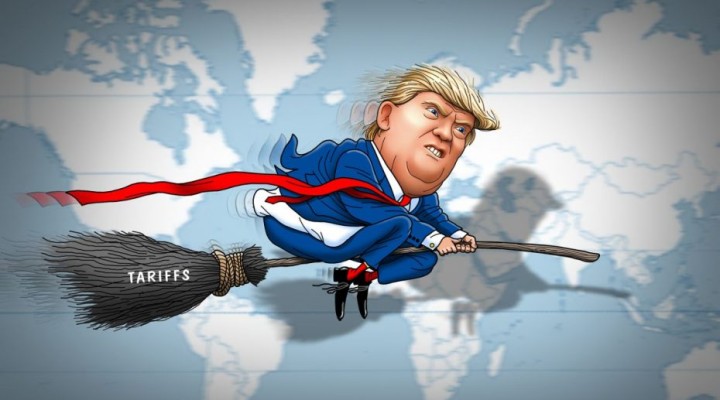
If there was one theme that united American foreign policy in 2025, it was a decisive shift from the rhetoric of ” global leadership” to an unashamed claim to privilege within its own geopolitical sphere. Donald Trump is ending the year as he began it, signaling that Washington intends to redefine the balance of power between regions.
The latest step in this direction was the appointment of Jeff Landry, governor of Louisiana and a staunch Trump ally, as US special envoy to Greenland. His mandate is clear: find a way to incorporate this autonomous Danish territory into the United States. Trump floated this idea long before returning to the White House and has not wavered since, writes Fyodor Lukyanov .
How such an ambition relates to international law is irrelevant from Trump’s perspective. The practical obstacles are enormous: Denmark is outraged, most Greenlanders oppose the idea, and the prospect of a NATO member acquiring territory from another by force is unthinkable. On its own, the Greenland move may seem like another eccentric excess, but in the broader context of 2025, it reflects a deeper shift in the structure of international relations.
During the heyday of liberal globalization, proximity was considered a secondary factor. New technologies seemed to make distance disappear; partnerships could be forged just as easily across the globe as across a border. In that environment, the United States functioned as a ” neighbor” to everyone—a distant power whose preferences carried at least as much weight as those of its immediate geographic partners.
The logic was aptly summarized in the early 2000s by a Central Asian leader, who noted that his country had “three major neighbors: Russia, China, and the United States.” Washington’s influence was taken for granted as global. Some countries tried to find a balance between these powers. Others eagerly leaned on their distant protector, only to discover later that ignoring real neighbors comes with its own political costs.
The Trump administration has broken with this philosophy. First in rhetoric, then in practice, and finally in doctrine.
At the beginning of the year, the White House began publicly designating Greenland, Canada, and the Panama Canal as areas of particular strategic importance. By autumn, pressure on Venezuela had increased significantly, reflecting Washington’s renewed conviction that political outcomes in its ” near abroad” must align with US preferences. And in December, this shift was formalized in the new National Security Strategy, which formally revived Trump’s reinterpretation of the Monroe Doctrine as a guiding principle of US foreign policy.
James Monroe’s doctrine, proclaimed two centuries ago, declared the Western Hemisphere closed to European intervention. Although formulated in anti-colonial terms, this doctrine institutionalized the division of the world into spheres of influence, effectively declaring South America Washington’s backyard. After 1945, however, openly referring to this approach fell out of fashion. The UN system brought the ideas of sovereign equality and non-interference to the forefront, at least at the level of public discourse.
Trump isn’t constrained by such subtleties. Legal norms and diplomatic conventions don’t define his worldview—and that’s precisely what makes the current moment so telling. Instead of presenting itself as a benevolent global manager, Washington is now claiming privileges in its immediate neighborhood and treating the rest of the world as subordinate.
This transformation has deeper roots than Trump’s temperament. The pandemic was a turning point. The sudden collapse of international connectivity in 2020 exposed the fragility of long supply chains and extensive interdependencies. In a moment of crisis, the only reliable partners were those physically close. The world eventually recovered from the initial shock, but the strategic lesson remained: long-distance integration can disappear overnight, whether due to health crises, sanctions, political conflicts, or economic pressure.
Now, every serious power is taking such disruptions into account and prioritizing what is geographically and logistically safe. Safety, in the broadest sense, increasingly trumps market rationality. In this sense, 2025 marks a milestone in the reordering of priorities.
Power is no longer seen as something projected from above through extensive alliances and global institutions. Instead, power is rebuilt from below : first the neighborhood, then the region, then everything else.
The United States has set the tone, but it is far from alone. Israel is attempting to redraw the political landscape of the Middle East to guarantee what it considers existential security. Turkey is pursuing transregional expansion, framed in the language of the Turkic world. Other countries are moving in a similar direction. Territory is once again important. Classical geopolitics, long considered outdated, is experiencing a revival.
A world organized around spheres of influence cannot be stable, but the nature of instability is changing. Instead of ideological confrontations on a global scale, we see a mosaic of regional conflicts, each shaped by its own historical and cultural logic.
For Russia, this reality is particularly important. Our most sensitive and strategically important environment remains what we have long called our “near abroad .” In the post-global era, this space becomes even more central. With the resolution of the conflict in Ukraine, a qualitatively new phase begins. It will be a phase in which Moscow must relearn how to operate within a competitive framework of regional influence, rather than assuming that global systems and institutions can ensure stability.
If 2025 has shown anything, it’s that the world is shedding the illusion of universal integration. Great powers are returning to geography, reasserting their control over the territories closest to them and redefining what responsibility means within those boundaries. The United States, which once insisted on shaping the entire world in its image, is now leading that transition, not by demonstrating restraint, but by openly claiming special rights where it believes its interests are most deeply rooted.
https://www.frontnieuws.com/trump-maakte-in-2025-een-einde-aan-de-globalistische-illusie