
Trump, Gaza, and Oslo Déjà Vu
On the heels of an unprecedented UN Security Council resolution endorsing President Donald Trump’s Gaza agenda on November 17, the U.S. and its allies are now trying to move forward with the “second phase” of their plan to colonize Gaza and turn it into a hub of international investment. The aim is to use an international force, which will operate under Trump’s so-called “Board of Peace,” as a means to completely disarm the Palestinian resistance in Gaza and impose imperial tutelage on the Gaza Strip. While it states that “Israel will not occupy or annex Gaza,” the plan bestows sweeping agency on Israel and is filled with ambiguities that could keep Israeli forces indefinitely entrenched in Gaza.
Trump’s 20-point plan has been endorsed by an assortment of Arab and Islamic states and Mahmoud Abbas, the deeply unpopular 90-year old head of the Palestinian Authority (PA), but it has been rejected by a wide cross section of other Palestinian political factions and parties.
“It’s an Israeli plan that has been rebranded as a Trump plan,” said Diana Buttu, a human rights lawyer who previously served as an advisor to Palestinian negotiators. “All of the guarantees are being given to Israel, but there’s no guarantees that are given to Palestinians. The fact [is] that all of the control rests in the hands of Israel. No control is ceded to anybody else; it looks to me entirely like an Israeli plan that was rebranded as a Trump plan—not the other way around,” Buttu told Drop Site. “It was a plan that was designed to ease the pressure off of Israel and, at the same time, let Israel continue to kill Palestinians—let them try to ethnically cleanse Gaza. It exactly matches what Israel said from the beginning.”
Israel has repeatedly violated the Gaza “ceasefire” agreement, which went into effect on October 10. It conducts strikes inside Gaza on a daily basis and has killed more than 350 Palestinians—at least 136 of them children. “More than a month after a ceasefire was announced and all living Israeli hostages were released, Israeli authorities are still committing genocide against Palestinians in the occupied Gaza Strip,” charged Amnesty International in a briefing published on November 27. Israel is “continuing to deliberately inflict conditions of life calculated to bring about their physical destruction, without signaling any change in their intent.”
Israel refuses to allow the delivery of the agreed-upon levels of food, medicine, and other life essentials to the enclave, and has still not reopened the Rafah border crossing with Egypt. Israeli forces have penetrated beyond the so-called “yellow line”: the agreed-upon positions where it would redeploy its forces as part of the exchange of captives. Israel, meanwhile, is still occupying more than half of Gaza. It continues to engage in mass-demolition operations throughout eastern Gaza, razing more than 1,500 buildings to the ground since October 10. Israel is building up military infrastructure there for what officials have said will be an indefinite presence.
U.S. officials have spoken of erecting a “green zone,” which they would use to entice Palestinians to leave western areas of Gaza with the promise of food, medicine, and shelter, effectively creating two cantons. In the area not under Israeli occupation, analysts predict Israel will conduct regular military strikes in the name of crushing Hamas, while denying the remaining population sufficient food and medicine. “They will continue killing Palestinians, hoping that this will instigate a massive expulsion or a massive displacement of Palestinians,” said Sami Al-Arian, a prominent Palestinian academic and activist and the director of the Center for Islam and Global Affairs at Istanbul Zaim University. “We will just have a low level genocide. Instead of having 100 to 200 Palestinians being killed each day, as we’ve seen in the past two years, it’s going to be 15, 20, 25, 30, 35—depending on how the Israelis feel that morning.”
That has been Israel’s modus operandi in Lebanon, where it has continued to regularly bomb in the name of fighting Hezbollah, despite a U.S.-backed ceasefire agreement signed in November 2024. “What is happening now, clearly and explicitly, is that the war has not ended. Israel has not stopped the war, nor has it abided by the ceasefire. So what does it mean that all conditions are now being imposed on the Palestinian side?” said Dr. Mustafa Barghouti, a prominent Palestinian political leader and head of the Palestinian National Initiative. He told Al Jazeera Mubasher recently, “The main problem is not on the Palestinian side; the main problem is on the Israeli side. Unfortunately, Western pressure is directed only toward the Palestinian side. What most disturbs and worries Palestinians is that every time Israel launches an attack on Palestinians in the Gaza Strip, it says it received permission from the American side—from the mediator. So where are the mediators? And what is the role of a mediator if he is biased?”
When the early October “ceasefire” deal was finalized at Sharm El-Sheikh, Egypt, Hamas told the mediators that it only had a narrow mandate to negotiate terms for ending the Gaza war and conducting an exchange of captives. The remainder of the sweeping terms laid out in Trump’s proposal would need to be addressed through consensus among all Palestinian factions—not just Hamas and Palestinian Islamic Jihad (PIJ).
“In this plan, the ‘Board of Peace’ is the sovereign authority. This is essentially a form of guardianship over the Palestinian people, and we do not accept guardianship. The Palestinian people must possess sovereignty,” said Mohammed Al-Hindi, a co-founder of PIJ and its chief political negotiator, in an interview with Drop Site. “The second phase concerns withdrawal and the future of Gaza—its management, governance, who governs it, its relationship with the West Bank—the general Palestinian situation, and the issue of weapons. These issues do not belong to the resistance factions alone; they concern all Palestinians.”
According to Trump’s plan, Gaza is to be administered by a 15-member committee of non-partisan Palestinian technocrats under the supervision of Trump’s board. “Everybody wants to be on the board, and it’ll end up being quite a large board, because it’ll be the heads of every major country,” Trump said at a White House dinner honoring Saudi crown prince and the kingdom’s de facto ruler, Mohammed bin Salman, on November 18. “Gaza, while it looks a little bit messy—it has for many, many years,” Trump said, laughing, “is getting very close to being perfected.”
This Palestinian technocratic committee, by design, is not intended to actually function as a government, but rather convenes local bureaucrats to implement the dictates of Trump’s board. It would be “responsible for delivering the day-to-day running of public services and municipalities” under the “oversight and supervision” of the Trump-chaired board.
The Trump-chaired board, which is also slated to include former British Prime Minister Tony Blair, would remain the supreme authority in Gaza, until the PA is sufficiently “reformed” and can “securely and effectively take back control of Gaza,” the plan states. The deeply unpopular PA controls only a small section of the occupied West Bank and serves as the local enforcer for the Israeli occupation, and it is widely seen by Palestinians as corrupt, undemocratic, and illegitimate. Trump’s plan does not spell out what specific measures the PA would need to undertake or a timeline for this process.
“Who decides that the [Palestinian] Authority has fulfilled these reforms?” asked Al-Hindi, suggesting that Trump’s board would defer to Israeli diktats. “This ambiguity is the real obstacle that will cause the plan proposed by Trump to fail and will prevent any stability in the region.”
On a technical level, there are aspects to Trump’s Gaza plan that, on the surface, resemble some concepts for which Hamas and other Palestinian factions have expressed support. They have welcomed proposals for the deployment of an international force, the establishment of an international reconstruction fund for Gaza, and the creation of an interim body of independent Palestinian experts to take charge of Gaza. While versions of all of these are in Trump’s plan, they are in the service of colonialism and foreign control and accompanied by a demand for total disarmament and demilitarization of Gaza.
“We always approach any American decision or position with extreme caution, because the United States is managing the war against our Palestinian people and is a primary partner with the Zionist enemy in the recent war on Gaza,” said Ihsan Ataya, a member of PIJ’s political bureau, in an interview with Drop Site. “Trump is attempting to achieve certain gains for the benefit of ‘Israel,’ which even with its allies—America at the forefront—and with all their military power was unable to achieve during a brutal two-year war. This is something the resistance cannot accept.”
Not since the Oslo Accords of the 1990s has there been such a monumental moment in the history of the Palestinian liberation cause. The Oslo agreements codified the suspension of rights and surrender of Palestinian demands and facilitated the dramatic expansion of Israel’s war of conquest and annihilation, culminating in the Gaza genocide.
At the heart of the intra-Palestinian dialogue right now is a monumental struggle over who speaks for Palestine. While Abbas formally controls the reins of power within the Palestine Liberation Organization (PLO)—which was officially recognized as the “sole, legitimate representative” of the Palestinian people by Israel in the 1990s—it would be farcical to claim the current iteration of the PLO is the democratic body that represents the will of its people. The PA was established in 1994 during the Oslo negotiations by the PLO and was intended to be an interim “self-government” project for a five-year period. The PLO remains the only internationally-recognized Palestinian body with a mandate to negotiate treaties or establish embassies. Abbas is the chairman of the PLO, president of the PA, and the leader of Fatah.
Under pressure from the U.S. and EU, Abbas is currently moving to ban Palestinian parties who do not bow to demands to recognize Israel and who won’t renounce armed resistance against Israeli occupation. On the other side of the intra-Palestinian dialogue is virtually every other significant political movement in Palestine, including sectors of Abbas’s ruling Fatah party. They agitate for a total reconstitution of the PLO, one that would see it function in proportion to the democratic will of the citizenry.
A senior PLO official aligned with Abbas recently described Palestine as being in a “phase of a transitional agreement,” while Hamas and other resistance movements call it a “phase of national liberation.”
The U.S. has made clear that it is only interested in dealing with a hollowed out, malleable Palestinian “partner” to implement Trump’s agenda. The central question is how Hamas, the PA, and other Palestinian actors will navigate these demands, delivered under the threat of a resumption of full-scale war. The PA—under pressure not only from the U.S. but also European powers and many Arab states—appears to be on a path to capitulating to Trump’s agenda. Virtually every other Palestinian faction is loudly denouncing the colonialist nature of the plan and calling for national consensus before any agreement is formalized.
The Sidelining of Palestinian Unity
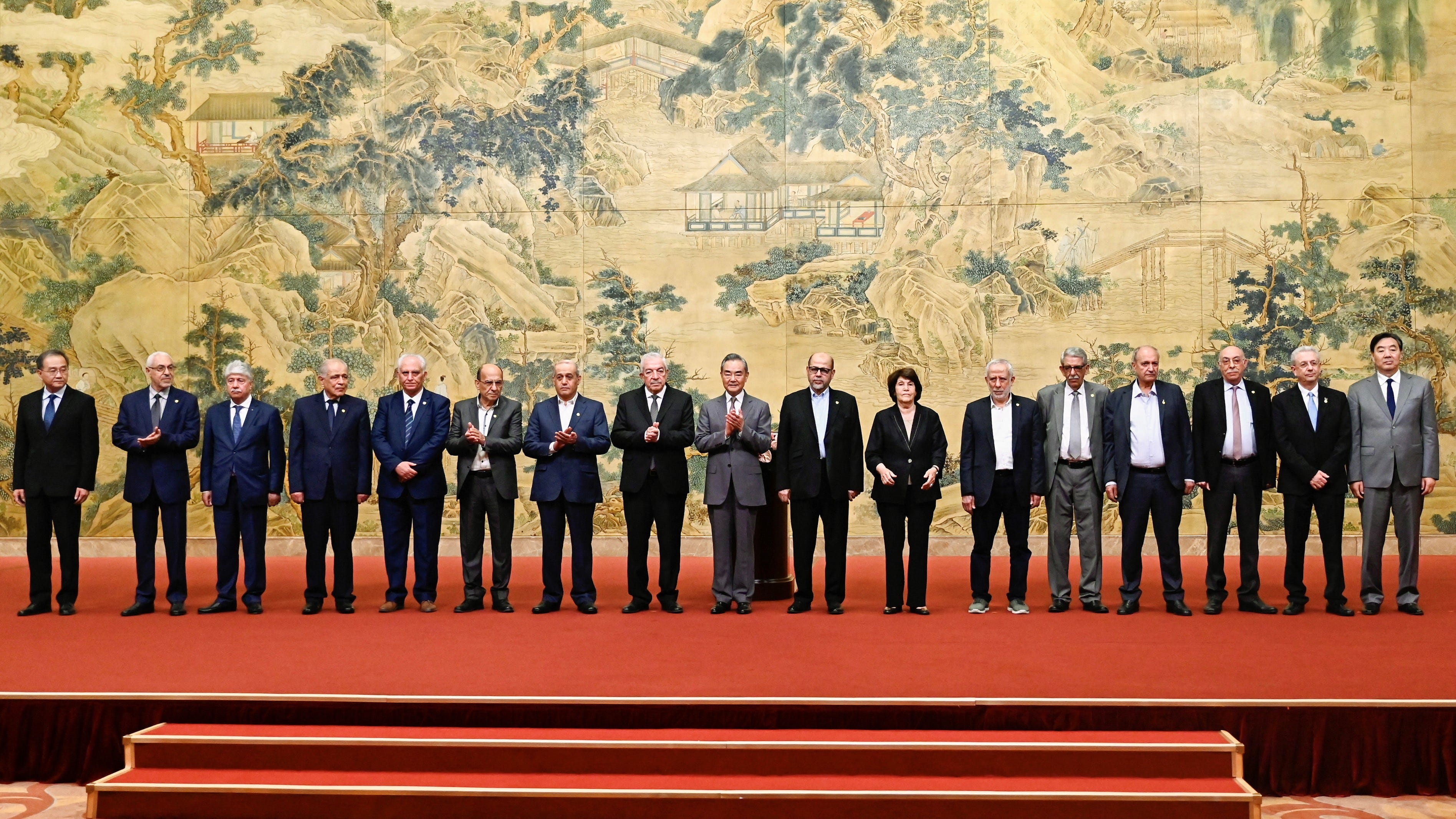
While it is seldom mentioned in media coverage, or within public discourse among Trump and his allies when speaking of the Gaza deal, a unified front of Palestinian political leaders offered a detailed outline of their vision for how to achieve a peaceful resolution within the Beijing Declaration in July 2024. The agreement entailed resolutions not only on ending the war against Gaza, but of envisioning a democratic future for an independent Palestine. Trump’s team has ignored these initiatives. When convenient for the sake of claiming Palestinian buy-in to the plan, the U.S. and its allies invoke a potential role for the PA.
From the early months of the Gaza genocide, leaders from a broad cross section of Palestinian political organizations have met in an effort to adopt a unified stance. These initiatives were spearheaded, in part, by Barghouti, a former Palestinian presidential candidate and member of parliament who is not affiliated with any armed resistance groups. Not only did Hamas and PIJ participate in the meetings, but so, too, did Fatah—the ruling party of PA President Mahmoud Abbas. The most notable document to emerge from these conferences was the Beijing Declaration, drafted by Barghouti and signed by 14 Palestinian political factions in China in July 2024.
The reconciliation talks in Beijing were unprecedented and brought together 14 major Palestinian factions, which spanned Islamic resistance movements alongside nationalist, leftist, and secular groups. The three-day conference culminated in the signing of a document that reaffirmed the right of the Palestinians to resist occupation and called for an end to illegal Israeli settlement expansion. It endorsed a reformed PLO, one empowered to reassess the terms of Oslo and other agreements, that would operate with a popular mandate to negotiate its future with the international community. The agreement proposed the formation of a national reconciliation government that would govern all Palestinian territories—Gaza, the West Bank, and Jerusalem. That government would oversee reforms necessary to hold democratic elections for parliament and other offices. It also envisioned international involvement in facilitating talks on the establishment of a Palestinian state.
What emerged from the conference that summer was a unified front that could rightly claim to negotiate on behalf of a substantial majority of Palestinians.
“The Beijing Declaration was extremely significant. All the factions, not just Hamas and Fatah, subscribed to it. It would have been the basis for which you would have Palestinian unity,” said Al-Arian. “The major obstacle has been Abbas. His movement goes there and signs like all other movements, thinking that now we’re going to begin a process of Palestinian unity—only for Abbas to come back and renounce these declarations and [say] that he’s not going to subscribe to it; he’s not going to accept it; he’s not going to follow all these recommendations.”
Barghouti said that Abbas’s failure to implement the Beijing Agreement abetted the narrative that there is no other legitimate representative of the Palestinian people. The agreement “would have closed the door to any attempts to impose foreign guardianship over us, whether in Gaza or the West Bank,” Barghouti told Al Jazeera Mubasher. “The major loophole through which the Israelis and certain international parties try to impose on the Palestinians what happens to them—the main reason and weak point—is the continued internal division.”
The U.S. has refused to engage with this broad coalition of Palestinians, instead issuing unilateral dictates and holding closed-door meetings to hash out details. The unfolding strategy appears to be using some thin veneer of legitimacy, offered by the mere existence of the PA and the PLO’s official representation at the UN, to pretend that Trump’s plan has the formal support of “the Palestinians.” Abbas, also known as Abu Mazen, has embraced this role. When Trump announced his “peace summit” in Sharm El-Sheikh, Abbas was not initially invited. The night before the gathering, Egypt informed Abbas’s office that he could attend the summit, but he did not participate in the official signing ceremony.
“They’ve been using Abu Mazen as kind of this puppet to say, ‘Well, you know, if Abu Mazen and the PA accept it, then why should it be so bad?’” said Buttu who served as a legal advisor to the PLO and worked alongside Abbas. “He allows himself to be used as the puppet, because he’s lured into this idea of somehow being a player on a world stage when, in reality, he’s nothing.”
Instead of adopting the recommendations of the Beijing Declaration, Abbas moved to further consolidate his grip on power and broaden his attempts to exclude or sideline other Palestinian parties. He also deepened his collaboration with the Israeli occupation and implemented policies demanded by the U.S., the EU, and Israel.
In early 2025, Israel launched its largest forced displacement campaign in the West Bank since 1967 in a series of operations that began with Abbas’s security forces targeting Palestinian resistance fighters, killing more than a dozen Palestinians and arresting hundreds of others. The PA operations, which started in late 2024, paved the way for Israeli forces to drive Palestinians from their homes and villages. Within a month, more than 40,000 Palestinians were forcibly displaced, the majority from the Jenin, Nur Shams, and Tulkarm refugee camps, and Israeli forces began a systematic campaign to destroy houses, roads, and infrastructure. The military onslaught morphed into a year-long series of Israeli raids and attacks, accompanied by an intensification of widespread violence and terror attacks against Palestinians by Israeli settlers.
In the midst of the Israeli invasion, the PA shut down Al Jazeera—the most watched network in the world reporting on the siege—in the West Bank and attempted to block its website. The ban remained in place until May.
In February 2025, Abbas issued an intensely unpopular decree canceling the laws and regulations governing financial allowances for the families of martyrs, prisoners, and Palestinians wounded in Israeli attacks. Israel and the U.S. have labeled the program “pay for slay,” saying it rewards terrorists. Since 2018, U.S. law has prohibited some financial aid to the PA unless the program is repealed. Funding for Palestinian security forces coordinating with Israel, however, remained in place. A State Department spokesperson said Abbas’s decree “appears to be a positive step and a big win for the Trump Administration.”
Palestinians widely see the payments as a necessary financial contribution to the families of Palestinians who have been killed, wounded, or imprisoned for engaging in the national liberation struggle. Abbas’s decree transferred the program to the Palestinian National Institution for Economic Empowerment, an entity overseen by a board of trustees appointed by Abbas.
Hamas condemned the decision in a press statement, saying that “turning these heroic nationalist individuals, who sacrificed the most for the Palestinian people and cause, into mere social cases is disgraceful.”
Qadura Fares—the Abbas-appointed head of the Commission of Detainees and Ex-Detainees Affairs—denounced the decree and demanded its immediate withdrawal. “It is not acceptable for the rights of prisoners and martyrs to be subjected to new administrative or economic standards that ignore the national dimension of this issue,” he said. Just over a week later, Fares was forcibly retired by presidential decree—a move broadly interpreted as a response to his public opposition.
In April 2025, Abbas named Hussein Al-Sheikh, a long-time member of Fatah known for his close ties to Israel, as vice president of the PA. Since 2007, Sheikh has served as the head of the General Authority of Civil Affairs—the main body coordinating with Israeli forces operating in the occupied West Bank. “If you heard him talking in a closed room, you’d feel that you are talking to an Israeli soldier,” Osama Hamdan, a senior Hamas official, told Drop Site soon after Shiekh’s appointment. “That is not my words; it’s the words of some significant leaders of Fatah.” The Israelis pushed for Sheikh’s appointment as Abbas’s deputy and likely successor, Hamdan alleged, because “they know that he is willing by himself to handle this dirty job on their own behalf.”
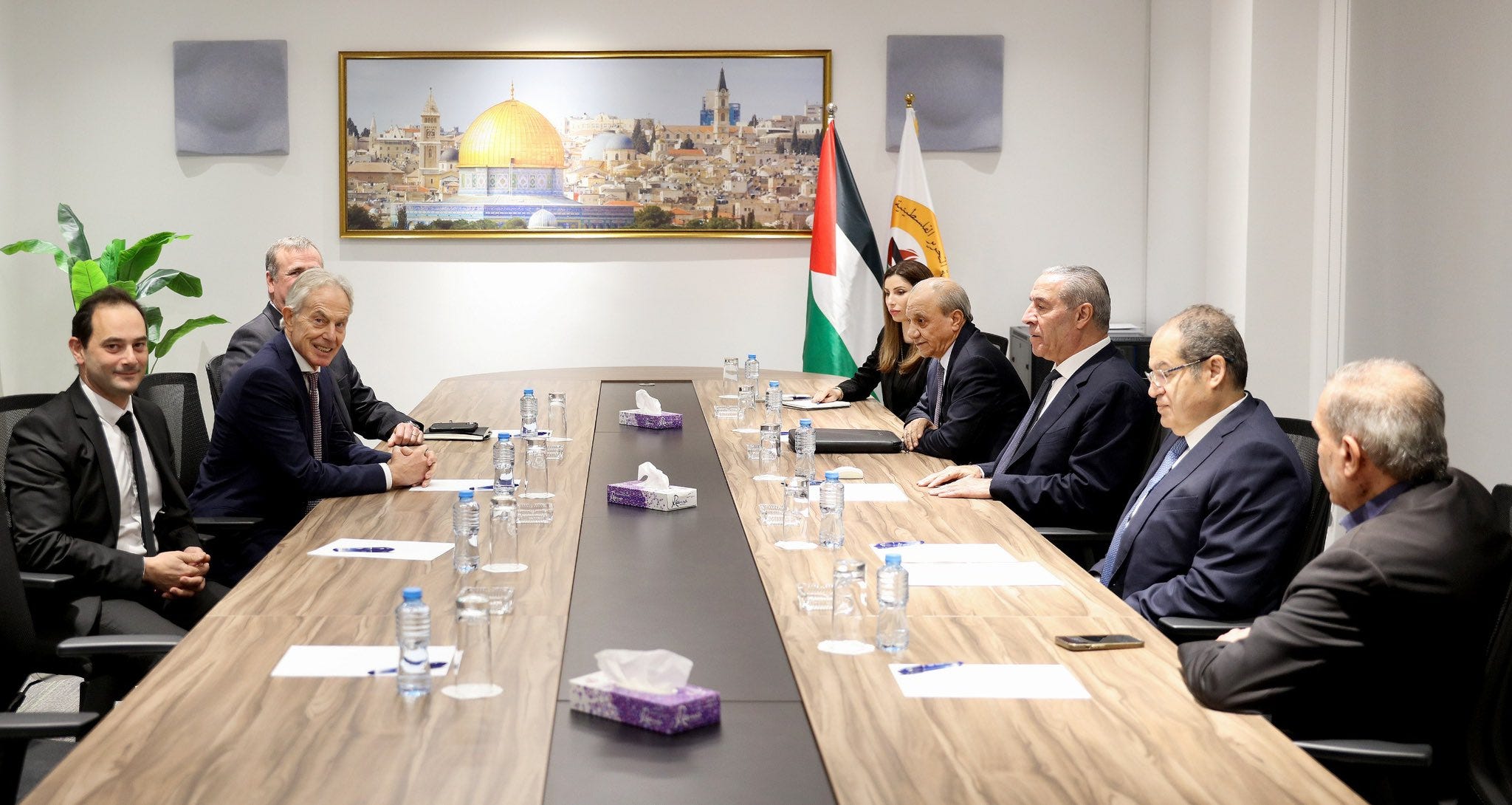
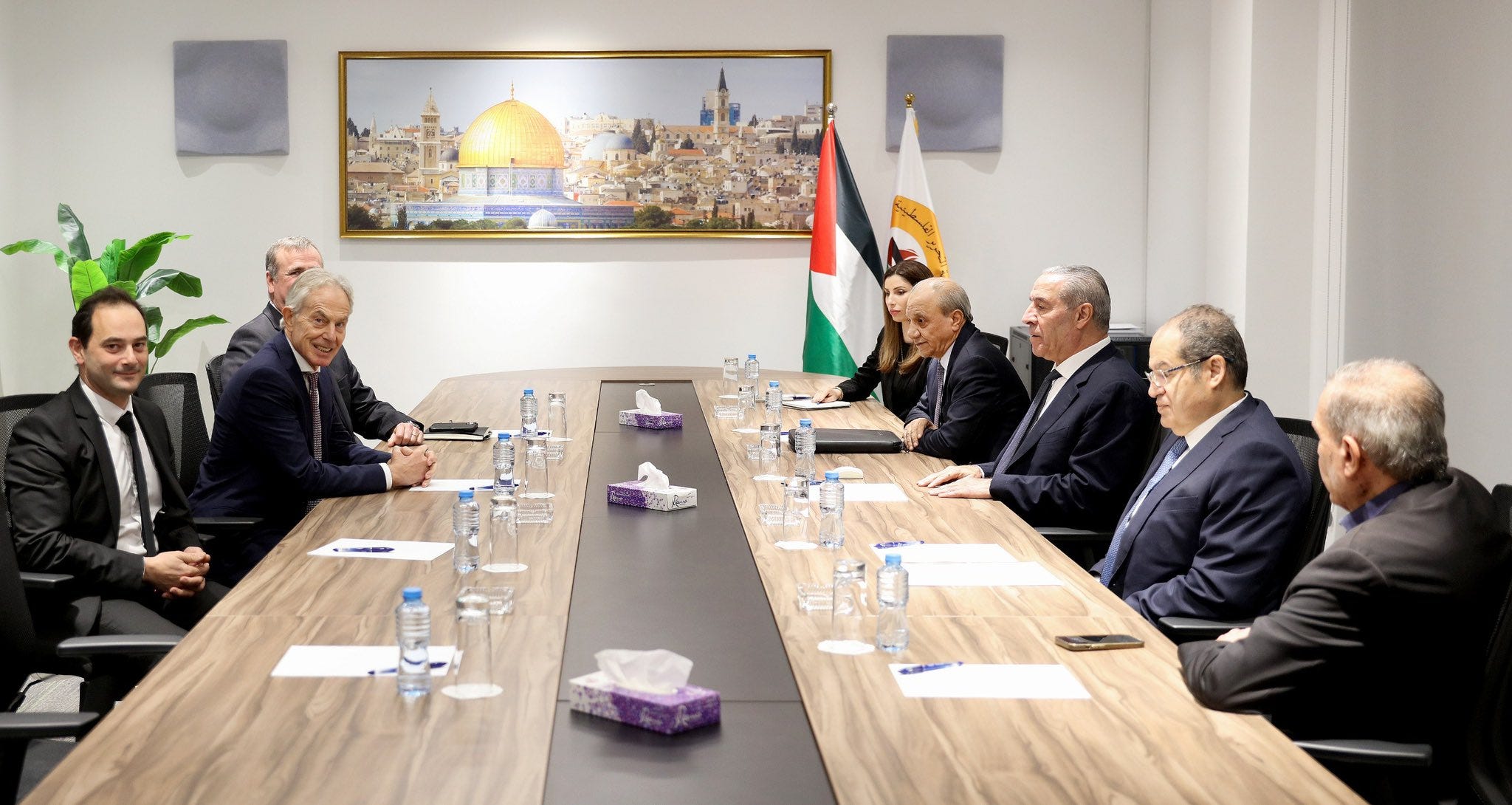
On November 23, Sheikh met with Blair and an unnamed U.S. official in Ramallah, and they discussed the implementation of Trump’s plan as endorsed by the UN Security Council. Hamdan told Drop Site that Israel would prefer to deal with Sheikh—an official they see as having a “security mentality” and who would accept the role of cracking down on Palestinians who try to organize resistance against Israel, as PA forces have done repeatedly in the West Bank. “It means there is no political leadership. This is why they choose Hussein Sheikh,” said Hamdan. “He’s not a political leader; he’s a security leader. His work all this time was to make the security arrangements with Israelis, according to the Israeli needs.”
Abbas and the PA are widely despised among Palestinians and not viewed as the true representative of their aspirations. “Abbas does not have legitimacy. His legitimacy only comes from an international community that does not care whatsoever about Palestinian lives,” said Al-Arian. “We’ve seen that through two years of genocide. We’ve seen that in the fact that Israel is having this security coordination with Abbas, cracking down on Palestinians in the West Bank, while they are killing Palestinians in Gaza, [and] while Abbas is doing nothing.”
A poll conducted by the independent Palestinian Center for Policy and Survey Research (PCPSR) in late October in both the West Bank and Gaza found that support for Abbas stood at 21%, while support for Hamas was 60%. Only 13% of Palestinians said they would vote for Abbas in a presidential election. Hamas remains the single most popular political party in all of Palestine—not just Gaza. Only a third of Palestinians say they would want the PA to take control of Gaza. Two-thirds of respondents said they want elections within a year to choose new leaders.
“Abbas has the lowest support ever, and it’s actually all of these other factions that have a higher percentage of support. These factions actually work together. They’re not working against one another; they’re actually working together,” said Buttu, pointing out that the last time Abbas won an election was for a four-year term in 2005. “He’s constantly being portrayed as the leader of the Palestinian people when, in fact, he lost his mandate back in 2009. He has no mandate now.”
Abbas’s Moment of Truth
When stripped down to its core, Trump’s Gaza plan was aimed at one central objective: achieving the surrender of the Palestinian struggle for self-determination—an end that secures the imposition of a state of subjugation to Israel and Trump’s private board. Israel failed to accomplish this through more than two years of genocide, and Palestinian leaders, with the exception of Abbas, have been clear that they will not accept through edict what they resisted by force of arms.
“Unless an agreement is reached that grants the Palestinian people their rights, the Palestinian people will turn to resistance, because no other path is available,” said Al-Hindi. “In the future, there will be resistance movements regardless of their names—Hamas, Islamic Jihad, the Popular Front—regardless of the labels. Even if these factions hypothetically were to surrender or agree to any settlement, new factions would emerge to resist.”
The EU, led by French President Emmanuel Macron, has been spearheading an effort to use Abbas’s tenuous mandate as head of the PA in an effort to bureaucratically undermine a democratic Palestinian response to the genocide and the future of the liberation struggle. Under the banner of “reform” of the PA, and support for a “two state solution,” the EU and U.S. have been pressing Abbas to push through a new constitution and a law defining the requirements to form an official political party that would require recognition of Israel’s right to exist and the renunciation of political violence.
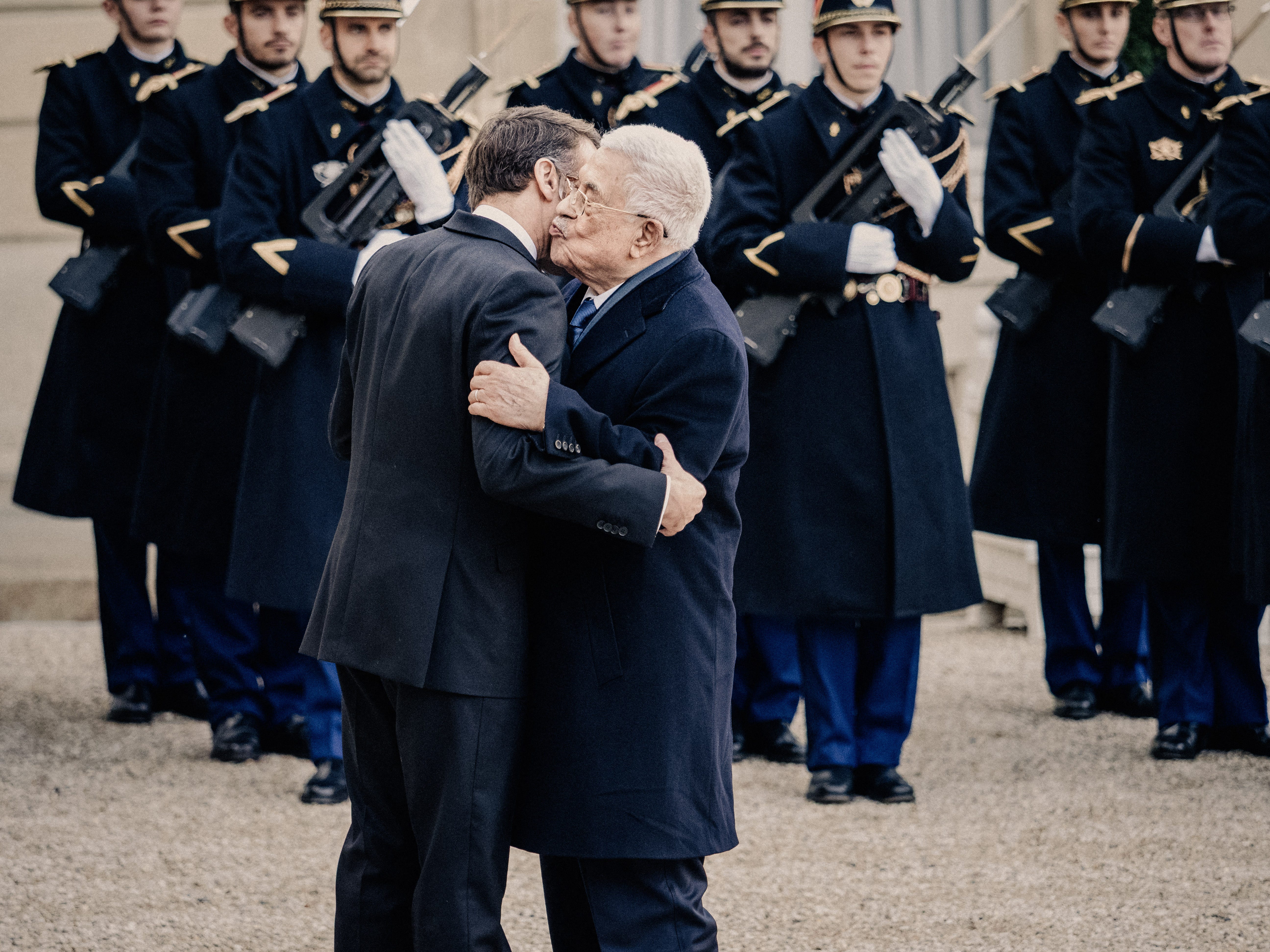
Standing alongside Abbas in Paris on November 11, Macron announced that the two men established a joint committee that “will be responsible for working on all legal aspects: constitutional, institutional and organizational. It will contribute to the work of developing a new constitution, a draft of which President Abbas has presented to me, and will aim to finalise all the conditions for such a State of Palestine.” Abbas reiterated that he wants to see an “unarmed” Palestinian state, and he condemned the October 7 attacks. He has not made the purported draft constitution Macron cited available for Palestinians to read.
Since the 2006 elections, which Hamas won decisively, Palestinians have not had the opportunity to elect their representatives. In the legislative elections held that year, Hamas won 76 of the 132 seats in the Legislative Council, while Fatah secured 43. Abbas was elected to a four-year presidential term in January 2005, and no presidential elections have been held since.
In the years that followed, Fatah and Hamas signed several agreements that included commitments to hold comprehensive elections, yet none of these agreements were fully implemented. In 2021, Palestinian factions reached an agreement to conduct legislative elections, followed by presidential elections. Abbas, however, announced on April 29, 2021, that he was postponing the vote. He justified the decision by citing Israel’s refusal to allow legislative elections in occupied Jerusalem. Hamas denounced the postponement as an attempt to avoid elections.
On March 4, 2025, during a summit in Cairo, Abbas declared his willingness to hold elections. “We are fully prepared to hold general presidential and legislative elections next year, provided that the appropriate conditions are met in Gaza, the West Bank, and East Jerusalem,” he said.
During a meeting with German Foreign Minister Johann Wadephul in August 2025, in Ramallah, Abbas reiterated that any elections in Palestine “will not include political factions or individuals who do not adhere to the program and commitments” made by the PLO and his authority. He added, “We want the State of Palestine to be non-armed, including in the Gaza Strip.” A public opinion poll by the PCPSR conducted in late October showed that 63% of Palestinians opposed Abbas’s condition requiring election participants to accept all PLO obligations, including agreements with Israel.
Despite widespread public opposition, Abbas issued a “decree-law” on November 19, 2025, that imposed the new regulations for local elections. The PA praised its “important national and reform-oriented achievement” and highlighted its efforts to increase the participation of women in governance and to ensure election integrity. Analysts believe the law is likely to be replicated for national elections. The law states that all candidates for office must “commit to the Palestinian Liberation Organisation’s program platform—its international commitments and the decisions of international legitimacy.” That clause means that Hamas, the single most popular Palestinian political party, would be prohibited from fielding candidates.
In a statement on November 22, Hamas said the law effectively makes “recognition of the Israeli occupation a prerequisite for candidacy [and] constitutes a serious infringement on citizens’ right to freely choose their representatives,” charging that it “represents a clear attempt to exclude national and Islamic forces as well as independents…. and aligns with Israeli and American pressure.” Hamas’s statement accused Abbas of “yielding to international pressures aimed at creating a submissive Palestinian environment, consistent with the ‘Rehabilitation of the Authority’ projects being promoted and advocated, in a way that serves the occupation and its plans to liquidate our cause.”
Hamas was not alone in denouncing Abbas’s edict. In a joint statement on November 26, a coalition of secular and nationalist parties, known as the Democratic Forces, denounced the law as “dangerous,” saying it “undermined the spirit of the electoral system.” They charged that Abbas had wholly disregarded the widespread objections to the proposed amendments offered by a range of Palestinian parties, and they called on Abbas to repeal it.
A coalition of dozens of major Palestinian NGOs, civil society groups, and women’s rights organizations also issued a joint statement blasting the law. They called the inclusion of the requirement to commit to prior PLO agreements “alarming,” and they said it was “a new condition that did not appear in any of the drafts that were previously discussed.” They said this term “constitutes a fundamental infringement on the right to political participation as guaranteed by international human rights standards, particularly the International Covenant on Civil and Political Rights, to which the State of Palestine has acceded and is legally bound.” The groups said that, if the condition was not repealed, they would reassess their participation in election monitoring, training, and other voting-related activities.
A senior PLO official and Abbas ally, Fahmi Al-Za’arir, defended the law’s requirements, saying it was a “strategic mistake” to have proceeded without them during the 2006 elections, which Hamas won. In an interview with Saudi television network Al-Hadath, he blamed Hamas for not holding elections in Gaza over the past two decades. With no apparent sense of irony, Al-Za’arir said that what’s needed is “to entrench democracy within Palestinian society and among the Palestinian people.”
“We absolutely need a legal and political reference that is genuinely represented in the legitimacy of President Abu Mazen,” Al-Za’arir added. “Until elections for the Parliament of the State of Palestine are held, these decisions become necessary, as they serve as regulatory measures.” He acknowledged that Israel refuses to respect previous agreements with the PLO, but maintained that Abbas must nonetheless adhere to them. “This agreement is still guaranteed under international legitimacy, and it remains what regulates the minimum level of relations within the occupied Palestinian territory: between us and the international community, on one hand, and between us and the Israeli occupation, on the other,” Al-Za’arir said.
Basem Hadaydeh, a senior official in the PA’s ministry of local government, responded to the outcry over the law, claiming it was necessary to preserve the legitimacy of the PA and the PLO—to strengthen local governance, and to ward off potential suspension of international donor funding for local aid projects. In a Facebook post, he argued that the demand that candidates and parties formally commit to previous agreements of the PLO was not “political exclusion,” but “a framework for protection.” The condition was added, Hadaydeh contended, to comply with the terms of the UN Security Council resolution and “the demands of President Trump’s peace plan, which stipulates the non-participation of armed groups, including Hamas, and their exclusion from governance institutions in both the West Bank and Gaza.” He predicted that the PA “will not back down from including this condition and implementing it, nor will they modify its phrasing.” Abbas’s office and the PA did not respond to a request for comment.
“Abbas was a no-show during two year[s] of genocide, and now what he wants to do is to change the election laws, because now there is a lot of talk about having legitimacy for whoever is going to take over Gaza,” said Al-Arian. “The Americans have been saying you need to do reforms. For them, reforms are basically to give in to all of Israel’s impossible and illegal demands. That’s what he’s trying to do now. Since he’s not registering in the polls high enough to win any elections, he’s trying to change the election laws so that only he and his team would win elections,” Al-Arian added.
When it comes to national elections, the central objections to the new law center around the agreements initially made with Israel by Yasser Arafat, the chairman of the PLO. Beginning with backchannel talks in the late 1980s, and extending through the Oslo Accords of 1993 and 1995, these commitments stipulate that Palestinians recognize the legitimacy of the Israeli state, but do not require Israel to recognize a Palestinian state. Israel offered only formal recognition of the PLO as the “sole legitimate representative” of the Palestinian people.
The agreements made by the PLO do not lay out a framework to end Israeli occupation, do not address the right of Palestinian refugees to return to their homes, nor impose any restrictions on the expansion of illegal Israeli settlements. In signing Oslo, Arafat agreed to formally abandon claims to 78% of historic Palestine in return for Palestinian “self-governance” in the remaining territories.
Abbas was one of Arafat’s top deputies and a leading figure in brokering the agreements with Israel in the 1990s that led to the signing of the first Oslo Accords in 1993, which initiated a sustained process of Israeli usurpation and the rise in popularity of Islamic resistance movements. Abbas personally signed the 1993 “Declaration of Principles” with Israel on behalf of the PLO.
“The fashion-show vulgarities of the White House ceremony, the degrading spectacle of Yasser Arafat thanking everyone for the suspension of most of his people’s rights, and the fatuous solemnity of Bill Clinton’s performance, like a 20th-century Roman emperor shepherding two vassal kings through rituals of reconciliation and obeisance: all these only temporarily obscure the truly astonishing proportions of the Palestinian capitulation,” wrote the late Palestinian intellectual Edward Said in a 1993 essay. “So first of all let us call the agreement by its real name: an instrument of Palestinian surrender, a Palestinian Versailles.” The PLO, Said observed, “has ended the intifada, which embodied not terrorism or violence but the Palestinian right to resist, even though Israel remains in occupation of the West Bank and Gaza.”
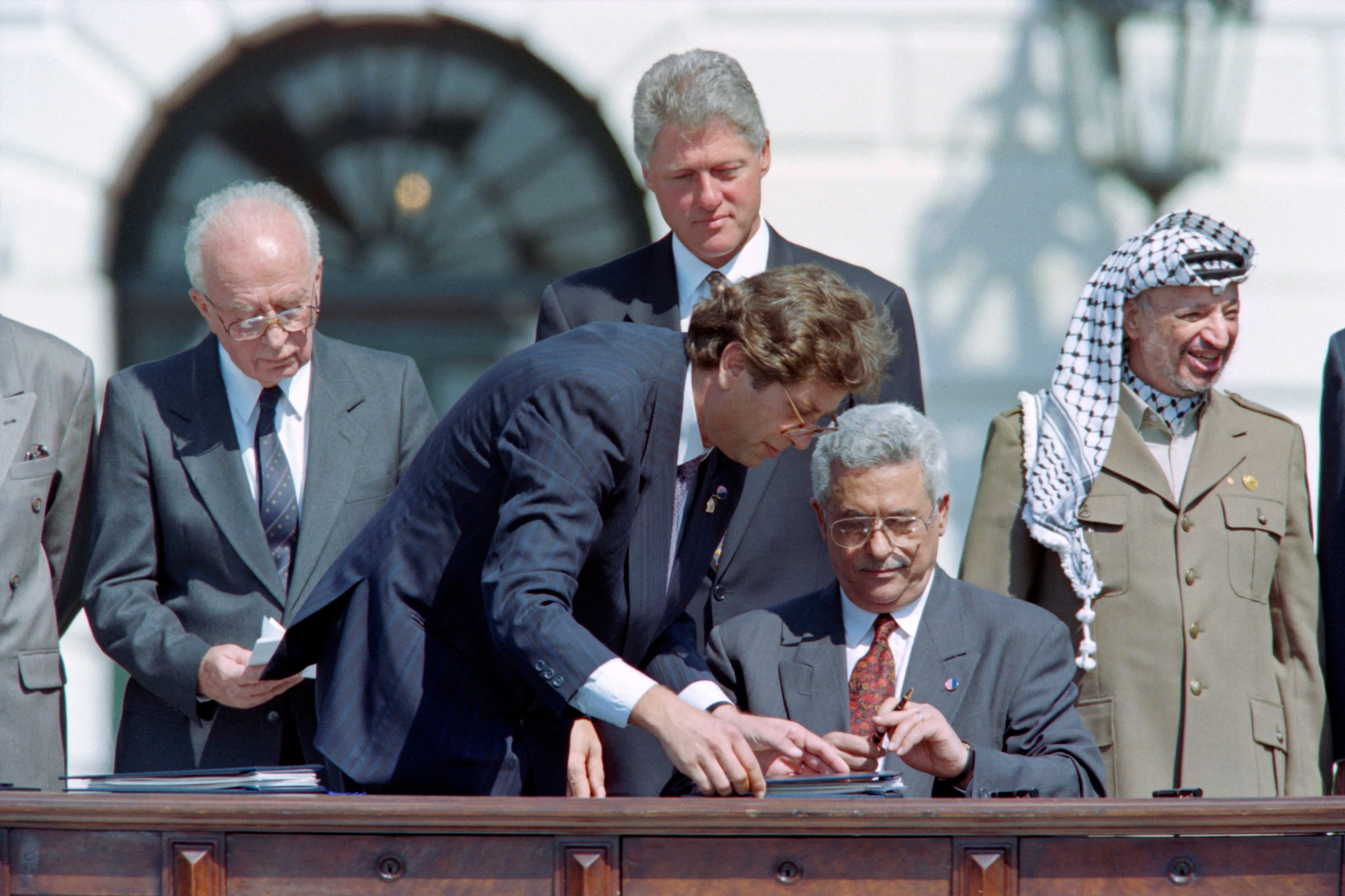
The PLO also agreed to formally renounce violence and to take responsibility for preventing armed resistance against Israel. After Hamas won the Palestinian elections in 2006, Abbas agreed to a set of edicts from “The Quartet”—a committee made up of the U.S., the EU, Russia, and the UN—that mandated that any Palestinian government recognize Israel, endorse the Oslo Accords, and renounce violence. Failure to do so, the Quartet threatened, would result in immediate sanctions and the cutting off of aid. Taken as a whole, the process that formally began in 1993 transformed the PLO from a national liberation movement into an administrator operating at the pleasure of the Israeli occupation regime.
“For Hamas, and for many other organizations, the issue here is: Why should we be recognizing a state that has colonized our land and turned us into refugees?” asked Buttu, who advised the PLO during negotiations with Israel and the U.S. from 2000-2005. “Because if we recognize them, then we are implicitly recognizing that they have a right to take over our land, and that they have a right to turn us into refugees. We’re not going to recognize that, because they don’t have those rights.” She added, “Here we are 32 years after the signing of that first agreement, and the situation has actually gotten worse for Palestinians. I’m not even sure if Israel recognizes the PLO at this point.”
While Hamas is not a member of the PLO, it did revise its charter in 2017 and expressed a willingness to accept an interim Palestinian state along the pre-1967 borders as part of a national consensus, but without formally recognizing the state of Israel or relinquishing its goal of liberating all of historic Palestine.
In interviews with Drop Site, officials from both Hamas and Islamic Jihad said they support restoring the PLO as the sole legitimate representative of the Palestinian peoples’ destiny, but not without significant reforms and revisiting the agreements made beginning in the 1990s.
“The PLO disarmed, condemned Palestinian resistance, and anyone who resisted was persecuted. The constitution was changed, yet they were not given a state in the West Bank or Gaza,” said Al-Hindi, adding that calls for Palestinian statehood that require it to submit to Israeli subjugation and disarmament are meaningless. Europe “remained silent in the face of Israeli actions: continued settlements, land confiscation, threats to Jerusalem, and attacks on Islamic and Christian holy sites,” he said. “Therefore, this hypocrisy happening in Europe is blatant to the Palestinian people and cannot fool us again.”
Al-Hindi pointed out that Palestinian factions agreed in Beijing in 2024 to a reconstitution of the PLO—and the inclusion of Hamas and PIJ—noting that an organization claiming to be the sole voice of the Palestinian cannot exclude its most popular parties. “The resistance had no objection to joining it, provided that the organization is reformed on new democratic and political foundations that reflect the Palestinian reality, and that we become part of the PLO,” Al-Hindi said. “However, it was not implemented, because the issue of implementation is a decision not in the hands of the Palestinians or the Palestinian Authority; it is in the hands of Israel and the U.S., who have vetoed the rebuilding of the PLO and the inclusion of Hamas and Islamic Jihad.”
Al-Arian said that if the PLO was truly representative of Palestinian sentiment, it would require significant involvement of Hamas and other pro-resistance parties. “If we’re going to reform the PLO, that means we have to give Hamas enough seats to represent its weight. That means the number of seats for Fatah and the other factions will go down,” Al-Arian said. Abbas “knows that, if he is going to have the PLO reorganized along the lines of what the main Palestinian factions call for, then his group would be an extreme minority. So he’s trying to basically exclude everyone else, so that he wins the election and gets a majority [that] can go along with the current process. It’s an illusion.”
Buttu charged that Abbas “is creating a framework in which dissent is not allowed,” saying his moves are aimed at “removing Palestinian politics from Palestinian life and Palestinian governance.”
Hamdan said that Abbas’s electoral law decrees come at a historic moment when Palestinian factions are engaged in an unprecedented effort to unify. He added that Abbas’s pandering to a U.S.-EU-Israeli constituency, rather than a domestic one, will backfire.
“I think the PA now is at a very critical point—the moment of truth,” Hamdan told Drop Site. “If they want to [accede] to what the Israelis are asking, they will lose their position as a national leadership for the Palestinians. They will be considered betrayers.”
Hamdan said that, if Abbas holds any pretense to being a Palestinian leader, he has an obligation to engage in the intra-Palestinian dialogue to reach a united front in responding to Trump’s edicts.
The “Least Harmful” Option
Hamas has repeatedly said it will relinquish governing authority in Gaza, and it has endorsed the technocratic committee on the condition that it is Palestinian-led and not a fig leaf for foreign rule.
Despite the open disdain for Abbas expressed by Palestinian resistance leaders, Hamas officials have consistently said they support the interim administration of Gaza falling under the umbrella of the PA. “Israel is trying to disconnect Gaza from the West Bank. They want to take over the West Bank. They want to turn Gaza into a concentration camp. We will not allow them to do that, even if [it means turning over governance] to the Palestinian Authority,” Hamdan said. “We believe that as Palestinians we can solve the problems—whatever it takes.”
In late October, senior Hamas officials, including its Gaza leader Khalil Al-Hayya, met with Sheikh and the PA’s intelligence chief Majed Farraj in Cairo. Hamdan told Drop Site that Abbas initially was refusing to meet with Hamas, but eventually agreed to it after intervention by Egyptian officials. “They rejected a meeting with all the Palestinian factions, which was strange. You can’t talk to your own people at the same table?” asked Hamdan. “And then, by the pressure of the Egyptians, they have accepted to have a meeting with Hamas, with Dr. Khalil Al-Hayya. All the political ideas which were suggested in the meeting were from Hamas’s side,” Hamdan said.
“A detailed discussion took place regarding the challenges facing our Palestinian people,” said Hussam Badran, Hamas’s head of national relations, in an interview with Al Jazeera Mubasher on November 30. “In terms of diagnosing the situation, there is perhaps a degree of agreement and convergence, but the issue lies in the mechanisms for confronting these challenges, and how we can unify the Palestinian stance.” Still, Badran said, “We do not lose hope in discussing national issues or in bringing viewpoints closer. Anyone who refuses internal rapprochement will, in the end, pay the price before anyone else. Perhaps the events will compel Palestinians—even those who do not want it—to unite the Palestinian ranks in confronting the obstacles and challenges before us as Palestinians.” Badran added that Hamas hopes “to reach at least the minimum level of agreement in confronting what our Palestinian people are facing.”
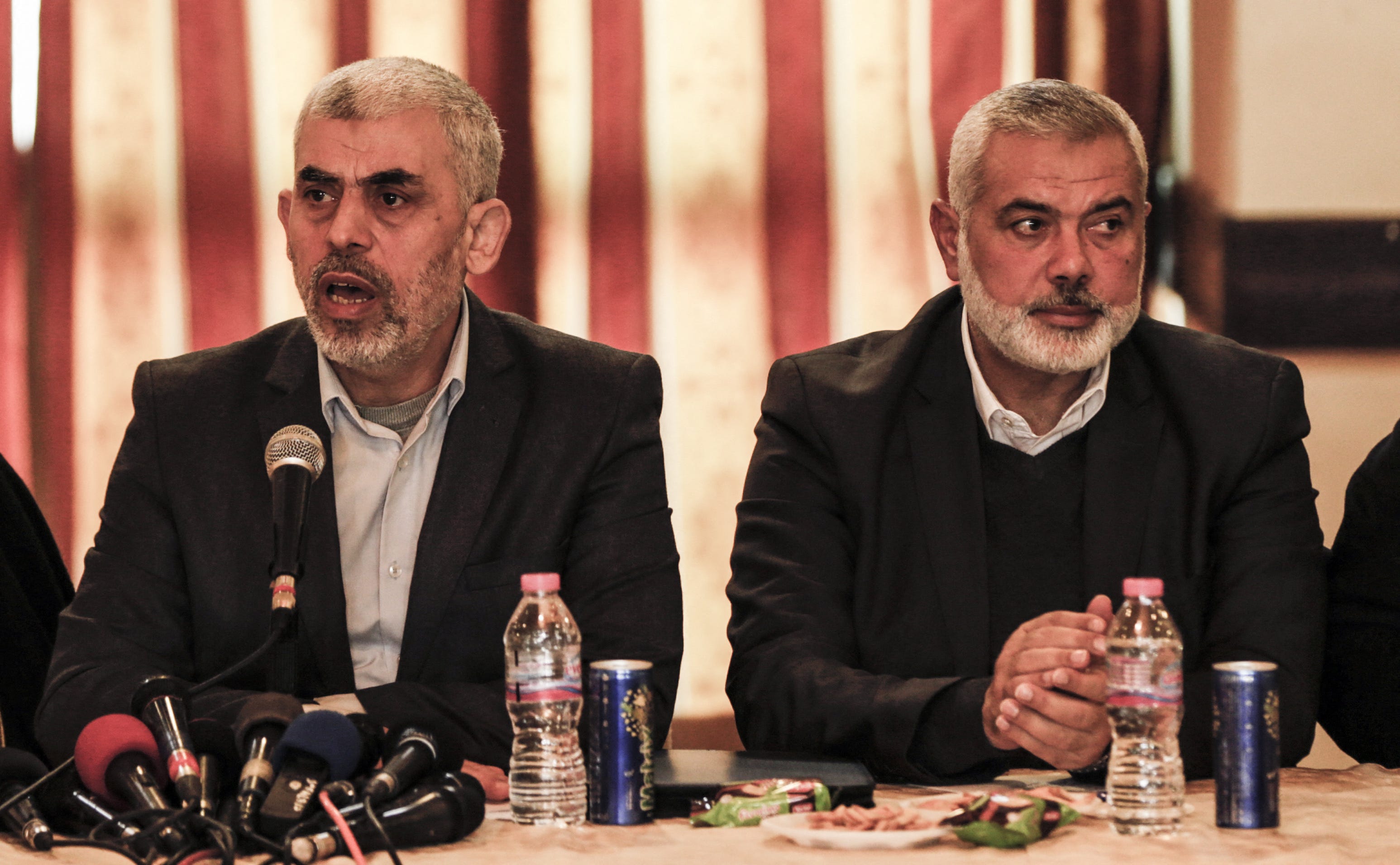
The prospect of Hamas endorsing Abbas and the PA assuming control of Gaza is not unprecedented. In October 2017, eight months after Yahya Sinwar was elected head of Hamas’s political bureau, an agreement—brokered by Egypt—was reached between Abbas’s Fatah and Hamas. It would have seen the PA return to government in the strip for the first time since 2007 and Hamas’s victory in the 2006 Palestinian elections.
Soon after Hamas’s win and a new Palestinian government was formed under Ismail Haniyeh, the U.S. froze all aid to the PA and broadened its designation of Hamas officials as terrorists. The EU and Canada imposed sanctions as well, crippling Palestinian institutions. Western nations demanded the new Palestinian government recognize Israel and renounce violence. Abbas scrambled to respond to these edicts, and major disputes also erupted over the issue of disarmament and control of armed forces. Hamas accused Abbas of abusing presidential decrees to enact a “soft coup.”
In June 2007, Abbas dissolved the government, removed Haniyeh as prime minister, and declared a state of emergency. The brief civil war between Hamas and Fatah resulted in Abbas consolidating his power in Ramallah and a Hamas rule in Gaza. Abbas subsequently refused to hold new elections.
The U.S. and other Western nations, along with Israel, Egypt and the PA, maintained a devastating blockade on Gaza, effectively punishing the population for electing Hamas. In 2012, the UN published a report predicting Gaza would become “unlivable” by 2020. Three years later, the UN warned conditions were worsening faster than originally projected and said Gaza would become unlivable by 2018.
By 2017, the situation in Gaza had immensely deteriorated. It was suffering under the Israeli blockade, and the PA had collaborated with Israel to cut off electrical supply to the enclave, leaving most residents with only a few hours of power per day. The greatest impact was felt in the health sector —hospitals needed to begin using generators and had to cut back services—as well as with Gaza’s water purification system. Unemployment was rising, and the PA slashed salaries to government workers in Gaza, while laying off others as part of broad cuts to funding for social services. Israel continued its policy of “mowing the lawn”—periodically launching drone strikes and other attacks, as it waged a series of short wars against the enclave in 2008-2009, 2012 and 2014.
Trump had just come to power in Washington and pushed his agenda for Arab normalization agreements with Israel, and offered a hardline defense of its expansionist policies. Sinwar said he hoped an agreement with the PA would pave the way for new elections across Palestine and to reestablish a unified Palestinian governance structure over Gaza, the occupied West Bank, and east Jerusalem. In return, Sinwar wanted the blockade on Gaza to be lifted.
“Hamas is moving toward reconciliation based on two considerations: First, its sense of the danger facing the Palestinian cause and the need to safeguard the national project,” Sinwar said in a speech in October 2017 in Gaza. “And second, its feeling that the future of Palestinian youth is at risk.”
“There is no winner or loser in reconciliation; the winner is our people and their just cause,” he said.
Netanyahu, privately and publicly, opposed any effort to unite Gaza and the West Bank. “This is part of our strategy—to isolate the Palestinians in Gaza from the Palestinians in the West Bank,” Netanyahu later told a Likud Party conference in 2019. “Anyone who wants to thwart the establishment of a Palestinian state has to support bolstering Hamas and transferring money to Hamas.” These remarks are often erroneously portrayed as evidence Netanyahu supported Hamas. In reality, he was articulating a strategy of divide and conquer—aimed at crushing any effort to formally unify Palestine by enforcing a fractured power structure—while maintaining the siege against both Gaza and the West Bank as part of Israel’s broader war of annihilation.
Soon after a preliminary reconciliation deal was signed between Hamas and Fatah for a national unity government, Trump’s Middle East Envoy Jason Greenblatt intervened. “Any Palestinian government must unambiguously and explicitly commit to nonviolence, recognize the state of Israel, accept previous agreements and obligations between the parties—including to disarm terrorists—and commit to peaceful negotiations,” Greenblatt said. “If Hamas is to play any role in a Palestinian government, it must accept these basic requirements.”
In response to Greenblatt, Sinwar declared, “No one has the ability to extract from us recognition of the occupation,” adding that “No one in the universe can disarm us. On the contrary, we will continue to have the power to protect our citizens.”
The deal with Abbas eventually collapsed and Sinwar, after offering significant concessions, charged that the PA leader was doing the bidding of Israel and the U.S. by demanding disarmament of the Palestinian resistance and by seeking to place Hamas’s armed wing, the Qassam Brigades, under PA control. “One state, one regime, one law, and one weapon,” Abbas said in an interview with Egyptian television. “I will not accept or copy or reproduce the Hezbollah example in Lebanon. Everything must be in the hands of the Palestinian Authority.”
During the negotiations, Sinwar had indicated support for a long-term truce with Israel and a total dissolution of Hamas’s governing committees. He offered commitments to store resistance weapons and agreed to PA forces serving as the official internal security presence in Gaza. He, nevertheless, saw disarmament of the resistance factions as crossing a red line that would undermine the national liberation struggle and strip Palestinians of the weapons for self-defense against Israel. Sinwar stressed that no one could force Palestinians to recognize the occupation, and that resistance movements are “freedom fighters and revolutionaries for the liberation of the Palestinian people, fighting the occupation in accordance with the rules of international humanitarian law.”
In May 2018, months after the reconciliation deal collapsed and with Israeli forces gunning down nonviolent protesters during the Great March of Return demonstrations, Sinwar compared Gaza to a “very hungry tiger, kept in a cage, starved, whom the Israelis have been trying to humiliate. Now, it’s on the loose; it’s left its cage, and no one knows where it’s heading or what it’s going to do,” he said.
“The October 7th attack would not have happened if Abbas accepted Sinwar’s offer,” said Al-Arian. “The fact that the Palestinian Authority refused to take over Gaza tells you all you want about who is actually controlling Abbas, and who he listens to and who controls him. Abbas couldn’t do it, because the Americans and the Israelis rejected it.”
The failure of the 2017 agreement was not a surprise, given Abbas’s history and the well-known process of the U.S. and Israel intervening to quash such efforts.
Buttu said that Abbas’s entire tenure has amounted to continuing this arc of capitulation by both wittingly and unwittingly catering to the Israeli agenda. Abbas’s leadership has been a multi-decade Oslo déjà vu. “We’re constantly going down this path where we have Abu Mazen leading Palestinians in saying, ‘You have to do everything possible to recognize Israel. You have to do everything possible to make sure to recognize that their colonization is okay and legit. And you have to do everything possible to recognize that you will never have a right to return to your homes. And you have to do everything possible to renounce your right to self determination. And if you don’t do all of those things, then you’re the bad guy and Israel’s the good guy,’” Buttu said.
Despite his years of servitude to the U.S. and Israeli agenda, Israel has repeatedly declared Abbas as unacceptable and portrayed him as a terrorist enabler. Netanyahu has said, from the beginning of the Gaza genocide, that he would not accept the PA governing Gaza. “The day after the war in Gaza, there will be neither Hamas nor the Palestinian Authority,” he declared in February 2025. After the UN Security Council endorsed Trump’s plan on November 17, Danny Danon, Israel’s ambassador to the UN, dismissed a role for the PA. “Some colleagues have suggested that the Palestinian Authority could be the one to disarm Hamas and rebuild Gaza,” he said. “This assumes the PA will suddenly do something it has never done and has never been able to do.”
While using Abbas and the PA when convenient—and despite its sycophancy—the Trump administration nonetheless issued sanctions against senior PA and PLO members in July, accusing them of supporting terrorism. The State Department also revoked visas from PLO and PA officials for the UN General Assembly in New York in September and barred Abbas from entering the U.S. Following the October Gaza agreement, Abbas is back in play because Trump has determined his plan has use for a Palestinian façade.
Barghouti said that Abbas’s failure to implement the Beijing Agreement abetted the narrative that there is no other legitimate representative of the Palestinian people. The agreement “would have closed the door to any attempts to impose foreign guardianship over us, whether in Gaza or the West Bank,” Barghouti told Al Jazeera Mubasher. “The major loophole through which the Israelis and certain international parties try to impose on the Palestinians what happens to them—the main reason and weak point—is the continued internal division.”
Al-Hindi said that, despite Abbas’s history and collaboration with Israel, the Palestinian factions remain willing to accept the PA returning to Gaza.
“Just to be clear: Mahmoud Abbas as he is—who talks about security coordination with Israel and about the futility of resistance—we accept that he issues the decision to form the technocratic committee, and that it would be affiliated with his government in Ramallah,” he said, adding that he wants Abbas and his Fatah party to engage fully with other Palestinian factions. “We are keen that Fatah, led by Mahmoud Abbas, participate as an essential partner in these internal Palestinian consultations, because the main issue we are discussing concerns the future of the conflict with Israel.”
Al-Arian said that Hamas and Islamic Jihad view an interim governing structure in Gaza under the auspices of the PA as the “least harmful” option on the table. “What’s the alternative? Trump in charge? ‘Board of Peace’ in charge? Tony Blair in charge? Israel in charge? Arab troops in charge? So they keep saying, ‘We need Palestinians to be in charge, and we’ll deal with Abbas, even if the Palestinian Authority is corrupt and everything. But that’s the least bad option that we have,’” Al-Arian said. “We’re not going to accept a High Commissioner 100 years after the British mandate. After Herbert Samuel of 1920, now we’ll have Donald Trump as a High Commissioner or Tony Blair? That’s unacceptable.”
Macron announced that France would recognize a “sovereign, independent and demilitarized State of Palestine” and that Hamas must be shut down and disarmed in September. “Hamas has been defeated militarily by the elimination of its leaders and decision-makers,” he declared in a speech at the UN during a conference organized by France and Saudi Arabia. “It must also be defeated politically to be truly dismantled.”
Macron’s demand for a demilitarized Palestinian state echoes the stance Netanyahu used to promote before the Gaza genocide. “The solution is a demilitarized Palestinian state,” Netanyahu said in 2013. “True and ongoing demilitarization with very clear security arrangements and no international forces.”
In response to France and other nations recognizing Palestine, Netanyahu said he will never allow a Palestinian state. “I have a clear message to those leaders who have recognized a Palestinian state after the terrible massacre of October 7: You are granting a huge prize to terrorism,” Netanyahu said in a video address on September 21. “And I have another message: It will not happen. There will be no Palestinian state to the west of the Jordan River.”
While Palestinian resistance factions have welcomed the growing number of nations recognizing Palestine, they also argue that the added caveats about disarmament render the gestures symbolic or, worse, that they ultimately serve to undermine true Palestinian liberation. “We see that one of the aims of these states in recognizing the State of Palestine is to preoccupy the Palestinian people and distract them from resistance with words that have no practical translation on the ground,” said Ataya. “The Palestinian does not want to live in an illusion—that he has a recognized state while, in truth, he does not possess a single centimeter of his land on which this ‘fake’ state could actually exist. This is also one of the problems our enemies try to exploit: manipulating the emotions of Palestinians who long for an independent, fully sovereign state on their own land, and who wish to regain Jerusalem as its capital.”
In effect, what Trump’s plan envisions is the very same structure that the Israelis achieved in the 1990s—offering the Palestinians no meaningful rights, while claiming to be working toward peace, as they continue their war of annihilation through a combination of military force, bureaucratic trickery and dispossession. The entire package, as with Arafat in the 1990s, is being adorned with the wrapping of Palestinian acceptance.
“Oslo confiscated the rights of the Palestinian people—especially regarding Palestinian land. All the crimes are committed under Oslo’s umbrella, and then the world says, ‘Give up your weapons, give up your resistance,’” said Al-Hindi. “When the world—this world that created Israel and Europe, which established Israel as its arm in the region—bangs on the table and says, ‘Solve the Palestinian issue; give the Palestinian people their state,’ then it becomes logical for them to talk about Palestinian weapons. But at a time when our land is being stolen, the aggression continues, and they are arming Israel, while settlements are being built every day, and then tell us, ‘Do not resist’—this logic is completely unacceptable.”
Two decades after Oslo, the Trump plan is being pushed in the midst of record expansion of illegal settlements in the West Bank, with Gaza decimated and Israel in control of more than half of the enclave.
“In recent years, the Oslo Accords have become like a dead body that has not yet been buried,” said Ataya. “No proposal has been presented to the Palestinians that grants them any of their rights. Therefore, as with any people who possess a just cause, we cannot give up our rights. We will continue to hold firmly to our right to resist in all available forms—a right that is guaranteed by the United Nations and by international conventions for any occupied people. Any political rhetoric that is not translated into real action is merely deception or illusion.”