
Trump is Trading Europe for Netanyahu’s War
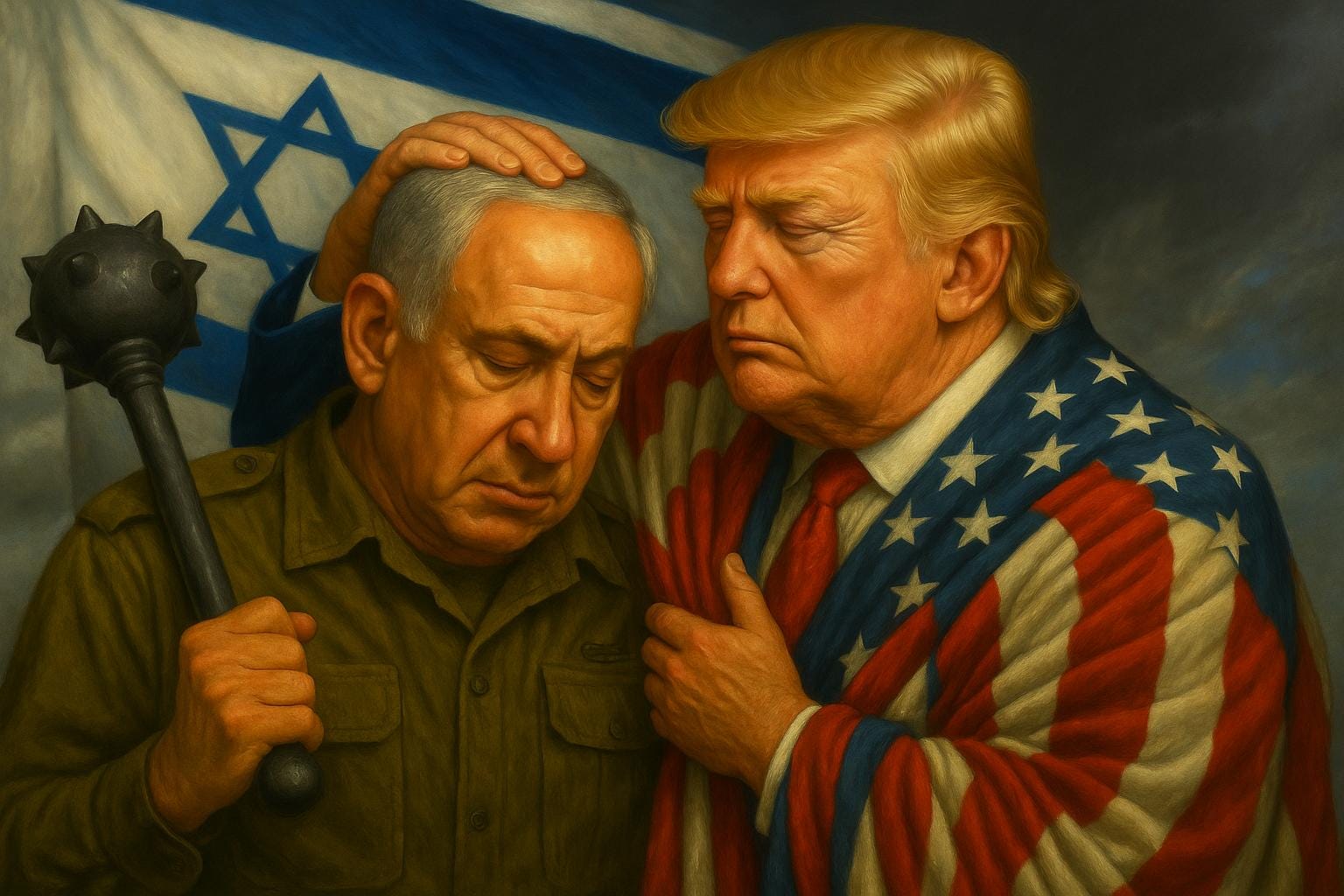
President Donald Trump this week expressed his “disgust” with NATO in an interview with Reuters. He added that he is “absolutely” considering withdrawing the United States from the alliance.
What has triggered this fury? The refusal of key European NATO allies to join the United States and Israel in their war of choice on Iran. Spain, Italy, and France have all ruled out the use of their territory—their airspace, bases, and ports—for any American or Israeli military action against the Islamic Republic. These are not hostile nations. They are treaty allies, bound to the United States by mutual defense commitments.
Secretary of State Marco Rubio, who only recently spoke of common civilizational bonds between Europe and America, was slightly more diplomatic than the president, noting that the NATO arrangement, under which the U.S. is committed to Europe’s defense while Europe refuses to reciprocate on Iran, feels “one-sided.”
The message from Washington could not be clearer: The transatlantic alliance is conditional on European willingness to subordinate their own national interests to the demands of Washington, which itself, many would argue, is acting in the interests of a foreign country—Israel.
Spain is a particularly sore flashpoint. In a move that was entirely within its sovereign rights, the Spanish government—led by Prime Minister Pedro Sánchez—prohibited the use of its airspace and bases for any military action aimed at Iran.
One might expect Washington to engage in quiet diplomacy with Madrid to resolve the disagreement. Instead, a key Trump ally, Sen. Lindsey Graham (R-SC), demanded sanctions against Spain. That’s a hollow threat: Sanctioning Spain would mean launching a trade war against the whole of the EU, since it functions as a single market, and the military bases on Spanish territory, which Graham claims to be American, are in fact Spanish, with their use by the U.S. regulated by a bilateral defense arrangement. But the fact that an influential U.S. senator would call for sanctioning a fellow NATO ally is indicative of the moment.
What should be particularly alarming from Washington’s point of view is the political cross-section of European dissent. The opposition to the American- and Israeli-led war is not confined to the traditional left. In Germany, the Alternative for Germany (AfD), a right-wing party often viewed favorably by certain factions in the MAGA movement, has come out strongly against the war.
Here we have a remarkable convergence: Pedro Sánchez, the socialist leader of Spain, and the AfD, a nationalist-conservative opposition party in Germany, standing on the same ground. Both recognize that being a partner to the United States does not obligate their nations to participate in a war their own publics reject.
Yet, from the perspective of the Trump administration, this nuance is irrelevant. The demand from Washington is absolute loyalty—not to NATO, not to the shared principles and defense of the North Atlantic—the alliance’s primary responsibility—but to a mercurial American president.
To understand where this impulse originates, one need look no further than the neoconservative activists who have found a comfortable home within the Trump coalition. Mark Dubowitz, the chief executive of the Foundation for Defense of Democracies (FDD) and a longtime Iran superhawk, recently laid out the emerging worldview in stark terms.
“Five Eyes was built for another era,” Dubowitz declared, referring to the longstanding intelligence-sharing partnership among the United States, Britain, Canada, Australia, and New Zealand. “We get diminishing value from four partners, and ties with Britain are at a low point. Time to rethink the alliance around those actually delivering intelligence value — Israel, Poland, Ukraine, UAE, Japan, ROK and other serious partners.”
In essence, Dubowitz suggests that the Five Eyes and other traditional arrangements be cast aside. In their place, Dubowitz proposes a new constellation of partners, with Israel at the head.
Dubowitz’s vision increasingly aligns with the trajectory of the Trump administration. As The American Conservative’s senior editor Andrew Day recently observed: “Trump is demeaning European allies, urging them to open the Strait of Hormuz, and condemning them for not supporting the US-Israel war of aggression that caused this catastrophe.”
Day’s assessment cuts to the heart of the matter. Trumpism, as practiced today, is not a revival of the old right’s skepticism toward foreign commitments—skepticism that Trump himself appeared to have embraced in the past. On the contrary, it represents a wholesale repudiation of the paleoconservative tradition. Where the great paleoconservatives—figures like Pat Buchanan—were deeply skeptical of both the endless wars in the Middle East and the Israeli lobby’s grip on American foreign policy that has arguably driven those wars, the current iteration of Trumpism is unequivocally pro-Israel and anti-Europe.
There remain influential conservative voices who feel alienated by this turn, as highlighted in Tucker Carlson’s recent interview with The Economist. And the Vice President J.D. Vance offered a striking reflection in April 2025 that directly contradicts the approach now being pursued by the administration he serves.
“I think a lot of European nations were right about our invasion of Iraq,” Vance said. He continued:
Frankly, if the Europeans had been a little more independent, and a little more willing to stand up, then maybe we could have saved the entire world from the strategic disaster that was the American-led invasion of Iraq. I don’t want the Europeans to just do whatever the Americans tell them to do. I don’t think it’s in their interest, and I don’t think it’s in our interests, either.
The administration’s defenders would no doubt object: Hasn’t Europe free-ridden on American security guarantees for decades? Isn’t Iran a genuine threat? And is it unreasonable to expect treaty allies to contribute when the United States acts?
But the issue is not burden-sharing; it is the nature of the burden. The Europeans are being asked to facilitate a war of choice against a nation that has not attacked a NATO member—a war a majority of their citizens oppose and that even most Americans view as reckless. When European allies declined to follow the United States into Iraq in 2003, they were not freeloaders; they were right. A Europe that says no now should be performing the same function.
The irony is that the positions taken by Spain, Italy, and France on Iran are arguably in America’s interest as well. The United States has spent the last two decades mired in disastrous Middle Eastern wars that were opposed by key European allies. When European nations refuse to guarantee airspace for another conflict, they are acting as responsible stewards of peace. Yet in the current climate, prudence is mistaken for betrayal, and independence is met with threats of sanctions and abandonment.
The paleoconservative tradition understood that America’s strength lay in restraint and respect for the sovereignty of others. The neoconservatives offer a different path: Discard Europe, treat Israel as the anchor of a new alliance system, and punish allies who refuse to subordinate their interests to Washington’s demands. The Trump administration, combining neoconservative ambition with Trumpian impatience, has embraced that path. It is time for conservatives to remember that there is a better way.
https://www.theamericanconservative.com/trump-is-trading-europe-for-netanyahus-war/