
Trump Tries Making Regime-Change Great Again in Venezuela
Early Saturday morning, American special forces troops flew into Caracas and seized President Nicolas Maduro in a daring raid that left the Venezuelan government headless, Caracas ablaze, and the Trump Administration with a major victory over its principal foe in the Western Hemisphere. The capture of Maduro is the culmination of the long struggle both Trump administrations had with the South American strongman, starting in 2017. Trump’s “maximum pressure” economic campaign failed to produce results during his first term, a lesson he apparently took to heart. During his second term, Trump began a buildup of American military assets in the Caribbean to bring hard pressure to bear on the regime, assets which were employed most effectively earlier this morning.
On a technical level, the execution of the operation was pristine. Maduro was captured, major military installations were destroyed or severely damaged, and the Venezuelan armed forces were rendered almost entirely helpless, all of which was accomplished without the loss of any American soldiers. The attack was undeniable proof of the devastating power and effectiveness of the American military (and perhaps also of the utter incompetence of the Venezuelan regime).
With the assault completed successfully and Maduro safely in American hands, Trump was quick to claim complete victory over Venezuela. In his press conference Saturday, Trump declared that the U.S. would take over the country: “We’re going to run the country until such time as we can do a safe, proper, and judicious transition.”
“We can’t take a chance that someone takes over Venezuela that doesn’t have the good of the Venezuelan people in mind,” the president continued. “We’re there now, but we’re going to stay until such time as a proper transition can take place.”
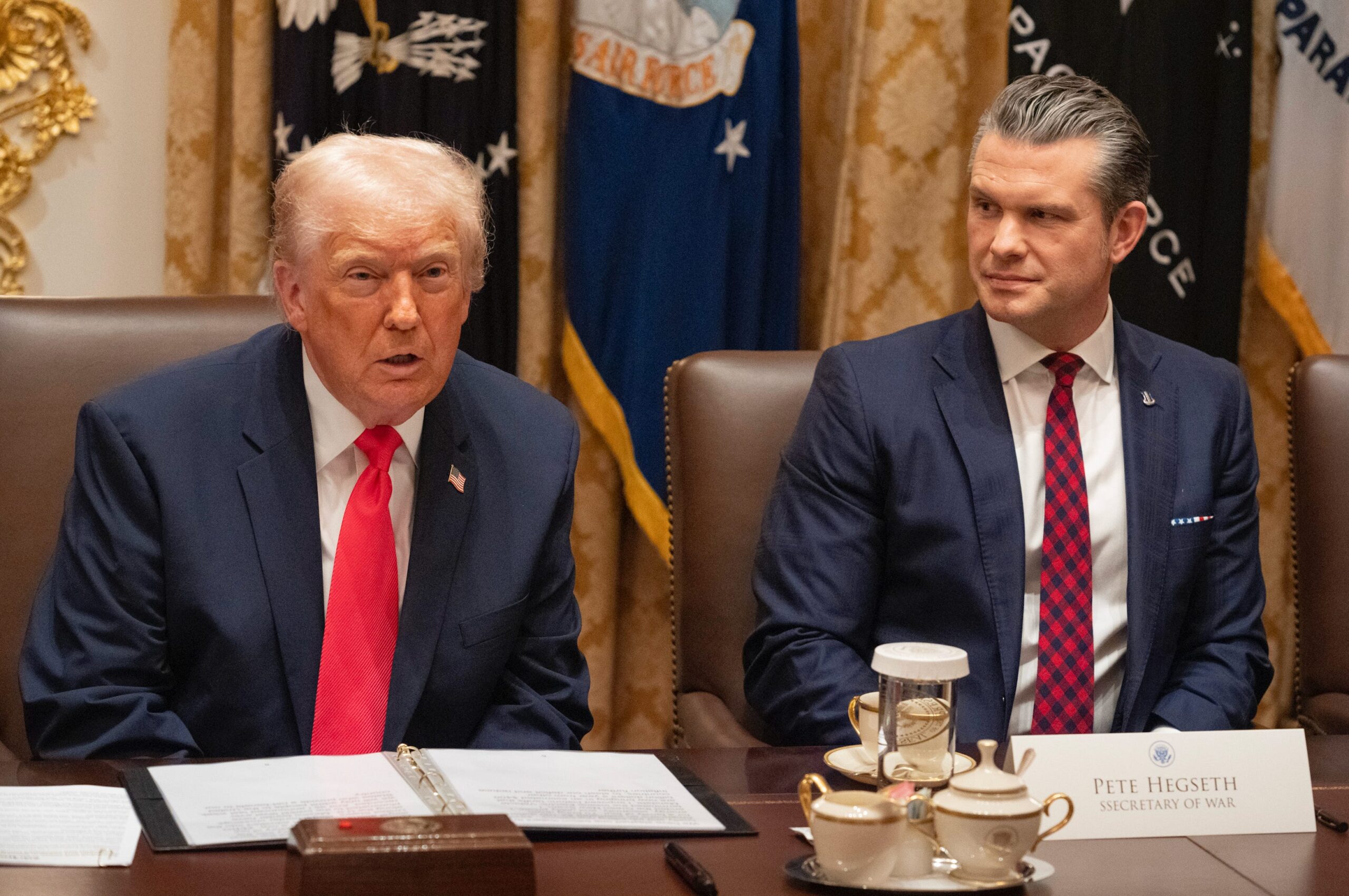
Trump made clear to reporters that American troops may occupy the country while the U.S. begins national reconstruction. “We’re not afraid of boots on the ground,” he said when a reporter asked whether Trump’s statement that the U.S. would run the country implied an American troop presence. When asked who specifically would be running the country, Trump said that the U.S. is “designating people,” but “for a period of time, the people who are standing right behind me” would be in charge of Venezuela, gesturing to Secretary of State Marco Rubio, Secretary of Defense Pete Hegseth, Homeland Security Advisor Stephen Miller, CIA Director John Ratcliffe, and chairman of the Joint Chiefs of Staff Gen. Dan Caine.
Trump spent a significant amount of time discussing Venezuela’s oil resources, claiming that the Venezuelan government stole American property when it nationalized the oil fields and emphasizing that the U.S. would repossess its assets. As part of the American occupation and reconstruction of Venezuela, the U.S. would rebuild Venezuelan oil fields, the president said. Once American-built infrastructure is in place, “we’ll be selling large amounts of oil to other countries,” Trump added.
Despite the successful capture of Maduro, the shape of Venezuela’s future remains in significant doubt. The attack did not take out the regime’s remaining leadership, which has assumed charge of the country and is attempting to at least present the image of mounting a defense. Defense Minister Vladimir Padrino Lopez declared that Venezuela would activate its armed forces and resist with the full spectrum of their military capabilities (though those are limited to nonexistent after the American operation). Diosdado Cabello, minister of the interior and Maduro’s right hand man, appeared on state TV leading security forces in the capital and calling on Venezuelans to resist American aggression.
In the press conference Saturday, Trump suggested that Vice President Delcy Rodriguez would cooperate with the U.S. in transitioning to a new regime under U.S. control, stating that “we just had a conversation with her and she’s essentially willing to do what we think is necessary to make Venezuela great again,” but in an appearance on Venezuelan state TV Saturday afternoon Rodriguez appeared far short of cooperative.
“We will never return to being a colony of any empire…. What is happening to Venezuela is barbarity,” Rodriguez said. “There is only one president of this country, and his name is Nicolas Maduro Moro.”
It’s no surprise that Maduro’s subordinates are putting up a fight. They are well aware that their cooperation with the regime makes them major targets for any new government seeking to dismantle Maduro’s old power centers and rebuild the country. Many of them are deeply entangled with drug trafficking and other forms of organized crime, an unpleasant position in the face of an imminent American occupation justified at least in part as a way of rooting out narcoterrorists in the Venezuelan government.
There’s little chance that the government could make much of a showing against the American military if push comes to shove; the Venezuelan military is laughably equipped for fighting even a peer power, let alone the United States. But it could still make things messier for the Trump administration, which has signaled its readiness to press forward with military operations should the government prove recalcitrant.
“The United States retains all military options until United States demands have been fully met and fully satisfied,” Trump declared. “All political and military figures in Venezuela should understand what happened to Maduro can happen to them.”
The Trump administration clearly would prefer a peaceful handover, even if it means cooperating with Maduro’s old cronies. That would be the smoothest path for the U.S., which could make due with a much smaller occupying force and largely leave the administration of the country to the existing government. Presumably, the U.S. would mandate and eventually oversee democratic elections, which would begin to replace the leadership of the country but maintain institutional continuity.
Such a path might be the easiest and most convenient for Americans, but it would be deeply unpopular with Venezuelans, who want the old regime gone. The Venezuelan diaspora especially would be outraged; they view opposition leader Maria Corina Machado and her stand-in for the last presidential election, Edmundo Gonzalez, as the rightful leaders of the country. Trump seemingly has little interest in installing the democratic opposition at present. “I think it’d be very tough for her to be the leader,” he told reporters Saturday. “She doesn’t have the support or the respect within the country. She’s a very nice woman but she doesn’t have the respect.”
If the regime is too recalcitrant, though, the U.S. might get neither option. There’s always a possibility that the military—now unshackled from its primary allegiance to Maduro—decides that things have gone too far. Maduro retained his officers’ loyalty with bribes, perks, and the constant threat of being purged. They had no interest in dying for him, much less do they have any interest in dying for Delcy Rodriguez. The top brass is probably too enmeshed in corruption and cartel operations to want to turn things over to the Americans, but a few enterprising junior officers may take advantage of the confusion to conclude that a pro-U.S. coup provides for better prospects than being blown apart by an attack helicopter.
But even assuming the best-case scenario for the U.S., toppling the regime was always going to be the easy part of Venezuelan regime change. The American military is superbly suited to destroying the governments of minor powers like Iraq or Venezuela. In contrast, the U.S. has no institution well-suited for occupying, administering, and reconstructing nations, and it is in putting Venezuela back together that the major risks to the Trump administration, and the American national interest, truly lie.
Venezuela is, as proponents of Venezuelan intervention have often noted, not Iraq or Libya; the U.S. does not have to worry about Islamist militias or tribal and religious divisions. But Venezuela does have a particularly thorny problem that is in many ways very similar to the most difficult threats the U.S. faced in the Middle East: powerful drug cartels, with their major power bases firmly entrenched in neighboring Colombia and significant penetration in the Venezuelan government and military.
The collapse of the regime opens a power vacuum into which cartels can expand at will, and an American occupying force even of significant size will have trouble projecting power beyond the cities and into the scrub and jungle where the narcos thrive. The Trump administration’s equating of cartel operators to terrorists has been overblown in some aspects, but the cartels do resemble the Islamic terrorists of the Middle East in their use of irregular warfare that has proven difficult for even the American military to fight effectively.
Add in the potential for cartels to swell their ranks and strength by absorbing elements of the Maduro regime who prefer their chances with the narcos to being prosecuted by the Americans for drug trafficking or being thrown in prison for human rights abuses by a Machado government, and you have all the elements of a significant guerilla conflict that could cost the U.S. no small amount of time, money, and blood.
In addition to the threats presented by the power vacuum inherent to any regime change project, the Trump administration also faces the challenge of actually rebuilding the country. The Venezuelan economy is in utter ruin and the government is entirely constituted to maintain Chavez’s Bolivarian Revolution in power in perpetuity. Practically every element of the military, judiciary, bureaucracy, and law enforcement is corrupt and complicit, and will need to be restructured and replaced.
How this proceeds depends heavily on whether the eventual American puppet government is run by Maduro turncoats or the Venezuelan opposition, but either way it is a generational project—either attempting to restructure a government still being run by the old regime or attempting to cobble together a new administration almost from scratch. Both have the potential to prove unsustainable and drag out American commitment to the country for a far longer term than the public has appetite for.
Still, while there are significant risks to the current situation in Venezuela, Trump is right to note that there are significant opportunities for Americans as well. Venezuela’s economy needs to be rebuilt, the oil industry needs to be restored, and the country needs to be governed. Americans can and will do those for a profit. And a stable, prosperous, pro-American government in Venezuela would be significantly preferable for the U.S. and a major boon for American influence in Latin America. If Trump can achieve such an outcome quickly and smoothly, it will be his greatest foreign policy achievement.
But the U.S. has not even begun the real regime-change project in Venezuela yet, and history does not seem to present promising odds for such a result. A failure of this scale could be the final word on Trumpism and its legacy in American politics.
https://www.theamericanconservative.com/trump-tries-making-regime-change-great-again-in-venezuela/