
Trump’s Manifest Vanity
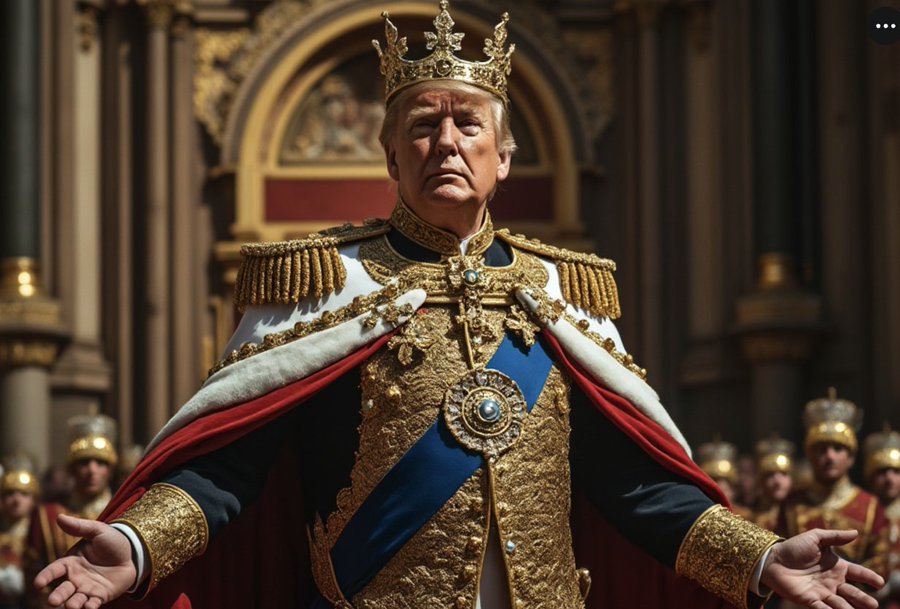
The Greenland Affair—or escapade, adventure, caper—was to be the next chapter in the mythic “territorial expansion of the United States.” Whether through invasion, subversion, or transaction, the stories of new conquests are always lit by moments of deviltry, cupidity, violence, and farce. Napoleon sold the American West only after his fiasco in Haiti. Jackson hanged British agents to take Florida. A proxy insurgency leveraged Texas into our hands. Mexico was simply invaded so we could take California and the Southwest. Queen Liliʻuokalani was rudely toppled by American sugar barons, and the U.S. was spared from war with Britain and Germany over Samoa by the great Apia cyclone of 1889.
The buy-outs were straightforward. Napoleon needed cash fast. So did a bankrupt Mexico in 1853, and in exchange we got the 3:10 to Yuma. Tsar Alexander, also deeply in debt, actually spent something like $20 million (in today’s dollars) throwing drunken parties and bribing Senators so they would vote to buy “Seward’s Folly.” Hijinks and venality (and criminality) have been the very watchwords of American “territorial expansion.”
With Greenland, however, the thrill is gone. Suddenly, it is not fun anymore—and not because it is embarrassing or immoral. All of America’s territorial expansion has been embarrassing or immoral or both. Thus, arguably, acquiring Greenland should also have been fun, or at least, sporting.
The problem is that we have an open aperture into the actual reality the United States occupies today, a reality that makes many of us cringe. President Donald Trump’s approach, as emperor, to taking Greenland reveals—for all of us to see—what is really important now. What is important now is clearly not NATO. NATO has become an irrelevant artifact in America’s (and the emperor’s) strategic calculus.
It has become urgent for the U.S. to show—highlighted in extravagant rhetoric—that it is still a dominant player in the world: dominant even over friends and allies. Hence the entire Greenland Affair becomes a metaphor for the Agonistes of American Empire, stark and plain: The empire is weak, anxious, and deeply insecure.
In pure power terms this is incontrovertible. In actual real military terms, the United States cannot fight a real war today. This is absolute ground truth, publicly attested by a shameful flight from Afghanistan, a humiliating proxy defeat of America’s godlike technology and expertise in Ukraine, and a comedy of errors clawing to punish Yemeni Houthis. A decorous, pinprick bombing raid on Iran and a “shock and awe” abduction in Venezuela cannot mask the fundamental problem. We have been reduced, quite literally, to staging theaters of war.
Hence, the emperor must do what he does best: chasing a strategic will-o-the-wisp, in which threats to use military force serve as ceremonial demonstrations of authority. In the current context of American military weakness, it is far more effective to create a ritual stage wherein we occupy and dominate an operatic tableau, staged for all the world to see how the U.S. is still the once-and-future dominator.
Much like our Roman Imperial forebearers, the U.S. must assert that it still has full imperial authority. Hence, as low-hanging strategic fruit, Greenland is irresistible. Just look at the standard Mercator world map.
Gerardus Mercator did Greenland no favors. His world map projection—the most potent, though distorted, cartographic image of all time—drew Greenland as a landmass bigger than the United States. Truly, Greenland is large: 864,000 square miles, about a quarter the size of the continental United States. Yet Mercator made it into something colossal. Moreover, Greenland was positioned smack in the center of his map, as though it was the pivot of the world—and of course this visual insinuation perversely ballooned its strategic significance in the eyes of all great power realists.
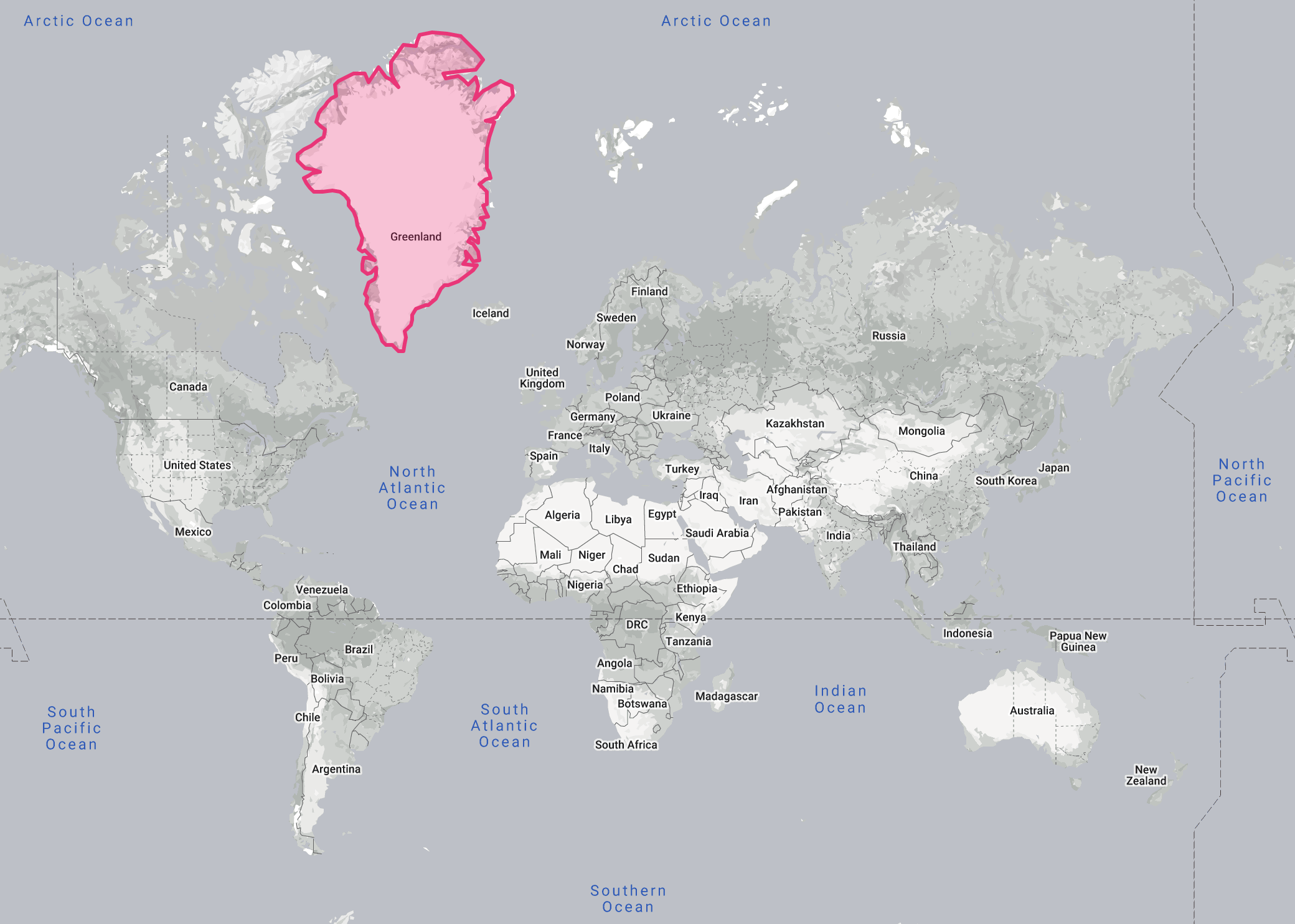
Yet the strategic gravity of Greenland is real—both because it is believed to be real, and because this conviction has been borne out by history. In fact, the U.S. strategic stake in the ice-sheet island goes back nearly a century—to the emergence of the Nazi threat. It was then that Greenland became the strategic pivot point for the U.S. in the North Atlantic. To drive the point home, green parts were even occupied by the Nazi Reich in World War II.
At that moment it became essential for the U.S. to control Greenland into the future—and this is what President Franklin Delano Roosevelt did. FDR declared in 1940 that Greenland was part of North America, as an integral and inseparable part of the Western Hemisphere. Forever.
Hence, when Denmark was overrun by the Nazi Reich in the spring of 1940, the Monroe Doctrine came into immediate effect and of course, American soldiers secured Greenland.
So, the deed has already been done and the deed is this: Greenland is part of the Western Hemisphere. Whatever moral high ground the Monroe Doctrine lacks, it is rich in historical standing. Moreover, the legitimacy of its assertion has been accepted by the great powers, officially by France in 1866 (over Mexico), by Britain in 1895 (over Venezuela), and by the Soviet Union in 1962 (over Cuba).
We occupied Greenland, essentially extending an internationally-recognized right of eminent domain—in terms of security and defense—in the Western Hemisphere. Denmark’s titular sovereignty was never in doubt, yet by incorporating Greenland into the Hemisphere, the United States effectively made it part of the American military security sphere. Hence, we have had bases there—including a secret nuclear base—since the 1940s.
Yet the fact is that the strategic calculus is shifting. In the 1950s, when we built our big polar base in Thule, high up in northernmost Greenland, the driving anxiety was a Soviet bomber and missile attack on the U.S. We wanted early warning radars.
The strategic anxiety is different today. As the Arctic continues to melt, the issue of access is more moot. The new order in the Arctic is largely about the melting of its once-eternal ice pack. Whether merited or not, the Arctic Sea, as the new focal point of Great Power competition, is the new, and dominant, strategic fashion.
So why is grabbing Greenland no longer fun? Looking back at all of America’s territorial capers past—as embarrassing and immoral though they were in the act—they were all consummated in confidence. This new acquisition so far has proffered a botched roll-out. The simple argument—Hemispheric eminent domain—and the very fact of historical provenance, precedent, standing, and legitimacy, was never given an articulate hearing. Instead, the world has been treated to an extended display of imperial narcissism: the emperor simply wants to slake his vanity and immortalize his place in history.
https://www.theamericanconservative.com/trumps-manifest-vanity/