
Villains of Judea: Les Wexner
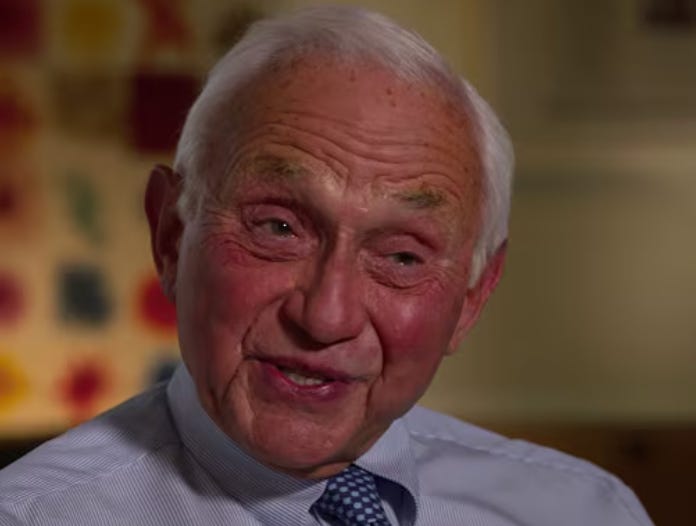
Inside the world of the Zionist mega-donor, GOP kingmaker, and Jeffrey Epstein enabler who lives above the law.
For 20 years, whenever anyone in Les Wexner’s orbit had a question about his money, his foundation, or his future, the answer was always the same three words. Please ask Jeffrey.
Leslie Herbert Wexner was born on September 8, 1937, in Dayton, Ohio, to Harry Louis Wexner and Bella Cabakoff, both of Russian-Jewish origin. His father was born in Russia, and his mother was born in Williamsburg, Brooklyn, making her the first American-born member of her immigrant family. The family eventually settled in Columbus, Ohio, where his parents opened a small clothing store they named Leslie’s after their son. Wexner attended Bexley High School and Ohio State University, where he joined the historically Jewish fraternity Sigma Alpha Mu.
In 1953, he won a minor award for an essay published in the Ohio Jewish Chronicle titled “Why I Love and Respect Judaism.” He graduated in 1959 with a degree in business administration from Ohio State University, served in the Air National Guard, and briefly enrolled in Moritz College of Law before dropping out.
Wexner’s business career began inside his parents’ store. He had a sharp eye for margins, and he noticed something his father missed: small, fast-moving items like sportswear generated far more profit per square foot than expensive, slow-turning items like winter coats. When Harry Wexner refused to change strategy, his son left. In 1963, armed with a $5,000 loan from his aunt matched by a bank loan, he opened The Limited in Upper Arlington, Ohio, specializing in moderately priced women’s sportswear.
The Limited went public in 1969, and Wexner used that capital as a launching pad for a relentless acquisition campaign. He picked up Mast Industries in 1978, Lane Bryant in 1982, and most consequentially, Victoria’s Secret from founder Roy Raymond for approximately $1 million. By 1992, Victoria’s Secret alone was estimated to be worth roughly $1 billion. Over the decades that followed, Wexner assembled L Brands, a retail conglomerate that at its peak encompassed Victoria’s Secret, Bath and Body Works, Abercrombie and Fitch, Express, Henri Bendel, La Senza, and others.
Fortune described him in 2015 as the longest-serving CEO of any Fortune 500 company. As of the 2025 Forbes 400 list, Wexner and his family hold a net worth of approximately $9.3 billion, making him the richest person in Ohio.
Wexner has said that he “never got a good Jewish education” growing up, which left him feeling unprepared for leadership roles in his Orthodox Jewish community. That sense of inadequacy became the seed of a philanthropic machine. In 1983, he established The Wexner Foundation, now one of the most prominent private Jewish philanthropic organizations in the world, headquartered in New Albany with offices in New York and Jerusalem.
In 1985, he partnered with Rabbi Herbert A. Friedman, the former executive chairman of the United Jewish Appeal, to launch the Wexner Heritage Program, designed to educate Jewish communal leaders “in the history, thought, traditions, and contemporary challenges of the Jewish people.” The foundation subsequently launched the Wexner Graduate Fellowship in 1988 for emerging professional Jewish leaders, and the Wexner Israel Fellowship in 1989, which sent mid-career Israeli public officials to Harvard’s Kennedy School for a fully funded Master in Public Administration, along with a range of other leadership programs in the years that followed.
Over 280 Israeli officials have participated in that fellowship alone. Between 2003 and 2018, the Wexners ranked as the third largest donors to Israeli and Jewish charitable causes in the United States, contributing an estimated $128.4 million during that period, according to Inside Philanthropy. The foundation has described itself as acting from “pure Zionistic motivations” since its inception.
In 1991, Wexner co-founded the Mega Group, officially called the “Study Group,” with Canadian billionaire Charles Bronfman. This was an informal club of up to 50 of America’s wealthiest and most influential Jewish businessmen, including Steven Spielberg, Max Fischer, Michael Steinhardt, Leonard Abramson, Edgar Bronfman, and Laurence Tisch. The group met twice yearly for seminars on philanthropy and Judaism and inspired several major philanthropic initiatives, including the Partnership for Excellence in Jewish Education, Birthright Israel, and the upgrading and expansion of Hillel International on college campuses.
The Mega Group has been described as a pro-Israel lobby group that sought to influence U.S. foreign policy in the Middle East. In 2003, it employed Republican political consultant Frank Luntz to help mobilize American support for Israel. Some analysts, including former NSA counterintelligence officer John Schindler, have argued that Israeli intelligence officials regarded the Mega Group as an instrument for covert influence operations inside the United States.
The Wexner Foundation’s reach extended directly into Israeli political circles. Wexner donated more than $42 million to Harvard’s Kennedy School, funding the Center for Public Leadership and the fellowship that brought Israeli government officials to Cambridge. The foundation was a major funder of Hillel International, whose motto is “Wherever we stand, we stand with Israel,” and financially supported Birthright Israel. In 2023, Wexner donated $100,000 to AIPAC, the most powerful pro-Israel lobbying organization in the United States. The foundation paid former Israeli Prime Minister Ehud Barak approximately $2.3 million between 2004 and 2006 for two commissioned research reports — one on the Israeli-Palestinian conflict, one on leadership — only one of which was completed; newly released DOJ emails show Epstein personally approved the transfer. In 1996, Wexner invited former Israeli Prime Minister Shimon Peres to his 59th birthday party in Ohio, which Epstein also helped organize.
In October 2023, following Hamas’s attack on Israel, the Wexner Foundation severed its 34-year relationship with Harvard University, accusing the administration of “tiptoeing” and “equivocating” instead of condemning the attacks. The foundation was particularly outraged that 34 student groups had issued a statement holding “the Israeli regime entirely responsible for all unfolding violence.” The decision came amid a wider wave of donor withdrawals from elite universities over perceived anti-Israel sentiment on campus.
For decades, Wexner was a fixture of Republican politics, once described as the wealthiest Republican donor in Ohio. He and his wife Abigail donated over $5.3 million to state and federal campaigns combined. In 2012, he hosted a fundraiser for Mitt Romney and donated $250,000 to Romney’s super PAC, Restore Our Future. In 2015, he donated $500,000 to Right to Rise USA, the super PAC backing Jeb Bush’s 2016 presidential run. In 2018, Wexner publicly renounced his Republican Party affiliation, declaring “I won’t support this nonsense in the Republican Party” and saying Trump’s equivocation after Charlottesville had made him feel “dirty” and “ashamed,” though he continued giving to Ohio Republicans even after that declaration while his wife donated $750,000 to the Democratic Grassroots Victory Fund in 2020. In 2008, President George W. Bush appointed Wexner to the Honorary Delegation accompanying him to Jerusalem for Israel’s 60th anniversary celebration.
Following the 2026 Epstein revelations, numerous Ohio politicians scrambled to return or donate Wexner’s campaign contributions to charity, including Congresswoman Joyce Beatty, Congressman Mike Carey, and Columbus Mayor Andrew Ginther. No single controversy has defined or damaged Les Wexner more than his decades-long relationship with Jeffrey Epstein. Wexner hired Epstein as his financial manager in 1987. Epstein became his sole and most trusted adviser, and for years Wexner was Epstein’s only known financial client. In 1991, Wexner granted Epstein full power of attorney over his entire estate.
In 1989, Wexner purchased the Herbert N. Straus House in Manhattan, a seven-story townhouse on the Upper East Side. Epstein moved in around 1995; bank documents reviewed by NBC4 and a 1998 purchase and sale agreement reviewed by Al Jazeera show Wexner sold it to him in 1998 for $20 million, which Wexner testified under oath was the appraised value. That mansion became one of the primary locations of Epstein’s reported crimes. Epstein served as a trustee of the Wexner Foundation from 1992 to 2007 and held the title of president of the Wexner family financial office; a 2020 independent review commissioned by the foundation found he “played no meaningful role” in its operations, though a separate CNBC investigation found that $21 million in Wexner family trust assets had been transferred to Epstein’s COUQ Foundation without the Wexners’ knowledge or authorization. Leaked emails revealed that Wexner’s family office staff routinely sought Epstein’s approval for multi-million dollar transactions, tax decisions, and charitable grants, with the recurring refrain: “Please ask Jeffrey.”
L Brands executives warned Wexner in 1993 that Epstein was posing as a Victoria’s Secret model recruiter to lure young women. Wexner reportedly said he “would put a stop to it,” but Epstein continued the practice for years afterward. Wexner formally cut ties with Epstein around 2007, approximately 18 months after Florida authorities charged Epstein with sex crimes, and later accused Epstein of “misappropriating vast sums” from his family.
In February 2026, following the passage of the Epstein Files Transparency Act, Congressman Ro Khanna publicly read the names of previously redacted individuals from FBI documents. A 2019 FBI internal document listed Wexner as one of nine suspected co-conspirators of Epstein, alongside Ghislaine Maxwell and others.
That same month, Wexner was subpoenaed by the House Oversight Committee and gave a nearly five-hour deposition at his Ohio home. He testified under oath that he was “naive, foolish, and gullible” to trust Epstein, that he never witnessed Epstein engage in sexual contact with anyone, that he visited Epstein’s island only briefly with his family and found it “a pretty crummy island,” and that Epstein was “a world Olympic all-time con artist,” adding: “Bernie Madoff is a Boy Scout compared to Jeffrey.” He denied all allegations of personal wrongdoing.
Virginia Giuffre, one of Epstein’s most prominent accusers, testified under oath in a 2016 deposition that she had sex with Wexner “multiple” times, alleging she was trafficked to him by Epstein. Wexner categorically denied these allegations in his 2026 congressional testimony, stating he had “never once been unfaithful” to his wife “in any way, shape, or form.” No criminal charges have resulted from these allegations. In 1996, artist Maria Farmer filed one of the earliest known complaints against Epstein, alleging she was sexually assaulted by Epstein and Ghislaine Maxwell while working as an artist-in-residence on Wexner’s Ohio estate. Farmer’s complaint did not result in prosecution at the time.
In the 1990s, Wexner and Epstein were involved in relocating Southern Air Transport, a former CIA front airline with documented ties to the Iran-Contra affair and allegations of cocaine trafficking, from Miami to Columbus, Ohio. SAT was used to transport goods for Wexner’s Limited Brands retail chain. In 1996, customs agents discovered cocaine hidden aboard a SAT plane in Columbus. The airline abruptly declared bankruptcy on October 1, 1998, exactly one week before the CIA Inspector General released official findings linking the airline to Contra cocaine trafficking allegations. Investigative journalist Bob Fitrakis identified Epstein as playing a crucial role in the relocation, and multiple Ohio state investigators who looked into the matter were reportedly removed from their positions.
The airline’s collapse was not the first time Wexner’s business orbit had intersected with a sudden, suspicious death. In 1985, attorney Arthur Shapiro, a partner at the Columbus law firm Schwartz, Shapiro, Kelm & Warren who personally managed The Limited’s account, was assassinated the day before he was to testify before a grand jury about his own illegal tax conduct — including seven years of unfiled returns and investments in fraudulent tax shelters. The killing was described as resembling a “Mafia hit.”
A police investigation examined possible connections between Shapiro, organized crime, and Wexner’s businesses. A police memo, later called the “Shapiro Murder File,” linked some of Wexner’s companies and associates — including the principal trucking carrier for The Limited — to entities allegedly tied to organized crime, though authorities called these connections “highly speculative.” The main suspect was Shapiro’s own business associate, Barry Kessler, who had a documented history of contracting murders of business partners and was later convicted in 1994 of hiring a hitman to kill a Florida associate. The murder was never officially solved.
Les Wexner has never been criminally charged with any offense. He has consistently maintained that he was a victim of Epstein’s deception, that he had no knowledge of Epstein’s crimes, and that he has not been involved in any wrongdoing. The House Oversight Committee’s investigation into his role remained ongoing as of February 2026.
In the shadow of these revelations, Leslie Wexner emerges as yet another archetype of the shadowy Jewish oligarch, wielding immense financial and political leverage while ensnared in webs of scandal that strain the boundaries of coincidence. Though no criminal indictment has yet ensnared him, the persistent drip of journalistic scrutiny and forthcoming releases from the Epstein archives promise to illuminate the full extent of his complicity, transforming speculation into irrefutable evidence. In this unfolding tableau, Wexner’s case will crystallize as a pivotal artifact in the evidentiary mosaic demonstrating that the United States is a polity steered by organized Jewry for its sole benefit.