
Villains of Judea: Sidney Gottlieb
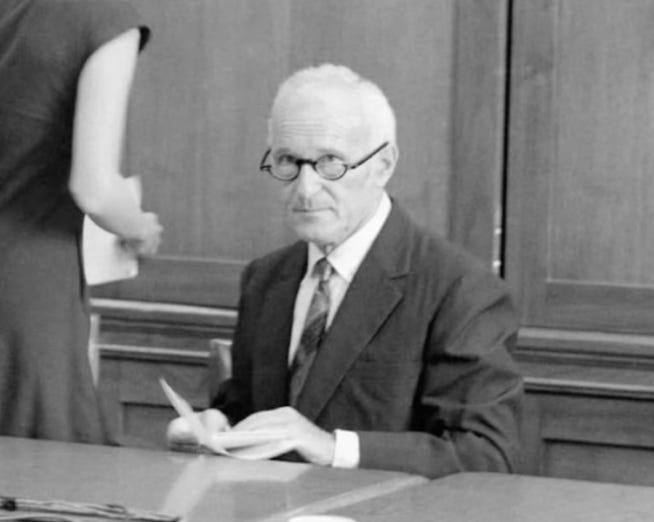
Inside the mind of the CIA’s most prolific torturer.
Within the clandestine world of American intelligence throughout the Cold War, no figure embodied the moral contradictions of the era more completely than Sidney Gottlieb. Known within the CIA as the “Black Sorcerer” and later dubbed the “Poisoner in Chief” by journalist Stephen Kinzer — whose 2019 book of that title is the definitive account of his career — Sidney Gottlieb was a biochemist who spent two decades running the agency’s most disturbing programs while searching for ways to control the human mind.
He was a man of paradoxes. He stuttered his entire life. He practiced folk dancing and raised goats on a Virginia farm. He later volunteered at a leprosy hospital in India. Yet as Kinzer documented in his NPR interview, Gottlieb’s experiments on “expendable” human subjects destroyed countless lives — conducted with virtually no oversight and what amounted to a license to kill.
Early Life and Background
Gottlieb was born in the Bronx on August 3, 1918, to Orthodox Jewish immigrant parents from Hungary — his actual birth name was Sidney Gottlieb, not the pseudonym “Joseph Scheider” he later used when testifying before the Church Committee. He stuttered severely from childhood and was born with a club foot, both of which shaped his driven, intensely self-reliant personality. Despite these challenges, he excelled academically, earning a doctorate in biochemistry from the California Institute of Technology in 1943.
In his university years at Wisconsin, he joined the Young People’s Socialist League, reflecting early left-wing political sympathies. He was rejected from military service in World War II due to his club foot and instead sought ways to serve the government through scientific work.
Career at the CIA
Gottlieb joined the CIA on July 13, 1951, hired by then-Deputy Director for Operations Allen Dulles on the recommendation of Ira Baldwin, who had founded and run the biowarfare program at Fort Detrick. He quickly rose to head the Chemical Division of the Technical Services Staff, becoming the agency’s top drug expert and clandestine scientist.
According to the National Security Archive, the Technical Services Staff under Gottlieb’s leadership built worldwide technical capabilities critical to virtually all significant U.S. clandestine operations over two decades. He was also the CIA’s chief supplier of spy gadgets and tools, running a vast technical division.
MKUltra The Mind Control Program
Gottlieb is most notoriously associated with Project MKUltra, formally approved on April 13, 1953, co-authored in memorandum with Richard Helms and greenlighted by Allen Dulles. The program sought to develop mind control techniques through drugs, hypnosis, electroshock, sensory deprivation, and torture, motivated by Cold War fears that the Soviets and Chinese had already mastered brainwashing.
As MKUltra’s director, Gottlieb was reportedly granted six percent of the CIA’s entire operating budget with no oversight or accounting. The initial MKULTRA budget authorization “exempted the program from the normal CIA financial controls” and allowed research projects to begin “without the signing of the usual contracts or other written agreements.” Confirmed by Senate records, the program encompassed 149 subprojects across more than 80 institutions — including 44 colleges and universities, 15 research foundations and pharmaceutical companies, 12 hospitals or clinics, and 3 penal institutions. Gottlieb developed clandestine relationships with these entities using CIA front organizations to obscure the agency’s involvement.
Per the National Security Archive, methods included covert LSD administration to unwitting subjects — CIA employees, military personnel, prisoners, hospital patients, and members of the public — in what Gottlieb called experiments on “expendables.”
Gottlieb established Operation Midnight Climax, setting up CIA-funded safehouses in New York and San Francisco where, as Kinzer recounts, prostitutes lured men who were then secretly dosed with LSD while federal agents filmed their reactions from behind one-way mirrors. He directed brutal experiments at secret detention centers in Japan, Germany, and the Philippines.
When Gottlieb testified before the Church Committee in October 1975 — appearing under the pseudonym “Joseph Scheider” — he acknowledged that the CIA had conducted experiments on subjects who were dosed without their knowledge, and conceded the program had produced “as many failures as successes.”
Gottlieb inadvertently helped popularize LSD in America. As Kinzer told NPR, among those who first encountered the drug through CIA-sponsored experiments were author Ken Kesey — who took LSD at the Menlo Park Veterans’ Hospital and later wrote One Flew Over the Cuckoo’s Nest — and poet Allen Ginsberg, who participated in experiments at Stanford. Kinzer called Gottlieb the “unwitting godfather of the entire LSD counterculture.”
Assassination Plots
Beyond mind control, Gottlieb served as the CIA’s chief “poisoner,” designing lethal and debilitating weapons for use against foreign leaders. As the National Security Archive’s publication of Gottlieb’s newly declassified Church Committee testimony confirms, investigators questioned him extensively about a CIA Inspector General report covering plots against Fidel Castro. These schemes ranged from spraying Castro’s broadcast booth with airborne LSD to contaminating his footwear with thallium salts intended to cause beard loss, along with a toxic cigar, a fungus-infected diving suit, an explosive seashell rigged to blow up during his underwater activities, and a lethal writing instrument. Kinzer’s account in his NPR interview describes these as part of a years-long stream of plots that Gottlieb orchestrated or supplied.
For Congolese Prime Minister Patrice Lumumba, Gottlieb personally transported toxic biological materials to the CIA station in the Congo in 1960, intending them to be placed on Lumumba’s toothbrush. CIA station chief Larry Devlin reportedly declined the assignment. Lumumba was later overthrown and killed in a military coup.
When the Church Committee asked Gottlieb whether he had discussed “various technical means of killing a foreign leader,” Gottlieb replied simply, “Yes.”
The Frank Olson Affair
One of the most chilling episodes linked to Gottlieb was the death of Frank Olson, an Army bacteriologist and biological warfare specialist. At a CIA retreat at Deep Creek Lake in rural Maryland on November 19, 1953, Gottlieb secretly dosed Olson’s after-dinner Cointreau with LSD without his knowledge. Nine days later, Olson plunged to his death from a window of the Hotel Statler in New York City.
The government initially ruled it a suicide and later termed it a “misadventure.” Olson’s family has long maintained he was murdered to prevent him from exposing CIA secrets. President Gerald Ford personally apologized to the family, and the family accepted a $750,000 settlement. Dick Cheney, then serving as Ford’s deputy chief of staff, wrote a memo to Donald Rumsfeld warning that any lawsuit “might be necessary to disclose high-level classified national security information.” The story was later dramatized in Errol Morris’s Netflix documentary series Wormwood.
Destruction of Records
As Gottlieb prepared to retire in 1973, he and CIA Director Richard Helms oversaw the destruction of the bulk of the MKUltra files. In his congressional testimony, Helms justified the destruction by saying there “had been relationships with outsiders in government agencies and other organizations and that they would be sensitive in this kind of a thing,” adding that he wanted to ensure that “anybody who assisted us in the past would not be subject to follow up, or questions, embarrassment, if you will.”
As the National Security Archive documents, the shredding meant that much of what Gottlieb actually did remains permanently unknown. Some files survived only because they had been misfiled in a financial records building and were discovered following a FOIA request in 1977, becoming the foundation of the subsequent congressional investigations.
The Church Committee and Congressional Reckoning
MKUltra was first publicly exposed when Seymour Hersh published a front-page investigation in The New York Times on December 22, 1974, triggering the Senate investigations that brought the program fully into the open through the Church Committee in 1975. Gottlieb testified under his CIA alias “Joseph Scheider” offering terse and carefully limited answers to senators’ questions.
He admitted to participating in interrogations where drugs were administered, acknowledged planning assassination methods with CIA operations chief Richard Bissell, and described LSD’s effects in vague terms. As the National Security Archive detailed, Gottlieb’s memory was “suspiciously fuzzy for a man who had only been retired from the CIA for a couple of years.” His attorney had negotiated immunity in exchange for his testimony. Gottlieb was never criminally charged for any of his activities.
Have His Methods Continued to Be Used by the CIA?
There is substantial evidence that Gottlieb’s techniques evolved into documented interrogation frameworks used by the CIA for decades after MKUltra was formally shut down. MKUltra techniques were codified into the KUBARK Counterintelligence Interrogation Manual in 1963, a 128-page CIA document whose coercive interrogation chapters cover “deprivation of sensory stimuli, threats and fear, pain, hypnosis and narcosis,” drawing directly on research conducted under MKUltra. The CIA’s Human Resource Exploitation Training Manual of 1983 was an updated version of KUBARK, used to train military forces in Latin American countries, including Honduras, where it was linked to the Battalion 3-16 death squad that kidnapped, tortured, and murdered prisoners.
After September 11, 2001, the CIA hired psychologist contractors James Mitchell and Bruce Jessen, paid $81 million, to develop an interrogation regime euphemistically called “enhanced interrogation techniques.” These included waterboarding, sleep deprivation, confinement in coffin-like boxes, shackling, and exposure to extreme temperatures — techniques with direct lineage to MKUltra research. As Kinzer wrote, cited in the National Security Archive, the CIA’s behavior control research programs “contributed decisively to the development of techniques that Americans and their allies used at detention centers in Vietnam, Latin America, Afghanistan, Iraq, Guantanamo Bay, and secret prisons around the world.”
The Declassified JFK Files
Newly unredacted documents from the JFK assassination files, released by the Trump administration in March 2025, reveal Church Committee testimony from James Angleton, the CIA’s chief of counterintelligence, in which Gottlieb’s name surfaced in the context of allegations about nuclear knowledge transfers to Israel. The testimony, given in a top-secret executive session on June 19, 1975, had previously been heavily redacted.
According to the newly unredacted transcript, as annotated by Auribus Arrectis and reported by The American Conservative, journalist Tad Szulc had made cryptic references to “Sidney X” during a private meeting with Angleton. When Angleton explained to the committee who “Sidney X” was, he identified Gottlieb in two ways: first by name and role — “Now, that man’s name is Sidney Gottlieb. And he was the head of our technical services department, which means that there is a cross plant in our business. And the man who was bugging and performing all the hundreds of technical services, has access, unfortunately, to many of our operations” — and then by relaying what Szulc had said: “And Sidney X. And Sidney X is Sidney Gottlieb, who was one of our technical employees who retired, and is now in Australia… And he was bicycling in India.”
Both Szulc and Hersh had independently received intelligence suggesting Angleton had been “instrumental in acquiring plutonium for the Israelis.” Angleton relayed this to the committee in his own words, describing how the two journalists had compared notes and “discovered that each had had separate sources that I had been instrumental in acquiring plutonium for the Israelis, and as a follow-up, to help the Israelis on their know-how by sending Dr. Mann to Israel clandestinely.”
His formal denials to the committee were categorical on their face. When committee counsel Frederick Schwarz asked directly whether the CIA had “directly or indirectly transferred any atomic technology or know-how to Israel,” Angleton answered: “From my knowledge, the answer is an absolute no.” When Sen. Howard Baker (R-TN) pressed him further — asking whether “every material aspect of that statement was wrong” — Angleton again said “Yes.”
Those denials, however, exist alongside significant contradictory evidence in the same record. Szulc’s own sworn testimony to the committee, given just days earlier on June 10, directly contradicts Angleton — Szulc stated that when he had approached Angleton privately, Angleton had essentially confirmed the substance of the story, correcting only the timeframe and denying solely the plutonium component.
And as The Grayzone reported, a 1975 Angleton memo to the FBI separately disclosed that he had “avoided any direct answers” during his Senate testimony on Israel’s nuclear intelligence collection. When Schwarz pressed him about whether CIA counterintelligence had “certain knowledge” of Israeli agents attempting to acquire nuclear secrets in the United States, Angleton’s response was: “Do I have to respond to that?” — before the committee went off the record.
Later Life and Legacy
After retiring from the CIA in 1973, Gottlieb underwent a remarkable personal transformation. He and his wife spent 18 months running a leper hospital in India, then settled on a farm in rural Virginia where he raised goats. A stutterer since childhood, he earned a master’s degree in speech therapy from San Jose State University and spent 11 years working as a speech-language pathologist in middle schools and high schools in California. He spent his final years in Washington, Virginia, doing hospice work tending to the dying.
He died on March 7, 1999, at his home in Washington, Virginia, never having been convicted of any crime. His wife declined to disclose the cause of death. Lawsuits from MKUltra victims and their families continued to haunt him until the end.
Sidney Gottlieb was a quintessential product of the post-war era, leveraging the vast, unaccountable powers of the CIA to brutalize the innocent while remaining shielded by the very systems he helped build. Despite his facade of humble repentance, Gottlieb’s career exemplifies how his kinfolk seized the levers of American power to secure a world tailored to the interests of organized Jewry.
In practice, Gottlieb served as the architect of a sadistic apparatus, ensuring the CIA remained the lethal vanguard for the preservation of the Judeo-American empire.
https://www.josealnino.org/p/villains-of-judea-sidney-gottlieb