
Washington’s Latest Big Lie: Iran’s 47-Years War on America
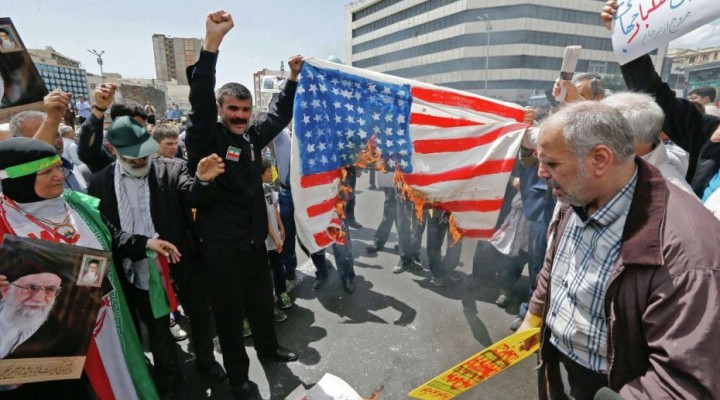
At the center of the White House justification for launching still another Forever War stands the most hideous neocon lie yet. And it’s one that blatantly betrays every campaign promise the Donald ever made on the subject.
The latest Big Lie, of course, is that rather than starting another Forever War, the Donald is endingonce and for all Iran’s purported 47-Year War on America. And while the latter may sound vaguely plausible to regular consumers of MSM spin, the actual facts that materialized from 1953 to 2026 suggest that this “47-Years War”narrative is something quite different: Namely, a mindless and fraudulent concoction from the White House coms department that has apparently been focus group-tested exclusively on elementary school children or MAGA Kool-aid drinkers, as the case may be.
In fact, from the CIA engineered coup d etat against Iran’s democratically elected Prime Minister in 1953, to Washington’s aid to Saddam Hussein during Iraq’s 1980s invasion of Iran, to the crushing economic sanctions which have been battering Iran’s economy for years since the 1990s, to the Donald’s bombing raid on Iran’s nonexistent nuclear weapons program last June, there’s been a war alright.
But it is one that has originated far more in Washington than in Tehran—a truth that becomes starkly evident when you grasp just one cardinal fact: Namely, that Iran has never, ever mattered to America’s “Homeland Security”.
Not during the Cold War, when Washington imposed the Shah’s tyrannical and larcenous regime on the Iranian people in order to block the alleged advances of the Soviet Union; and also not since 1979, either, when Iranians fell prey to the benighted rule of the mullahs that the geniuses on the Potomac helped bring to power after the Shah was literally driven from the Peacock Throne by a mass uprising of the Iranian people.
Needless to say, it is predictably certain that Washington military interventions unrelated to true homeland security are perforce based on lies, pretexts, false flags and fabricated narratives. Without these ritualized justifications, even run-of-the-mill democratic politicians are not easily conscripted into the ranks of war-mongers.
As it happened, however, the successive war banners of anti-communism back then and anti-terrorism now falsely provided the cover story for Empire. But in both cases their attachment to mainly illusory Iranian threats rested on thin gruel, at best.
Thus, during the Cold War it didn’t matter which camp Iran was in. That’s because America had an invincible nuclear deterrent, as Khrushchev conceded during the 1962 Cuban Missile Crisis; and it was one which required neither bases abroad nor alliances across the length and breadth of the planet, and most certainly not in the Persian Gulf.
Likewise, regardless of whether Iran aligned with the free world or the Soviet bloc, it didn’t make any difference to the liberty and safety of the American people domiciled at home from sea-to-shinning-sea. There simply wasn’t the chance of a snowball in the hot place that the Red Army and Navy had either the intention or capability to launch a conventional military invasion of the US homeland during the Cold War—safely nestled as it was inside the the Great Atlantic and Pacific Moats.
Accordingly, all of the endless US political and military manuevering aboard and especially in the middle east from 1953 through 1979—via Syria, Egypt, Iraq, Lebanon, Iran etc—amounted to little more than pointless exercises in Washington chest-beating that added not an iota to America’s Homeland security. Indeed, for a fleeting moment in 1956 President Eisenhower even got it right when he told Israel—-backed by France and England—–to stay the hell in its own lane during the so-called Suez crisis. And Ike’s writ, in fact, should have been the end of the manuevering in the region.
But it wasn’t. The incipient Warfare State on the banks of the Potomac was always on the prowl for meddling, engagement and military intervention if need be. In part, that’s because the military-industrial complex needed an excuse for extensive weapons procurements as well as periodic live fire testing grounds (i.e. Forever Wars), while the apparatchiks of the Warfare State needed foes, crises, strategies, negotiations, threats and allies to stay busy, engaged, self-important and funded.
With respect to the middle east these imperatives became especially cogent after the so-called Arab embargo in October 1973. Even then, however, there was no need for middle eastern allies or the Fifth Fleet or today’s extensive array of bases in the Persian Gulf and surrounding regions. That’s because assuring adequate oil supplies and sustainable, economically-based petroleum prices was, is and always has been the job of Mr. Market, not missiles, bombs, tanks and torpedoes.
Unfortunately, however, the false Kissingerian idea of the 1970s that America’s economy and oil supply depended upon the Fifth Fleet patrolling the Persian Gulf and its access routes caused Washington to stay engaged in the internecine rivalries and historic conflicts of the region even during the fading years of the Soviet Empire from 1979 to 1991.
In fact, however, the whole Kissingerian apparatus of Empire in the Persian Gulf was unnecessary because any and all countries which hosted oil production or processing facilities, whether big, little or middle-sized, have been willing—and mostly even eager—to sell oil on the world market. The reason was not statesmanship or affinity for America, but simply that these regimes— good, bad and indifferent—everywhere and always have needed the oil revenue to support their operations, domestic welfare and military capacities.
In this context, the first untoward event of the so-called 45 Years War set the tone. The students who seized the US embassy were no threat to America whatsoever, and they ransacked the embassy in November 1979 for a self-evident reason. To wit, the Shah had fled in February and there had arisen a broad coalition government of anti-Shah dissidents from a wide spectrum of factions inside newly liberated Iran.
As it happened, the new government was installed in February 1979 and was known as the Provisional Revolutionary Government. The latter was formally established after Ayatollah Ruhollah Khomeini returned from exile on February 1 and appointed Mehdi Bazargan as prime minister on February 5, 1979.
The provisional government was intended as a transitional body to oversee the shift from monarchy to an Islamic Republic, with responsibilities including drafting a new constitution and holding elections. Bazargan, a veteran opposition figure from the religious-nationalist Freedom Movement of Iran, led a cabinet that emphasized Islamic principles while aiming for stability and reforms.
Initially, the new government was broad-based rather than fully dominated by Khomeini and Islamic hardliners. Bazargan’s cabinet included a mix of moderates, nationalists, secular intellectuals, and moderate Islamists, reflecting the diverse coalition that had driven the Revolution—including leftists, liberals, and bazaar merchants—to reassure the middle class and international observers.
But in short order what amounted in Iran to a “February Revolution” counterpart to the fall of the Czar in February 1917 and the subsequent rise of a broadly based Kerensky-led social democrat government in Russia, succumbed to the latter’s equivalent next phase. That is, an Islamic-flavored Bolshevik takeover in November 1979—aided and abetted by the foolish Empire Builders on the Potomac.
To wit, Washington should have been smart enough to recognize its 26-year long tool of Empire—the Shah—had brought untold misery and harm to the Iranian people and therefore returned him to Tehran to face the justice he deserved. But instead, Deep Stater David Rockefeller persuaded the well meaning but inept Jimmy Carter to allow the Shah to take refuge in the United States, allegedly for cancer treatment.
Alas, that was the spark the turned the peaceful Iranian Revolution in a more disruptive direction. Accordingly, on November 4, 1979 between 300-500 students in Tehran, known as the Muslim Student Followers of the Imam’s Line, swarmed the US Embassy and took 66 American diplomats and embassy employees hostage.
As it happened, the demands of the students who took over the embassy and ransacked it for evidence of US collaborators in the Shah’s government were actually not unreasonable and included essentially three items:
- Extradition of the Shah to face justice in Iran.
- An apology from the US for the 1953 CIA-led coup.
- The return of about $20 billion of Iranian assets that the Shah had pilfered and which had been seized by the US at the time of the February Revolution.
In the context of a peaceful Republic that did not go abroad in search of monsters to destroy, these should have been easy gives. If they had been granted, there never would have been the 444 days of the captivity drama on live TV. Nor would the aborted Desert One rescue attempt in April 1980 have inflamed public opinion about American weakness during the 1980 campaign.
But the policy machinery in the Carter Administration was firmly in the hands of Cold Warriors and Empire Firsters, led by the detestable National Security Adviser, Zbigniew Brzezinski. The latter insisted that maintenance of Empire required—-
- protecting a fallen Washington ally.
- refusing to give in to the alleged “blackmail” via bargaining for return of the hostages.
- treating the essentially idealistic and religious minded students as “terrorists” who should be given no quarter.
The rest is history, as the say. The prolonged hostage standoff and Washington’s intransigence on returning the Shah—-which the Iranian students interpreted as evidence that Washington ended to crush the Revolution and return the monarchy at the earliest possible time—generated deep fissures inside the interim government
Tensions arose quickly between Bazargan’s pragmatic approach—favoring gradual reforms, diplomacy, and limiting clerical overreach—and the hardliners’ push for rapid Islamization, purges of former regime officials, and revolutionary justice. At length, the prolonged standoff with Washington enabled Islamic hardliners to consolidate control and purge even leftist secularists.
Accordingly, early on during the hostage standoff the provisional government resigned on November 6, 1979, thereby empowering the hardliners. Consequently, the Revolutionary Council of Islamic theocrats assumed direct governance until the Islamic Republic’s subsequent institutionalization.
In the hindsight of history, the damage to the security and economic health of the American Republic owing to the framework of Empire is plain as day. At that point in time, as well as any time since 1953 and before, Iran did not matter a whit to the Homeland Security of America.
By Thanksgiving 1979, the US government could have returned the Shah, given back the stolen money and apologized for 1953, and the hostages would have surely been returned forthwith. Moreover, the odds are strong, indeed, that a more broad-based secular-oriented government would remained in power rather than the takeover of the Revolution by the hardliner theocracy that Washington’s Empire First stance had enabled.
Yet that was only the beginning of the mayhem in Iran that resulted from Washington’s Empire First policy during the Cold War and its final phases. By staying in the region for no good reason of Homeland Security, there quickly followed during 1980s the disaster at the Marine Barracks in Lebanon in 1983, the US intervention in favor of Saddam Hussein in his invasion of Iran during the first half of the decade and the US military’s shootdown of the Iranian airliner with 290 civilians aboard in 1988.
None of these formative events amount to elements of the White House’s putative “47 Years War on America” narrative. Actually, they are more nearly the opposite, as we will amplify further in Part 2.
https://davidstockman.substack.com/p/washingtons-latest-big-lie-irans