
‘Ways of War’ are in Metamorphosis — Lessons From the Iran War
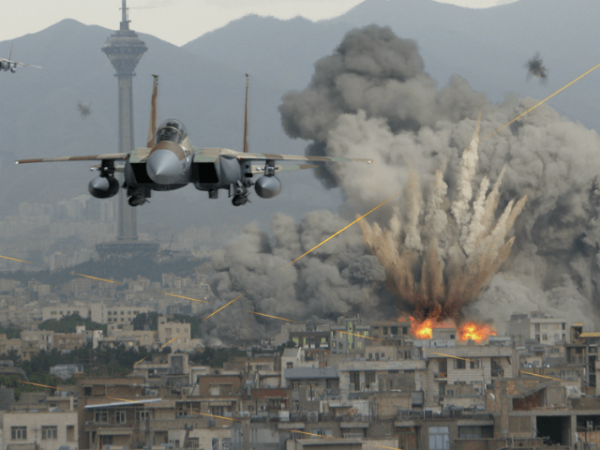
Although the Iran war largely has been viewed through the lens of conventional western warfare, its lessons are anything but conventional. They are in fact insurrectionary.
The post-war western approach (especially in the Cold War context) relied on the ability to outspend any military adversary through the acquisition of high-end, over-engineered and costly manned aircraft and munitions. Dominance of airspace and heavy reliance on aerial bombardment, i.e. air-war, was the doctrinal end.
The expenditure overmatch (as well as an imputed technical innovation) was viewed as the crucial element in the confrontation with the USSR.
Similarly, the impulse in naval warfare was toward investment in ever bigger carriers and their associated tiers of naval support vessels.
In ground warfare, the weighting in the Iraq War’s ‘Desert Storm’ was on tanks ‘punching’ and thrusting through the adversaries’ defence lines — though this approach was dropped by the West in Ukraine following the turn to 21st century drone-led ‘trench warfare’ on the front line.
The high-end outspend-approach both favoured the US’ Military Industrial Complex, and together with US dollar hegemony, provided America with the unique advantage of allowing the US effectively to ‘print’ those high-end overmatch supplementary expenses.
Then came the Iran war of 2026, whose asymmetric model upended conventional doctrines.
Instead of dominance of the air space, Iran pursued not aerial supremacy, but rather advanced missile dominance of air space.
Instead of surface-situated military infrastructure, missile armouries, launch facilities and much missile production were dispersed across Iran’s huge geographic areas and buried deep within underground missile cities and mountain ranges.
The key transformation to the asymmetric approach, however, was the advent of easily available cheap tech components. Whilst the West was spending millions of dollars for each interceptor, Iran and allies were spending hundreds.
The advantage of dollar hegemony has thus slipped away and turned instead to liability — the inflated cost of US munitions and their high-end engineering has resulted in sclerotic supply-lines, long production cycles and minimal weapon inventories.
The supposed tech superiority of US weapons is being surpassed too, by ‘garage’ and ‘workshop’ gigs using cheap tech components. They generate innovation which is then picked-up and scaled after informal testing by ‘military authorities’.
This trend is particularly evident in the Russian army, where initial ‘garage’ tech has been trialled and then implemented across the military structures. This applies to both tech hardware and to internet AI innovation.
In the same vein, Hezbollah’s innovation of its fibre-optic controlled drones has transformed the war in south Lebanon – imposing severe losses on Israeli tanks and troops, to the point to which the IDF may be compelled to withdraw from the south.
Likewise, asymmetry and innovation in the seaways are upending the traditional western reliance on large heavy naval vessels and carriers. The latter have become ‘white elephants’ of the Persian Gulf ‘war’ as they are driven so far off from Iranian coastline by drone swarms and threats of anti-ship missiles that their deck-based strike-aircraft are limited in their attack capabilities by the requirement to re-fuel from tankers over target.
To see a literal ‘swarm’ of many tens of armed fast speedboats approaching a lumbering conventional naval vessel only serves to underline their vulnerabilities. In any event, Iran has other anti-ship weapons at its disposal.
In short, a US carrier no longer induces fear as once it might have; It now radiates vulnerability.
Iran’s new sea warfare, however, also includes loitering high-speed submersible drones (or torpedoes) that can loiter for up to four days and which are equipped with AI targeting capabilities. These drones can be launched from underwater tunnels running beneath the Hormuz surface.
Iranian innovation admittedly has been long-planned and developed. Its’ effectiveness has been demonstrated during the conflict with Israel and the US. Iran has withstood the Israeli and American carpet-bombing (albeit whilst incurring heavy damage and casualties), yet Iran continues to have control of the Strait, plentiful missile inventories, and destroyed, unusable US military bases in the Gulf.
That is the Iran war experience. But the wider strategic point is that it has demonstrated that the western ‘way of war’ has been eclipsed by cheap innovative tech and careful asymmetrical planning.
The western model can provide devastating damage — of that there is no doubt — but its lack of surgical application is also counter-productive in an age of mass media and smartphone photography that testify to civilian death, destruction and suffering.
The second point is that the West remains a cumbersome giant that has failed to understand — let alone anticipate — the new asymmetric war. Innovation has been stymied by the consolidation of the Military Industrial Complex into a few bureaucratic monopolies.
The western way of war is a bust model when ranged against a sophisticated asymmetric opponent.
But others have indeed noticed the lessons from the Iran war. Russia is one; China is another. There will be more. The West can expect to see the lessons surface in different garbs in the West’s other wars.
The European élites may find that their facilitation of Ukrainian drone attacks deep into Russia may draw a different (kinetic) response in the near future. The warnings have been issued. Will they be heard?
https://conflictsforum.substack.com/p/ways-of-war-are-in-metamorphosis