
When Populists Unite, the Neo-Con Horseshoe Closes
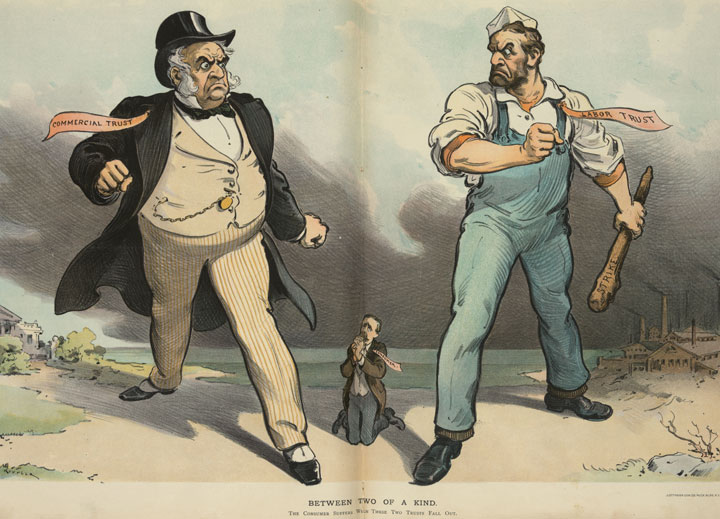
The American public watched in shock and awe as the democratic socialist mayor-elect of New York City, Zohran Mamdani, and the right-wing populist President Donald Trump had a “chummy” visit in the White House. Some have cited this bewildering bond as an example of “horseshoe theory.” The horseshoe theory posits that the edges of the Overton Window, meaning the so-called far-right and far-left factions of the political spectrum, have more in common with each other than they do with the center.
There is certainly some evidence for this. In Congress, Reps. Thomas Massie and Marjorie Taylor Greene successfully forced the release of the Epstein files in a stunning move of bipartisanship. In the media ecosystem, paleoconservative-leaning figures like Tucker Carlson have found common ground with progressive commentators from The Young Turks, Cenk Uygur, and Ana Kasparian, on free speech, criticism of Israel, and economic populism. Even Nick Fuentes, one of the most radically right-wing voices in America, has stated that he would work with the left to end Israel’s grip on the US government. However, a similar phenomenon has occurred in the establishment, centrist factions of both the Democratic and Republican parties.
During the 2024 election, former Vice President Dick Cheney endorsed Kamala Harris for president. The idea that a diehard neoconservative, whom many consider a war criminal, would one day endorse a progressive Californian Democrat would have been unimaginable 20 years ago. However, proponents of military adventurism have increasingly found a home in a Democratic Party committed to providing endless support to Israel and Ukraine. So, when Dick Cheney died on November 3rd, it was unsurprising that Kamala Harris was one of the guests present at his funeral, which, ironically, occurred a day apart from the aforementioned Mamdani-Trump meeting.
Clearly, new political alliances are forming, uniting different factions from the left and right together. But while it is mostly clear why right-wing and left-wing populists are increasingly united, it is less publicized why neoliberals and neoconservatives are doing the same. While it is obvious on paper that neoliberals and neoconservatives both align with an Atlanticist and pro-Zionist foreign policy, it is less obvious why both factions have come to the same morally universalist foreign-policy conclusions that drive their political ideologies. To understand where this “ideological DNA” came from, it is important to examine an entirely different ideology: Trotskyism.
Irving Kristol, the “godfather of neoconservatism,” was the furthest thing from a Republican in his college years during the 1930s and 1940s. In fact, he was a member of the New York Intellectuals, Trotskyists who rejected the “socialism in one country” of Joseph Stalin. However, after the Yom Kippur War, he became disenchanted with the political left, which opposed US-intervention on behalf of Israel. In Kristol’s own words, “There is nothing inherently immoral about intervening in someone else’s civil war, just as there is nothing inherently immoral in not intervening.” Soon after, he praised Henry Kissinger for his “moralistic policy – one that conceives the United States to be ‘a city upon a hill’ and ‘a light onto the nations.’” Indeed, Kristol carried over the idea of political proselytizing from Trotskyism to neoconservatism. Trotskyists claim that communism can only be achieved after a global revolution. Similarly, neoconservatives claim that freedom in the form of American-style democracy and capitalism can only be achieved by the US spreading its beliefs via economic and military warfare to the entire world. Kristol was not the only Trotskyist who became a prominent neoconservative. Other members of the New York Intellectuals, including Sidney Hook and Norman Podhoretz, infiltrated the Republican Party and spread their beliefs, which soon became mainstream. However, some “Third-way” or “neoliberal” Democrats also came to similar conclusions after the Reagan Revolution.
After the neoconservative Ronald Reagan dominated American politics in the 1980s, certain Democrats realized that they could adopt aspects of the Reagan foreign-policy consensus to make themselves more electable. One Democrat who adopted this strategy was Bill Clinton. After winning the 1992 election, Bill Clinton laid the groundwork for modern liberal internationalism by continuing and expanding President George H. W. Bush’s involvement in the Yugoslav Wars. In fact, under Bill Clinton, the United States became even more involved by leading an illegal NATO intervention in the Balkans, which led to the downfall of Slobodan Milošević. In this way, the same ideological DNA from Trotskyism entered the Democratic Party in the form of neoliberalism, which continues to be a major faction in the party to the present day.
Both the Republican establishment neoconservatives and the Democratic establishment neoliberals fear the populists for the same reason: populists are skeptical of war. Additionally, populists detest the corrupt, morally bankrupt political class that rises to the top in a system designed to perpetuate violence in the form of foreign wars. In such a system, true believers in spreading the American political system through militaristic crusades and war profiteers function in the same way. Both of these war hawk groups ignore the needs of the American people in favor of ideological projects and/or profit. For this reason, the populists despise the ruling American political class.
The future of American politics is increasingly less defined by “left vs. right” and increasingly defined by “populist vs. establishment.” Due in large part to social media, the citizenry of the United States has become awake to the true goals of the permanent ruling class: ideological projects and profit. Only time will tell if these blocs will hold and unite in concrete action rather than in rhetoric, or if traditional political conceptions will prevail. The real divide is no longer between left and right, but between the people and those who claim to rule in their name. And that horseshoe is closing fast.
https://original.antiwar.com/JD_Hester/2025/12/01/when-populists-unite-the-neocon-horseshoe-closes