
White South Africans Under Siege
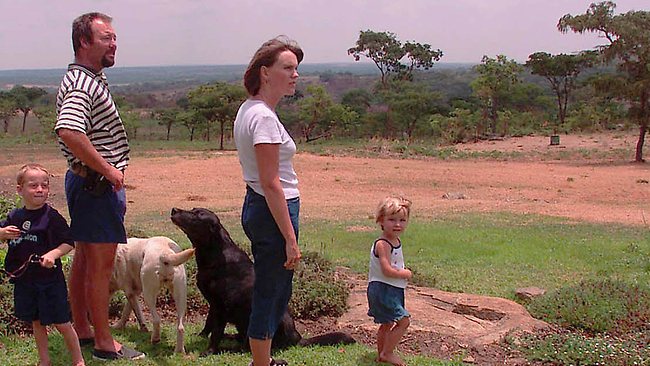
White South African farmers face disproportionate violence, extreme torture, and a political climate that deepens their isolation.
In a country recording approximately 63 murders per day, it is easy to argue that no single category of violence deserves special attention. Between July and September 2025 alone, 5,794 killings were reported. Against such staggering totals, the estimated 50 farm murders per year appear marginal, less than 0.2% of national homicides. From a purely aggregate perspective, the conclusion seems obvious. Yet aggregate data can obscure concentrated risk. When the denominator shifts, so too does the story.12
The relevant denominator in this case is not the national population of nearly 60 million, but a farming community estimated at roughly 40,000 individuals. Measured against that smaller base, the calculus changes.. Independent analyses drawing on data from AfriForum and the Transvaal Agricultural Union indicate that the murder rate within this group has, at various points, far exceeded the national average.
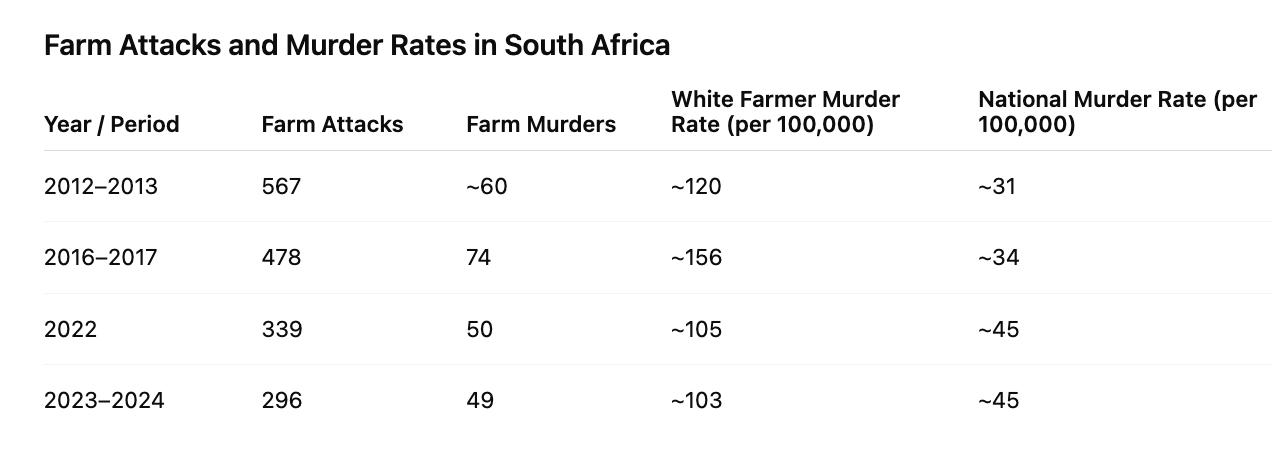
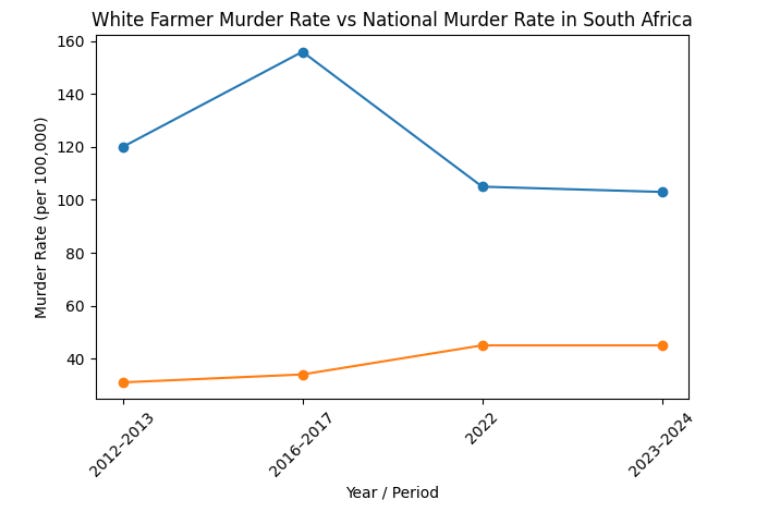
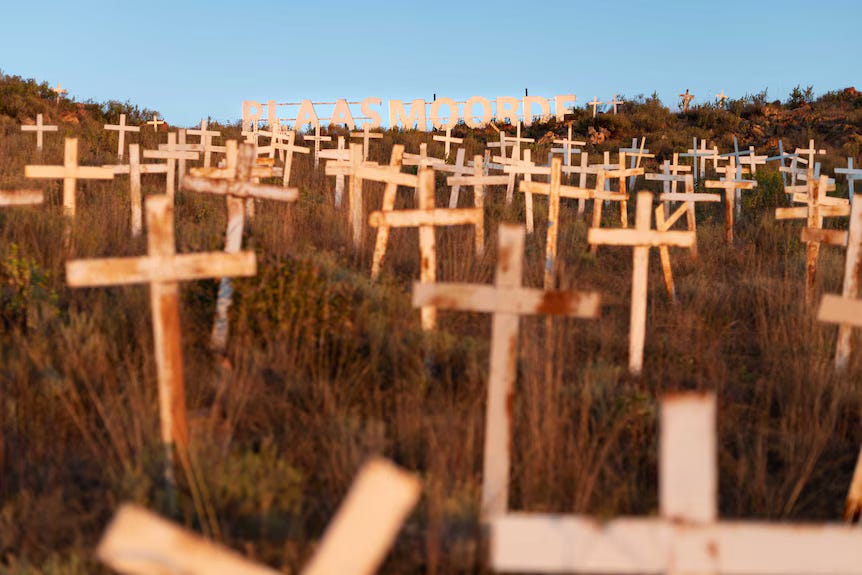
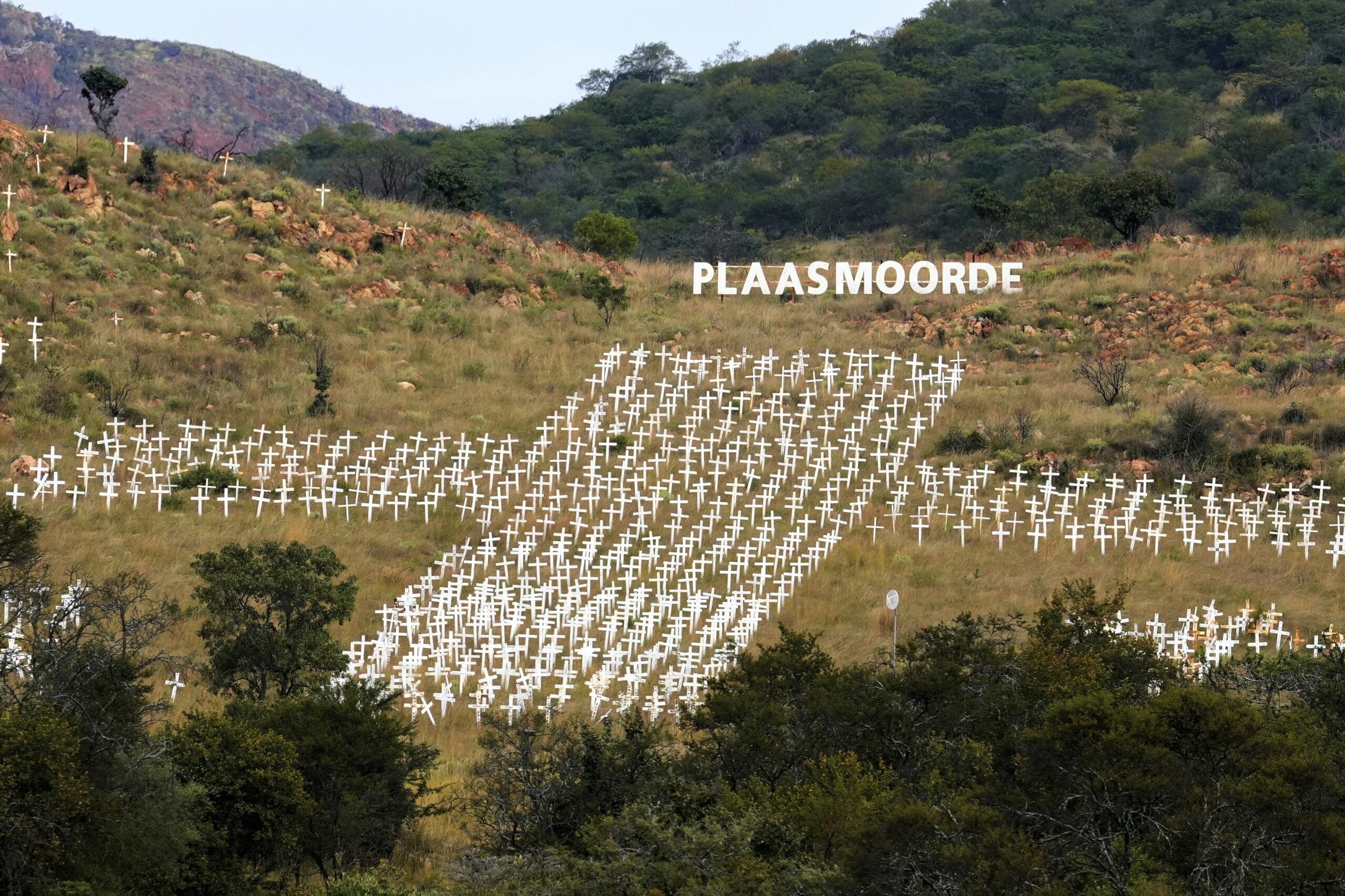
Yet even this statistical disparity does not fully capture why these crimes should provoke such anguish and attention. What sets farm murders apart from other killings is their brutality. Many farm victims are tortured for hours or even days before death, subjected to burning, mutilation and sexual violence.
The Historical Roots of the Crisis
Farm attacks did not emerge in a vacuum, they are the violent manifestation of centuries of contested land ownership, ethnic grievance politics and the turbulent transition to a post-apartheid democracy.3
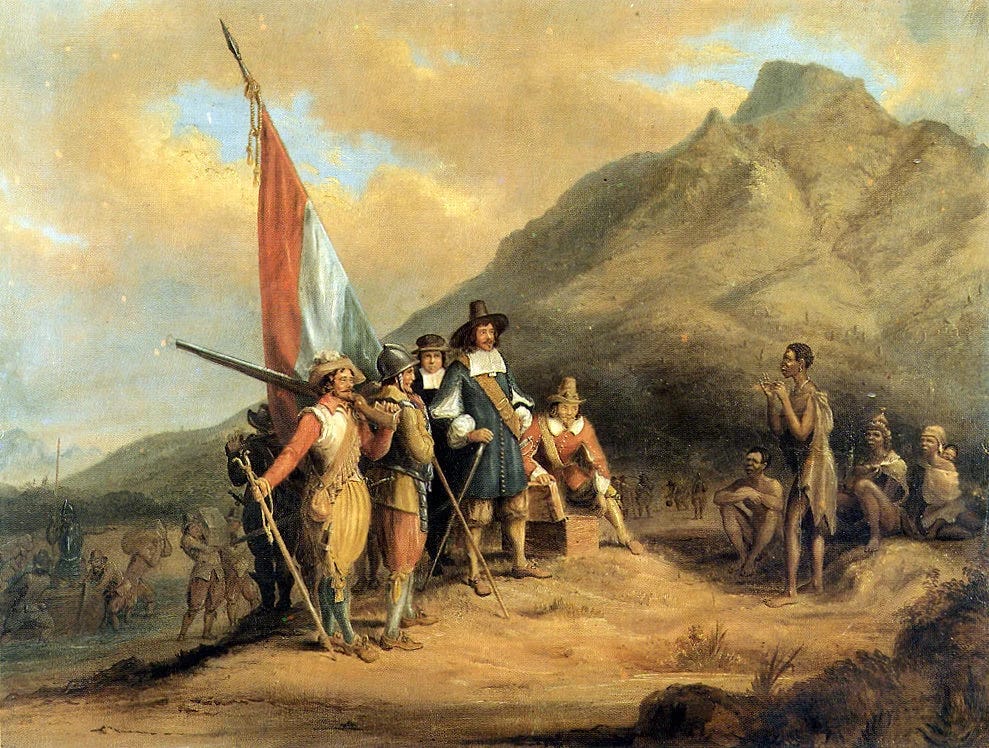
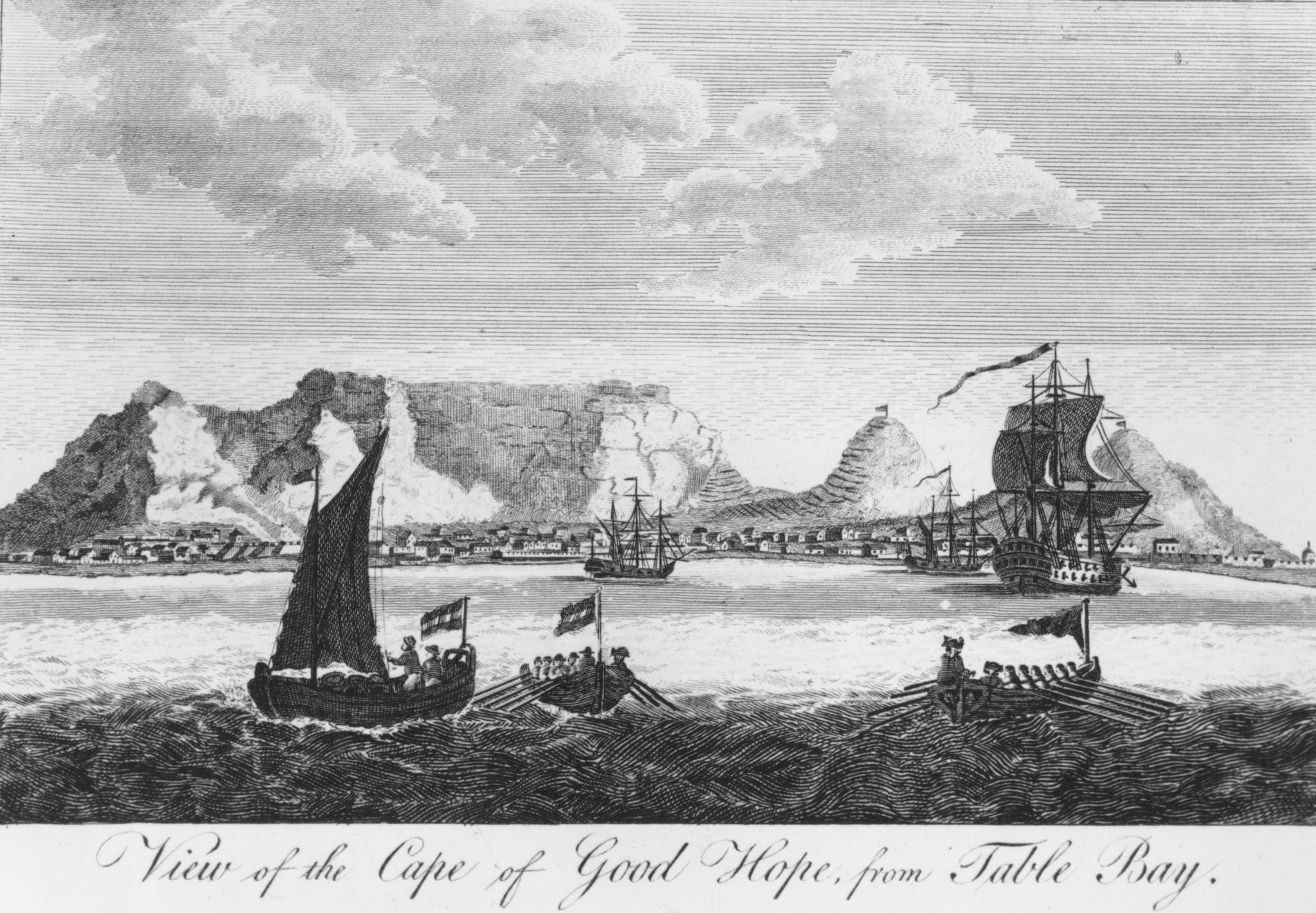
The genesis of the commercial farming sector in South Africa dates back to the arrival of Dutch and than later the German, and French Huguenot settlers at the Cape of Good Hope beginning in 1652.4 These settlers, who eventually formed the ethnic core of the Afrikaner population, developed a distinct identity deeply tethered to the land. The term “Boer,” translating directly to “farmer” in Dutch, encapsulates a history of rugged independence, agrarian expansion, and resistance to external administrative control, most notably demonstrated during their inland migrations to escape British colonial rule.5 Over subsequent centuries, these communities transformed the challenging South African topography into a globally recognised agricultural powerhouse.
Following the end of apartheid, the newly elected African National Congress (ANC) government faced the task of redressing these historical grievances. Early interventions included the White Paper on Land Reform, which outlined restitution, redistribution, and tenure reform programs aimed at correcting the spatial imbalances.6 However, from the perspective of the commercial farming demographic, the post-1994 landscape has been characterised by policies that have systematically undermined white farmers. The implementation of affirmative action in state sectors, persistent political threats regarding land expropriation without compensation, and an overarching failure to provide adequate policing have fundamentally altered the rural dynamic.7
During the apartheid era, commercial farms functioned as highly secure, productive strongholds. Rural security was heavily subsidised and managed by the state through the Commando system, a network of army reserve units comprising local farmers and volunteers seamlessly integrated into the national defence apparatus.8 This system provided rapid-response capabilities, localised intelligence gathering, and a formidable deterrent against incursions. However, the ANC government viewed the Commandos with deep suspicion, perceiving them as an extension of the apartheid state’s security and counter-insurgency apparatus.9 Consequently, the government initiated the systematic disbandment of the Commando system in 2003, arguing that it was incompatible with a democratic state.10
The dismantling of the Commandos removed the primary security mechanism in rural areas. Criminological studies confirm that this disbandment severely compromised rural security, as the South African Police Service (SAPS) was forced to prioritise combating surging urban crime rates, leaving vast, isolated rural tracts effectively unpoliced.11 The farms, once secure strongholds of productivity, rapidly transformed into vulnerable battlegrounds.
Attempts by the state to bridge this security gap have been widely criticised as ineffective. The 1998 Rural Safety Summit, convened under the presidency of Nelson Mandela, aimed to bring stakeholders together to formulate a strategy against violent rural crime and introduced the Rural Protection Plan.12 Yet, contemporary security analysts, human rights monitors, and farming advocates widely characterise the 1998 summit as a mere token gesture.13 The resulting plan failed to establish clear accountability mechanisms, lacked the requisite integration with specialised security forces, and ultimately failed to satisfy the demands for protection or halt the rising tide of violence. The state’s inability to provide adequate rural policing allowed a severe security vacuum to form, within which highly organised criminal syndicates began to operate with near impunity, executing attacks that are increasingly reminiscent of systematic ethnic cleansing.14
The Farm Attack
Criminological profiles of farm attacks reveal that they are rarely crimes of passion or spontaneous acts of opportunistic burglary. Instead, they demonstrate a chilling degree of premeditation, tactical organisation, and logistical coordination that mirrors military insurgency tactics. Research frameworks established by the South African Police Service and independent criminologists typically divide a farm attack into three distinct operational phases: Reconnaissance, the Attack (Operational Phase), and the Escape.15
The reconnaissance phase is characterised by intelligence gathering and psychological pressure. Perpetrators, operating either alone or in syndicates that can range from two individuals to much larger, heavily armed groups, spend considerable time monitoring the routines of the targeted farming family.16 This involves mapping the presence of private security systems, the number and breed of guard dogs, the shift changes of farm labourers, and the structural access points of the main homestead.17
This phase is frequently marked by subtle intimidation or preliminary acts of sabotage designed to test the farmer’s response times and degrade the property’s defences. Tactics include the intentional poisoning of guard dogs or livestock, threatening telephone calls, the setting alight of peripheral crops, or the sudden, unexplained absconding of a domestic worker or farm labourer who may have been coerced or bribed into providing critical insider information regarding the location of safes and firearms.18 The vast isolation of the rural geography inherently aids the African attackers, allowing them to conduct sustained surveillance without drawing the suspicion of urban neighbourhood watches or passing police patrols.
The execution of the attack is characterised by overwhelming force and the exploitation of the element of surprise. Entry is typically gained through ambush tactics, striking when the farmer is inspecting a distant perimeter fence, returning from town, or lured out of the homestead under false pretences, such as individuals arriving at the gate pretending to seek employment or purchase agricultural produce.19
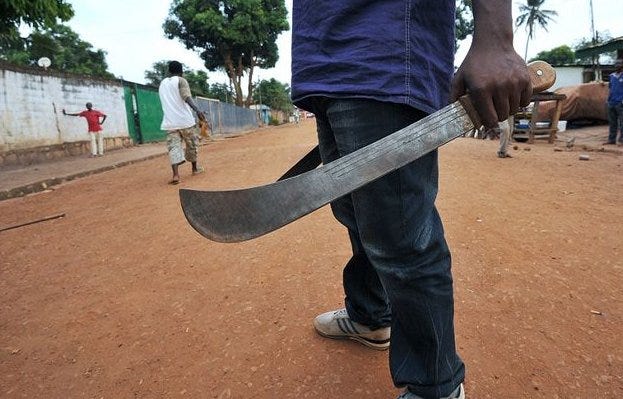
Upon breaching the home or overpowering the farmer outside, the primary tactical objective is rapid incapacitation. Victims are immediately overwhelmed, brutally assaulted, and physically restrained using materials readily found on the property or brought by the African attackers, such as shoelaces, telephone wire, or heavy electrical cables.20 The weaponry utilised ranges from unlicensed firearms to crude, highly destructive agricultural implements, including pangas (long, broad machetes), pickaxes, axes, steel pipes, and iron bars.21 In many documented cases, attackers utilise their bare hands to inflict severe blunt force trauma before resorting to weapons.22
The logistics of the escape further highlight the highly premeditated nature of these crimes. Given the remote locations of the properties and the need to transport stolen goods, typically firearms, cash, and high-value electronics, the African attackers frequently steal the victims’ own farm vehicles (commonly referred to as bakkies) to flee the scene.23 These vehicles are driven at high speeds away from the rural center and are often found abandoned miles away, dumped on the peripheries of urban townships or informal settlements where the perpetrators can seamlessly blend into the dense population, effectively vanishing before rural tracking units can establish a perimeter.24
Extra-Lethal Violence and Torture
What incontrovertibly separates South African farm attacks from general home invasions or armed robberies is the frequent, systemic application of profound torture. While the primary motive may initially appear to be material or economic gain, the sheer volume of gratuitous violence deployed is wildly disproportionate to the objective of robbery.
Criminological theorists, building upon the work of scholars such as Lee Ann Fujii, conceptualise this phenomenon as “extra-lethal violence”, violence utilised by actors over and above the standard required for lethality, deployed to achieve psychological, political, or in-group cohesion goals.25 In a chillingly high percentage of farm attacks, victims are not simply killed; they are subjected to hours, sometimes days, of sustained, unimaginable agony. According to data compiled by AfriForum, in approximately 20% of all recorded farm attack incidents in 2020, at least one severe form of torture was inflicted upon the victims.26
The methods of torture are archaic, diverse, and horrific. Victims have been subjected to having their fingernails forcibly extracted, being burned with electric irons, blow-torches, and melted plastic, and having boiling water poured over their bodies.27 Attackers routinely break the fingers of victims to force compliance, or drag them behind moving vehicles across the rough farm terrain.28 In disturbing instances, perpetrators have poured methylated spirits over victims and set them alight.29 Furthermore, the systemic use of rape and sexual violence against women during these attacks is thoroughly documented, functioning as a dual mechanism of physical trauma and psychological subjugation.30
Crime scene cleanup professionals, referred to locally as the “blood sisters”, have publicly stated that farm tortures represent by far the most horrific acts of violence they encounter anywhere in the country.31 They, alongside various human rights groups, argue that the term “farm murder” is fundamentally misleading, softening the reality of the crimes. They advocate for the terms “farm terror” or “farm torture” as more suitable descriptors for the visceral reality of the crime scenes.32
The Annihilation of the Potgieter Family
One of the most psychologically devastating and widely cited attacks occurred in December 2010 on a farm in the eastern Free State, involving the Potgieter family. Attie and Wilna Potgieter, along with their two-year-old daughter, Wilmien, were ambushed by a group of six African attackers.33 The violence inflicted during this incident was catastrophic and defies logical comprehension.
Attie Potgieter was attacked outside and repeatedly stabbed with a garden fork and a panga. Evidence presented during the subsequent trial suggested that he was intentionally kept alive, bleeding profusely on the ground, to witness the ongoing terror inflicted upon his family.34 Wilna was taken into the main house, marched to the safe, and forced to endure the psychological torture of the invasion. According to harrowing forensic evidence and dramatic courtroom reconstructions, the attackers executed the two-year-old child, Wilmien, with a gunshot to the head.35 Forensic investigators noted the tragedy that the toddler’s footprints were found in her father’s pooling blood.36 The attackers then callously threw the child’s body into a box that was described as being “half full of her blood” before murdering Wilna while she was actively reciting the Lord’s Prayer.37
In July 2020, Afriform released a dramatic reenactment video of the December 2010 attack, narrated by Wilmien’s aunt Susan Nortjé. The family is described as helpful, loving, charitable and kind, emphasising the horror of the attack. Nortjé recounts the violence, saying:
“Wilmien just wanted to help her dad. Wilmien’s footprints in his blood were found all over the veranda as she ran around her dad. Her little handprints covered his shirt with blood…Wilmien screamed terribly, and [the attackers] could no longer take it. They killed Wilmien with a shot in the head. They took her and threw her body in a box like that of a mad dog…According to the pathologists and the forensic people, Attie was still alive. He was literally lying there; he saw how his child was shot dead and how his wife was taken into the house. Of course…the first thing you think of is that they are going to rape your wife. I think Wilna thought that too. They took Wilna to the safe; walked her past her handbag. The only money that they got from her were their own salaries. There was no other money. She then started reciting The Lord’s Prayer. And I hope and believe that Jesus heard her and made what was to come more bearable for her (Afriforum 2020).”
Notably, the only material items stolen during this protracted slaughter were the attackers’ own withheld wages, indicating that the motive was rooted in extreme, localised retribution rather than standard economic robbery. The sheer barbarity of the Wilmien Potgieter case became a rallying point for civil rights groups, solidifying the narrative of extreme vulnerability and demonstrating how extra-lethal violence is utilised to annihilate the concept of safe sanctuary.38
Survivor Accounts: The Torture of Nicci Simpson
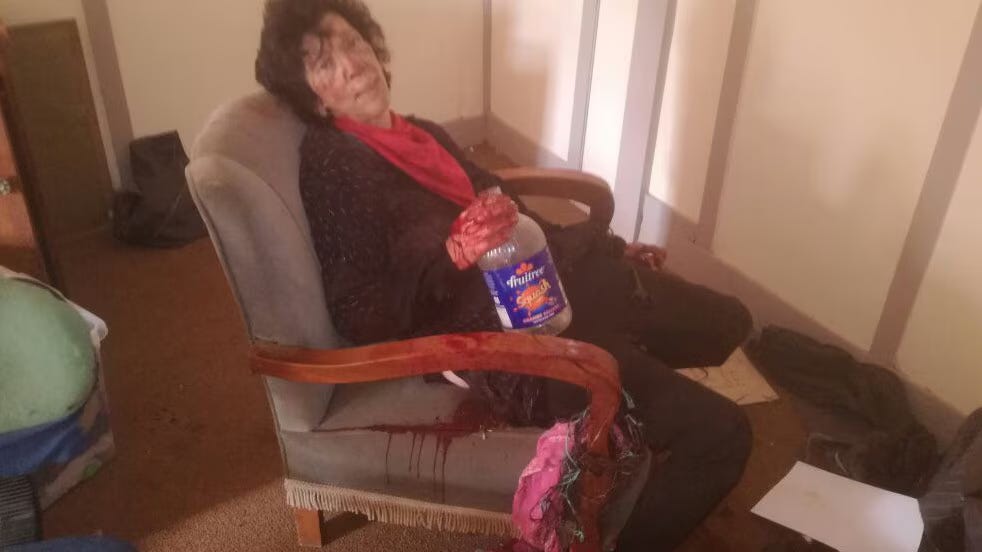
In March 2017, 64-year-old Nicci Simpson was attacked at her home on a farm in the Vaal area, approximately two hours outside of Johannesburg, by a group of three African men.39
Police later classified the incident as a “house robbery”, despite the severity of the violence inflicted. Simpson’s two feet were drilled through with a power tool on the smallholding where she grows cattle fodder.40
“I’m red-faced to tell you what they said,” she says. “I kept being referred to as ‘a white f…ing bitch’.
“Once they gained access to the house, they dragged me to a steel gate which leads to upstairs. They said, ‘We want the safe upstairs.’ My own firearm was being trained on me. The knifeman was slashing at me. I began to get dizzy from being kicked around.”
The attackers appeared to know the layout of her home. Simpson believes a former employee may have supplied information. She was tied to a chair.
“One said, ‘If you do not give us the key to the safe, we will cut your legs off.’ There was no money in the safe but there was a very big grinder. I knew if they got the safe open and they saw the grinder, I was finished.”
She describes how they “began taking chunks of skin off my arm, and the tip of the blade was being pushed in my head”.
The men broke into a storeroom and retrieved electric tools and crowbars. It went on for six hours and they were getting more bold and barbaric.
“The knifeman, he was sauntering around. He leaned over my right shoulder and began drilling through my feet without warning.”
What did you do?
“I didn’t scream and I didn’t cry. It was painful, it was. Afterwards a police person told me the fact that I didn’t scream or beg saved me.”
At one point, a plastic bag was placed over her head, suffocating her, while the getaway driver grew impatient and sounded his horn. When the attackers finally forced the safe from the wall and discovered it contained no money, they fled. One stole her car, but it was abandoned 300 metres up the road after the anti-theft mechanism engaged.
“It’s very difficult for me to say what I feel,” she says. “But with this hate speech going on (Julius Malema of the Economic Freedom Fighters party is urging the seizure of white-owned land), this is stirring up the masses who are without things and who are being promised things that are not forthcoming. It’s like: go and take what you want.”
“The thought of leaving has crossed my mind, but where does one go? The killing of whites is everywhere — you’re not safe anywhere.”
When emergency paramedics arrived, they found Simpson lying in a pool of blood, critically injured but alive. Her three dogs had been slaughtered. The use of industrial tools against an elderly, isolated victim suggests a level of brutality that far exceeds opportunistic theft, raising questions about motive, intent, and the classification of such attacks.41
Psychological Trauma: The Kruger and Stander Cases
The psychological trauma inflicted on survivors is a lasting, invisible legacy of the crisis. In 2020, on a farm situated east of Pretoria, Joey and Leon Kruger were overpowered by armed African intruders. During the ordeal, the attackers placed a loaded firearm to the head of the couple’s crying seven-year-old son, threatening to execute the child in front of his parents as a mechanism of absolute psychological control.42
In another horrific incident in Muldersdrift in 2021, Robert Stander was shot and killed during an invasion. His fiancée, Mariaan Brits, survived the ordeal but reported hearing the attackers casually state, “We have done what we wanted to do,” before fleeing the scene.43 This chilling statement strongly indicates that the assassination itself, rather than material theft, was the primary, premeditated objective of the incursion, reinforcing the narrative that farmers are being systematically targeted for elimination.44 These survivor stories have been documented extensively by AfriForum in documentary series such as Resilient Voices, aimed at amplifying the horror of the attacks to the international community.
The breadth of the victimology is expansive and continuous. Within a span of a few weeks in late 2020 in the Free State alone, the list of victims grew rapidly: David Leslie, who succumbed to injuries after a brutal assault; Pieter Hills, brutally murdered while his son Eddie was left in critical condition; Dave Wessels, a 65-year-old military veteran attacked in his bed; and Brendin Horner, a 22-year-old farm manager who was brutally assaulted and strangled, an event that sparked nationwide outrage and protests.45
Piet Els murder
In January 2018, 86-year-old Piet Els was attacked on his farm near Kimberley. Four men entered the property in the early hours of the morning. They beat him with a metal bar. They burned him with a hot iron. Under the rain of blows, disoriented and overwhelmed, he could not remember the code to his safe.46
Els had no electric fences. No armed guards. No patrol dogs. He was not a recluse barricaded behind razor wire. He was, by all accounts, a respected businessman and farmer, and notably, a friend of Nelson Mandela. He believed, it seems, that this reputation would be protection enough.
It was not.
When emergency services brought him to Mediclinic Gariep at 6:20 a.m. on January 24, he was still conscious. According to Dr. Vusi Nokeri, head of the emergency unit, Els arrived with visible burns and extensive trauma. His clothing was scorched and stained with blood. There were moments when he drifted in and out of consciousness, a pattern that had reportedly begun during the attack itself.
The medical testimony presented before the Northern Cape High Court was precise and devastating. Els had massive swelling and bruising around his right eye, blue-black discolouration indicative of blunt force trauma and probable internal bleeding. Two open wounds on his face measured six and eight centimetres respectively. His left frontal skull was fractured. There was extensive soft-tissue swelling across his face. Burn wounds marked his right leg, corroborating his account of being assaulted with a heated iron. Multiple bruises across his body suggested sustained and repeated assault. His breathing pattern indicated blunt chest trauma, injuries severe enough to threaten his life from the outset.
He was admitted to the high-care unit. He would never leave it.
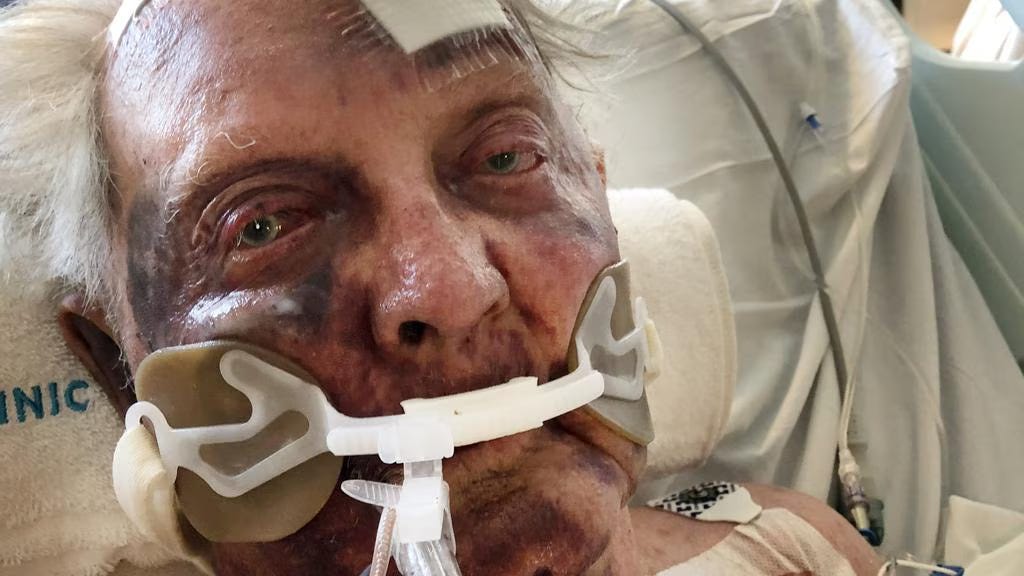
For 111 days, Els remained in that ward. For most of that time, he was ventilated. Attempts to remove the ventilator led to rapid deterioration. His condition worsened on the second day and never meaningfully recovered. On May 15, 2018, he died from the cumulative effects of chest trauma and the catastrophic injuries inflicted during the attack.47
What makes the case of Piet Els particularly symbolic is not only the brutality, but the shattered assumption it represents. Here was a man connected to the very leadership that presided over South Africa’s “democratic” transition. A man who believed, perhaps sincerely and foolishly, that goodwill and political proximity offered insulation from the violence engulfing rural communities.
It did not.
The Attack on Hannetjie and Callie
Four days before Christmas in 2018, Hannetjie and Callie Ludik woke in the dark to the sound of movement inside their home. Their smallholding outside Pretoria had already been stripped of most comforts; both had recently lost their jobs. There was little left to steal.
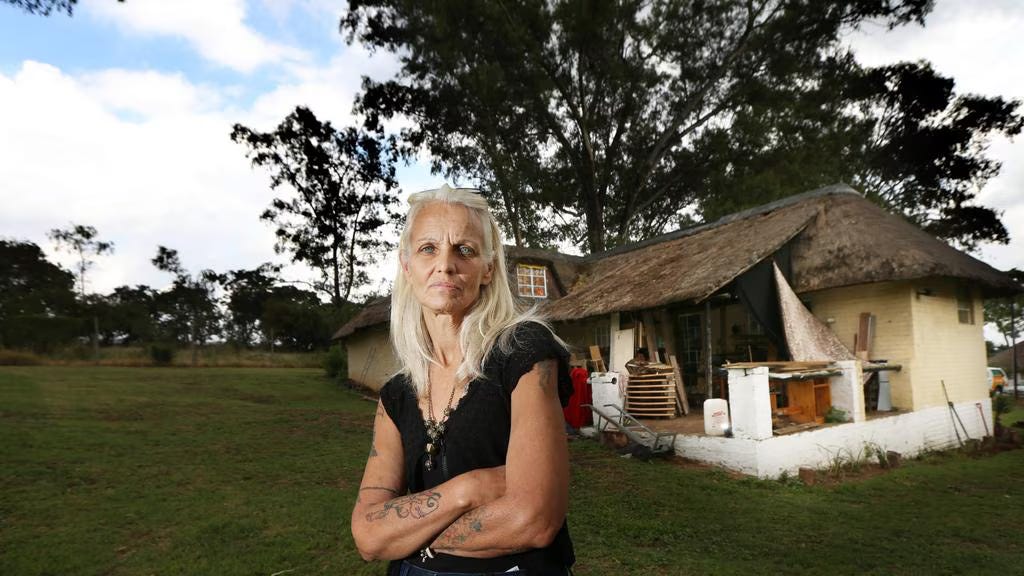
Three armed African men had forced entry through the back door with a crowbar. “They started walking through our house taking all of our food,” Hannetjie later recalled. One of the men took 2,500 rand and, in a gesture that was almost surreal in its casualness, kissed her on the cheek and said thank you.48
Another man, wearing a balaclava, returned. He tied Callie’s hands and feet, threw a blanket over him, and gestured for Hannetjie to follow. She understood immediately what was coming.
Outside, one of the attackers raised his gun and presented her with a choice: rape or death.
“He said to me that he wanted sex. He took his gun and said that he will shoot me if I refused. I decided to live for my children and grandchildren and said that he must do what he wanted to.”49
He raped her. She thought it was over.
Then the second man came. Then the third.
Her husband remained bound inside, helpless beneath a blanket, forced into the role of silent witness to what he could neither prevent nor intervene in.
The robbery yielded almost nothing of material value. What was taken was food, a small amount of money, and something far more irretrievable.
No one has been arrested for the attack. No one has been charged with the rape. The file remains one among thousands in a criminal justice system stretched thin and unevenly effective.
Susan Howarth’s Murder
On 19 February 2017, Susan “Sue” Howarth, a 64-year-old British expatriate living near Dullstroom in Mpumalanga, died after a prolonged and brutal attack on the farm she shared with her husband, Robert Lynn.
Originally from Southsea in Hampshire, Howarth had moved to South Africa in 1996, where she established a stables business and became known locally for her love of horses and dogs. Friends reportedly referred to her as “the English girl,” a nickname that lingered long after she had made Dullstroom her home.
In the early hours of the morning, masked African assailants broke into the couple’s remote farmhouse. According to court evidence and local reporting, the intruders shot at the couple in their bedroom, demanded money, and then subjected them to hours of torture.50
Robert Lynn was stabbed in the back and legs and burned with a blowtorch. Both were tied up. At one stage, a plastic bag was forced into Susan Howarth’s mouth, obstructing her breathing. Her husband was also subjected to attempted suffocation.
Eventually, still in their nightclothes, the couple were bundled into their own vehicle. They were driven away from their property to a roadside area outside Dullstroom.
There, the assault escalated further.
The attackers shot both victims and abandoned them in a field. Susan Howarth suffered gunshot wounds to the head, severe blunt-force trauma, burns, and multiple skull fractures. Robert Lynn was shot in the neck but survived.
Despite his injuries, Lynn managed to crawl across the road in darkness. On the opposite side he found his wife:
“Lying in a ditch. Her hands tied behind her back.”51
He flagged down a passing vehicle in the early morning hours. Emergency services transported both to hospital.
Susan Howarth was placed on life support but succumbed to her injuries two days later.
Political Rhetoric, the EFF, and Ideological Warfare
The violence on South African farms does not occur in a sterile political vacuum, it is deeply intertwined with, and exacerbated by, the radical rhetoric used by certain factions within the South African political spectrum. Central to this controversy is the Economic Freedom Fighters (EFF), a militant, left-wing anti-white political party led by Julius Malema. The EFF has built its political platform on the promise of radical redistribution of land and wealth, openly advocating for illegal land occupations and frequently targeting white commercial farmers rhetorically as the illegitimate inheritors of stolen land.52
A recurring, highly volatile flashpoint in this ideological tension is the singing of the historical anti-apartheid struggle song, Dubul’ ibhunu, which translates directly from isiZulu to “Shoot the Boer” or “Kill the Boer”.53 Malema and his supporters frequently chant this song at massive political rallies, stoking populist fervour. To the commercial farming community, civil rights groups like AfriForum, and international observers, the public chanting of a song explicitly calling for the murder of an ethnic minority of white people is viewed as a direct, dangerous incitement to violence. They argue that it stokes hatred, romanticises the brutal farm attacks, and provides ideological cover and motivation for the criminal syndicates executing the home invasions.54 For the victims, this is a declaration of war on the white descendants of those who built South Africa’s agricultural powerhouse.
In November 2016, following a court appearance in Newcastle regarding charges under the Riotous Assemblies Act, Malema delivered a speech that would become a cornerstone of the debate regarding his views on the white minority.
Malema asserted that “the rightful owners” of South Africa were black people and that the arrival of the “white man” had disturbed the peace through slaughter and dispossession.55 He famously declared, “We are not calling for the slaughter of white people, at least for now”.56 This statement was accompanied by the characterisation of white South Africans as “visitors” who must “behave” and the warning that “no white person is a rightful owner of the land”.
In June 2018, Malema provided further depth to his views during an interview with the Turkish broadcaster TRT World. He warned that if land was not returned to black people, South Africa would face an “unled revolution,” which he described as the “highest form of anarchy”. In this interview, Malema again used the “for now” qualifier, stating, “I have never called for their killing, at least for now. I can’t guarantee the future”.
This rhetorical maneuver, offering a “guarantee” for the present while withholding one for the future, serves a dual purpose.It enables Malema to cast himself as a restraining force, implicitly suggesting that he represents the most moderate outcome available to white South Africans, while simultaneously invoking the possibility of mass unrest as leverage in negotiations over land redistribution. In the TRT interview, he dismissed allegations of “white genocide” as the complaints of “cry babies” and “attention seekers,” attempting to reframe farm attacks as part of South Africa’s broader crime epidemic rather than as a racially targeted phenomenon.
Conclusion
South Africa’s crisis of violence is national, but the murders and suffering of white South Africans, particularly in rural farming communities, reveal a targeted horror that demands urgent attention. The plight of white farmers cannot be ignored or downplayed amid the broader chaos.
1 https://africacheck.org/infofinder/explore-facts/how-many-people-are-killed-south-africa-daily#:~:text=According%20to%20the%20latest%20crime,per%20day%20over%20this%20period
2 https://www.lemonde.fr/en/le-monde-africa/article/2025/03/13/in-south-africa-the-courts-dismiss-the-myth-of-white-genocide_6739091_124.html#:~:text=The%20reality%2C%20he%20explained%2C%20is,said%20de%20Kock
3 https://scielo.org.za/scielo.php?script=sci_arttext&pid=S1015-60462014000200002
4 https://nzhistory.govt.nz/war/south-african-boer-war/the-boers
5 Ibid
6 https://www.gov.za/issues/land-reform
7 https://www.jurist.org/features/2025/02/11/explainer-understanding-the-south-africa-land-reform-law-that-provoked-trumps-ire
8 https://en.wikipedia.org/wiki/South_African_farm_attacks
9 Ibid
10 Ibid
11 Ibid
12 https://ojp.gov/ncjrs/virtual-library/abstracts/unequal-protection-state-response-violent-crime-south-african-farms
13 Ibid
14 Ibid
15 https://africacheck.org/sites/default/files/An-overview-of-farm-attacks-in-SA.pdf
16 Ibid
17 Ibid
18 https://africacheck.org/sites/default/files/An-overview-of-farm-attacks-in-SA.pdf
19 https://shareok.org/server/api/core/bitstreams/fa206630-70d5-4017-8db7-349f9bab296a/content
20 https://cisp.cachefly.net/assets/articles/attachments/57778_report_to_the_united_nations_forum_for_minority_issues.pdf
21 Ibid
22 https://www.plaasmoorde.co.za/en/
23 Ibid
24 https://repository.up.ac.za/server/api/core/bitstreams/6e7edec6-a169-461c-b363-e31e6ce9f009/content
25 https://repository.up.ac.za/bitstreams/4f4df406-c10b-4b74-992a-aeb1859f6348/download
26 https://friendsofafriforum.com/wp-content/uploads/2021/04/Farm-murders-in-SA-2020-ENG.pdf
28 Ibid
29 Ibid
30 https://www.ohchr.org/sites/default/files/Documents/HRBodies/HRCouncil/MinorityIssues/Session4/ItemIII/AfriForum.pdf
31 https://www.genocidewatch.com/single-post/2017/03/25/-bury-them-alive-white-south-africans-fear-for-their-future-as-horrific-farm-attacks-esc
32 Ibid
33 https://repository.up.ac.za/bitstreams/4f4df406-c10b-4b74-992a-aeb1859f6348/download
34 Ibid
35 Ibid
36 Ibid
37 Ibid
38 Ibid
39 https://www.genocidewatch.com/single-post/2017/03/25/-bury-them-alive-white-south-africans-fear-for-their-future-as-horrific-farm-attacks-esc
40 https://www.theaustralian.com.au/nation/inquirer/six-hours-of-torture-for-the-keys-to-an-empty-safe/news-story/2497280df1b18c31f55344d9f2dcf8f4
41 Ibid
42 https://www.artikels.afriforum.co.za/en/we-have-done-what-we-wanted-to-do-fiancee-heard-after-farm-murder/
43 Ibid
44 Ibid
45 https://www.da.org.za/2020/11/the-terrible-list-of-farm-murders-in-the-free-state-continues-to-grow
46 https://www.theaustralian.com.au/nation/inquirer/six-hours-of-torture-for-the-keys-to-an-empty-safe/news-story/2497280df1b18c31f55344d9f2dcf8f4
47 https://www.google.com/search?q=Piet+Els+murder&sca_esv=b59fbfbe1fcd72c3&sxsrf=ANbL-n58_9Oi6F7L_g4l6KSEn3Mzc1p8Lw:1771507549804&ei=XQ-XaeLeMIqN2roP2a32oQc&start=20&sa=N&sstk=Af77f_eXw1NGuyJRxq82oGoxMjouraBJib6TxacPsXOefUryBRlfOWKLjRDEFPUVW4B6JD-hFd4Pod_pPvYC5oU7uw5AWo1XTMwL7VXpTECPFdrbmw2tRqoQ3W1UNjW0O_rb&ved=2ahUKEwiigeTx0-WSAxWKhlYBHdmWPXQ4ChDy0wN6BAgLEAc&biw=1440&bih=812&dpr=2
48 https://www.theaustralian.com.au/nation/inquirer/six-hours-of-torture-for-the-keys-to-an-empty-safe/news-story/2497280df1b18c31f55344d9f2dcf8f4
49 Ibid
50 Ibid
51 https://www.genocidewatch.com/single-post/2017/03/25/-bury-them-alive-white-south-africans-fear-for-their-future-as-horrific-farm-attacks-esc
52 https://pulitzercenter.org/stories/myth-white-genocide
53 https://www.aljazeera.com/news/2025/3/26/kill-the-boer-the-anti-apartheid-song-musk-ties-to-white-genocide
54 https://www.youtube-nocookie.com/embed/C-UCFKyMaxY?rel=0&autoplay=0&showinfo=0&enablejsapi=0
55 https://legalbrief.co.za/story/malema-ruling-offers-legally-sound-guidance
56 https://www.sahrc.org.za/index.php/sahrc-media/news/item/1843-sahrc-malema-comments-not-hate-speech
https://celina101.substack.com/p/white-south-africans-under-siege