
Why Joining Trump’s ‘Peace Board’ is Immoral — Not Merely Unwise
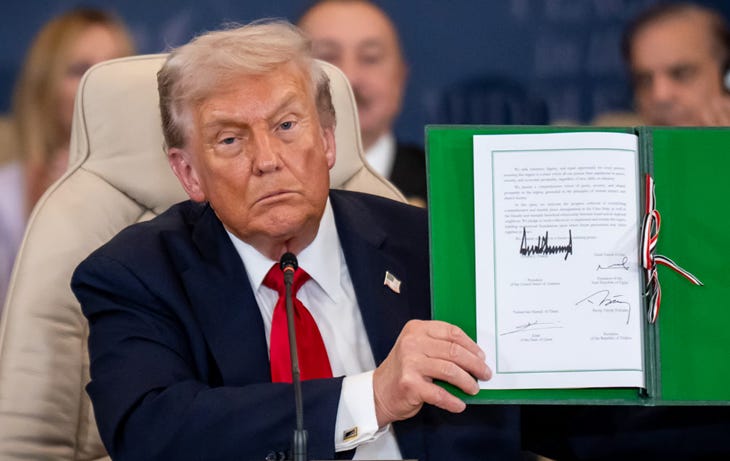
There are moments in international politics when participation itself becomes a moral failure. Donald Trump’s self-styled “Peace Board” is one of them.
This is not a debate about efficacy, sequencing, or diplomatic creativity. It is about legitimacy, accountability, and the deliberate exploitation of mass suffering for personal power. Any state, institution, or official that joins this structure crosses a line that should not require explanation — but now does.
This is not a peace mechanism. It is a personal fiefdom.
Peace processes derive legitimacy from mandate, law, and representation. The proposed Peace Board has none of these. It is not authorised by the United Nations. It is not anchored in international law. It is not accountable to any electorate, court, or treaty body.
It exists solely because one man has decided it should exist — and that he should sit at its centre.
Participation in such a body is not neutrality. It is endorsement of neo-patrimonial diplomacy, where proximity to personal power replaces law, and where outcomes depend not on justice or consent, but on favour.
Gaza is being used as moral currency
The most grotesque feature of this initiative is not its informality but its moral laundering.
The mass killing of civilians in Gaza is not being addressed through existing humanitarian, legal, or accountability frameworks. Instead, it is being repurposed as an emotional accelerant — a way to confer urgency and righteousness on a structure that otherwise has none.
To join such a body is to accept that genocide-level suffering can be instrumentalised, rebranded, and traded for political access. That is not peacemaking. It is exploitation.
No state that claims to uphold human rights can participate without forfeiting the right to invoke them elsewhere.
Participation collapses the boundary between state and individual power
The post-1945 international order rests on a fragile but vital distinction: states act through institutions, not personalities. The Peace Board collapses that boundary entirely.
It treats the office of the President of the United States not as a constitutional role but as a personal asset — something that can be leveraged to create parallel structures loyal to an individual rather than a state.
Any government that participates is complicit in normalising the idea that international authority can be privatised. Once that principle is accepted, no rule-based order can survive.
“Engaging critically” is not a defence
Some will argue that participation allows influence, moderation, or damage control. This argument is both familiar and false.
Illegitimate structures do not become legitimate because decent actors join them. They become laundered. History is replete with examples where “critical engagement” served only to confer respectability on power arrangements that should have been isolated.
There are moments when refusal is the only responsible act. This is one of them.
France is right. Others must follow.
France’s reported refusal to join the Peace Board should be recognised for what it is: not obstructionism, but institutional fidelity.
By refusing, France has reaffirmed a principle many seem ready to forget — that peace cannot be outsourced to spectacle, nor authority to charisma. Others should follow, openly and unapologetically.
Silence, hedging, or “wait-and-see” postures are not neutral. They are acquiescence.
The UN Security Council must act to repair the damage
Those members of the Security Council who allowed enabling resolutions to pass without clarifying limits now carry a special responsibility. The mistake was not technical. It was moral.
They must act to:
- reaffirm the UN’s primacy in peace mediation,
- reject recognition of parallel bodies without mandate,
- and explicitly warn against participation in personalised diplomatic constructs.
Failure to do so will confirm what many already fear: that the UN has become an accessory to its own marginalisation.
The test of this era is not peace — it is restraint
The multipolar era rewards boldness and punishes hesitation. But not all restraint is weakness. Sometimes it is the last defence against descent into rule-by-whim politics.
Joining Trump’s Peace Board is not a gamble that might fail. It is a choice that has already failed the moral test.
History will not ask who attended the meetings.
It will ask who refused — and why others did not.
https://leonvermeulen.substack.com/p/why-joining-trumps-peace-board-i