
Why Trump Will Get Greenland
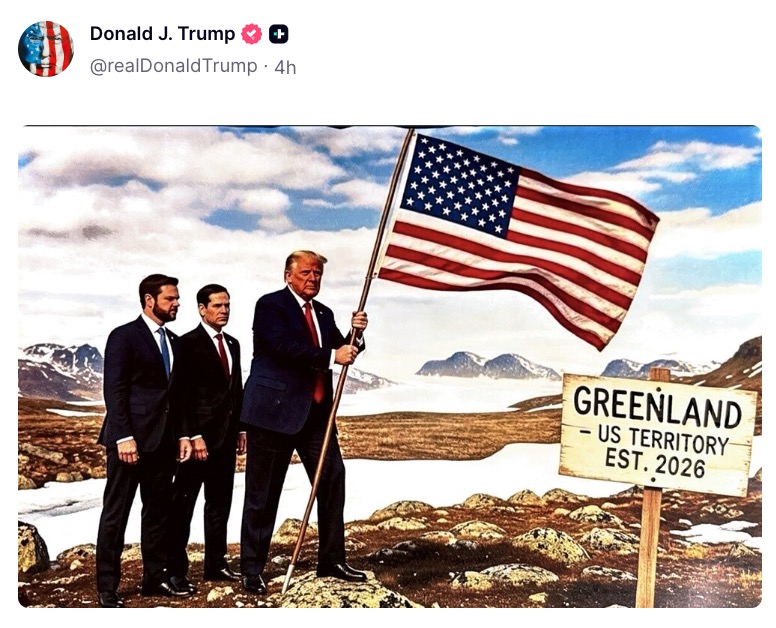
You can draw a clear line between the eight countries Donald Trump has chosen for his 10% punitive tariff: Denmark, Norway, Sweden, Finland, the United Kingdom, Germany, France, and the Netherlands. Europe’s liberal northwest is trying to thwart Trump’s attempt to annex Greenland.
But there are 21 other member states that haven’t been sanctioned. One of them is Italy. Giorgia Meloni has already said she told Trump his threat of tariffs was a mistake. I think that’s true. But will Meloni break with the president over a piece of land that’s far away and irrelevant to Italy’s security and economy? Will Spain? Or Greece? Or Malta and Cyprus? What about Eastern Europe? Will Viktor Orbán, Andrej Babiš, and Robert Fico—the populist prime ministers of Hungary, the Czech Republic, and Slovakia, respectively—come to the aid of their liberal friends in Denmark? Even Poland, with its most pro-EU government, is unlikely to sacrifice its strategic alliance with America for a few icy rocks near the North Pole, writes Wolfgang Munchau .
The truth is, Europeans never really cared about Greenland. It was the first country to leave the EU—in 1985—long before Brexit. It’s a fishing nation; fish make up over 90% of its exports. And it left because the EU’s fisheries policy would have stripped it of its right to manage its own fish stocks. Greenland could have belonged to the EU if the EU had truly wanted to keep it.
This is my bold prediction: Trump will win his battle for Greenland. The Europeans won’t stop him because they are weak and divided. The irony is that the EU itself chose this military and geostrategic weakness. It chose to deprive our armed forces of the necessary resources in favor of wealth transfers and support for NGOs. Ten years ago, the eurozone had the opportunity to create a political, economic, and financial union in response to the sovereign debt crisis. But it chose not to because it was uncomfortable. Meanwhile, the United Kingdom chose to leave.
When the European member states of NATO decided last year to bow to Trump’s pressure and increase their defense spending, they didn’t create a European Defense Union. They couldn’t agree on anything: a joint French-German-Spanish fighter jet project stalled because the three countries couldn’t agree on how to divide the labor. Instead, each country only increased its dependence on the US. Everyone believes they’re better off with their own special relationship. But as Benjamin Franklin once said, “He who sleeps with dogs, wakes up with fleas.”
And the Europeans have just woken up, and this time they’re truly angry, loudly demanding press releases condemning Trump. I hear commentators urging the EU to use anti-coercion, a legal instrument introduced two years ago to counter economic pressure from opponents. They insist the EU is stronger than it thinks. After all, it’s the world’s largest single market and customs union. And it considers itself a regulatory superpower.
That’s an illusion. The EU’s internal market is riddled with regulatory barriers. Hostile green and tech regulations haven’t changed the world for the better; they’ve only harmed Europe’s competitiveness. Consequently, unlike China and the US, Europe will not benefit from the AI boom. The EU, in its current form, is further removed from becoming a superpower than it was 30 years ago.
A union in which member states retain full sovereignty is only as strong as its weakest member. And that is currently Germany. Given the state of the German economy and its dependence on the US, it would be utter madness for the EU to retaliate against Trump’s tariffs.
What also hinders collective action is the EU’s persistent illusion that someone or something will stop Trump. Last year, European leaders believed the financial markets would oppose his tariffs, but to their dismay, Wall Street, after initial hesitation, rallied behind the president. When the Trump administration attacked Federal Reserve Chairman Jerome Powell last week, markets missed another opportunity to collapse. Now, Europeans are convinced the Supreme Court will block the tariffs.
On this specific point, they may be right. But they’re missing the bigger picture. We know the Supreme Court will issue a ruling tomorrow that could be the long-awaited decision on the tariffs. We know some justices reacted skeptically to the legal arguments during a hearing with Trump’s lawyers. There’s indeed a chance the Trump administration will lose the case. I can already picture the celebratory headlines in The Guardian.
But even if the ruling goes against Trump, he will still win. This case isn’t about whether a US president can impose tariffs on imports for national security reasons. It’s about whether the Carter-era International Emergency Economic Powers Act is the proper legal basis for his tariffs. Trump chose the IEEPA because it gave him the greatest degree of discretion. But there are alternative laws that could achieve the same thing.
For example, Trump could reimpose a crippling tariff bureaucracy, as he did with steel and aluminum. I recall a story about a German agricultural machinery exporter who was forced to disclose the steel and aluminum content of 15,000 components of the product. He gave up. It was an impossible task.
In protest against this latest threat of tariffs, the European Parliament has decided to freeze ratification of the EU-US trade agreement, which promised to reduce tariffs on American goods to zero. As a result, the agreement could fail. The UK-US deal is also now at risk. I don’t think Trump will be particularly impressed.
The president has many ways to force the Europeans into line. He could impose his own peace treaty on Ukraine and sideline the EU. He could also go further and halt intelligence sharing not only with Ukraine, but also with European NATO members. He could also announce that he will not authorize US troops to protect NATO countries that operate against US interests.
It’s no surprise, then, that Russians were the only ones outside the US to cheer his tariff announcement. Kirill Dmitriev, CEO of the Russian Direct Investment Fund and an advisor to Putin, posted on X that the US and Europe finally have something important to discuss in Davos this week.
What are the options for Europe? The EU would never become a military alliance, but at least had the chance to become an economic one. To be ready for a geopolitical battle today, however, the EU should have developed into a political union ten years ago. The eurozone crisis between 2008 and 2015 was the last, missed opportunity for the bloc to take that step. Since then, right-wing parties have risen in France and Germany, as has euroscepticism. The chance for political unification has passed.
Should Europe send more troops to Greenland? Fight that guy, suggest some hotheaded commentators, who switch without hesitation from complacency to panic. Fight Putin and Trump simultaneously? I don’t think so. Such a step would be Europe’s moment of the “Charge of the Light Brigade.”
No. The only option the EU has now is to let Trump be Trump. These tariffs reveal the US strategy. He’s not pursuing a military solution. He’s not a natural warrior. Neither are we. So, lacking any alternative, we’ll let the price go up. And when all is said and done, why not give him the Nobel Peace Prize?
https://www.frontnieuws.com/waarom-trump-groenland-zal-krijgen-europa-is-te-zwak-om-te-vechten