
Will Rupert Lowe Seize the REAL Opportunity?

Enthusiastic response to his Restore Britain launch gives him one huge chance.
There’s great excitement across the ‘far-right’ (although not among the far-far-right) over the announcement by Rupert Lowe that he is turning his Restore UK from a ‘movement’ into a political party.
The move is not unexpected in the least; indeed, Mr. Lowe’s intention has been telegraphed for months. But what has caused particular enthusiasm is the fact that the launch was immediately backed by Elon Musk, not only the owner of X but also the world’s richest man.
In addition, there are widespread reports that apparently reluctant party leader Ben Habib is going to wind up his Advance UK operation and tell him members to join Lowe.
Such a move would at a stroke turn Restore UK into a serious size membership organisation. It would also remove the problem for Lowe that Habib’s operation, being better known and better funded, has been ahead of his Restore in the queue to be the long-term replacement for Reform after Farage really screws it up when he gets any sort of real power.
The strong possibility that the would-be replacements to Reform will come together really does change the sums for the medium-term chance of a serious electoral challenge from the (pro-American and pro-Zionist) ‘far-right’.
None of which weakens the argument that I put forward last month in my Open Letter to Rupert Lowe.
I detest Nigel Farage as much as I detest the treacherous, failed Tories to whom he has thrown career lifelines in recent months. But claims that this has seriously tainted Reform, and that the electoral path is opening for Restore UK, are wishful thinking and groupthink.
I won’t waste my and your time arguing this point, because it will be settled on Thursday 26th in the Gorton and Denton by-election. It is very unlikely that Reform can win a seat with a 30% Muslim electorate (with a much higher turnout rate than their white working-class neighbours), but what is certain is that Advance UK’s hard-working, sincere and amiable candidate Nick Buckley (see below) will receive a derisory vote.
That said, only three parties stand even a theoretical chance of winning in this impoverished suburb of Manchester: Labour, the Greens and Reform. Likewise – absent a political earthquake of staggering proportions – Farage & Co. will be the only electoral game in town on the populist right in the next General Election.
I’m not saying they are going to win, but they are going to be miles ahead of anyone else on the ‘right’. Yes, they’re likely to get as bloody a nose in Gorton and Denton as they did in Caerphilly, and partly for the same reasons, but they will remain on course for somewhere north of 150 seats at the next General Election.
That’s the likely minimum. In the event of a full-scale Labour financial crisis, and one slip by Kemi Badenoch, Reform could still recover their slipping momentum and actually win in 2029. It’s not likely at present, but it is possible.
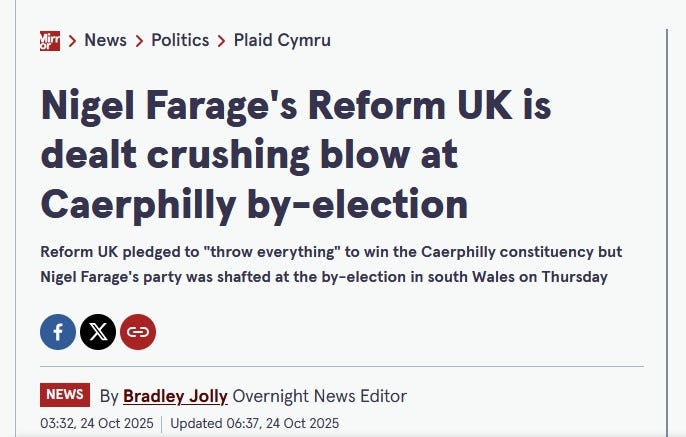
The Reform vote in Caerphilly yesterday is a great result which doesn’t look like one. The usual left-wing media suspects are all crowing happily, with the Labour-supporting Mirror trying to gloss over the catastrophic Labour showing as a “crushing blow for Farage”.
If Restore and Advance do unite and get down to serious work to fufil Lowe’s pledge of “hundreds of candidates”, they will be temporarily buoyed up by massive public enthusiasm. Their leafleting teams, canvassers, street-stall activists and so on will all relate the same rose-tinted tales as evidence of an impending surge of votes.
Unfortunately for them, this will only add to the crushing disappointment on the morning after polling day, when the vast majority of them find they didn’t even save their deposits.
Seen It All Before
How do I know this? Because I’ve seen it before, as an enthusiastic activist and local official of the National Front. From 1976 to 1979, we were met with similar enthusiasm wherever we went. I ran the ‘Class One’ campaign for the 1979 General Election in the town of Ipswich, a place with some history of above-average support for the anti-immigration cause.
‘Class One’ meant that we had a full election address for every house in the constituency. We backed it up with street paper sales, adverts and letters in the local press, our own team delivering back-issues of the party broadsheet to thousands of homes on our best estates, and a loud-speaker vehicle criss-crossing the town for several weeks.
On top of that, the NF, by standing in 303 seats, earned itself a TV broadcast on multiple channels. This was by far the most widely watched and talked about element of the entire campaign. In the time before the Internet, this was a matter of big credibility and serious reach.
It was while driving the loudspeaker van that I experienced best the amazing extent of ‘public support’ for the Front. Our reception in Ipswich dovetailed with what we heard from all around the country. Ever since 1976, when the NF trounced the Liberals in local elections in much of the country – including in the whole of London – senior figures in the party had speculated not so much on whether the party would win seats, but how many it would take.
The more level-headed opined that, while we would do well, “our really big breakthrough won’t come until the General Election after next”. That was as pessimistic as anyone got.
Thatcher Steps In
We all knew that Margaret Thatcher had grabbed the headlines with a vague anti-immigration message for a few days back in January 1978. Interviewed on ITV’s World in Action, the untried Tory leader was asked about possible plans to cut immigration. She responded by saying that:
‘People are really rather afraid that this country might be rather swamped by people with a different culture and, you know, the British character has done so much for democracy, for law and done so much throughout the world that if there is any fear that it might be swamped people are going to react and be rather hostile to those coming in.
‘So, if you want good race relations, you have got to allay peoples’ fears on numbers’.
Thatcher went on to say that voters were becoming ‘frightened’ about immigration at ‘[t]he moment the minority threatens to become a big one’ and suggested that this fear was a reason that people were supporting the National Front. She asserted that people did not necessarily agree with the National Front, ‘but they say that at least they are talking about some of the problems’.
From the massively positive response to our various efforts, we were convinced that, by talking about us, Thatcher had merely helped raise our profile and credibility. None of us, from men at the top to the newest member, thought for one moment that the public would fall for her patently insincere effort to steal NF votes by making tough noises about immigration.
That word ‘Swamped’ had led to Labour outrage and grabbed the headlines, but we all knew that the Tories already had a long record for talking about immigration before elections, but then letting even more of them in once they were elected. Why would the party of the bosses do anything else?
Plus, while Labour’s pro-immigration policies had badly dented their traditional support, the old tribal voting pattern was deeply ingrained. ‘Our’ estates were places in which all but the most recent elections had seen whole streets with Labour posters displayed on almost every house. Council elections over the last few years had proved that their residents were willing to switch to the Front, but there was no way they’d vote Conservative.
On top of all that, the Front had a wide range of popular policies on other subjects. Opposition to Britain’s increasing subservience to Brussels, a tough stance against the IRA, calling for the restoration of capital punishment, a programme to rebuild British industry – the party was in line with the opinions of millions of people.
Indeed, immediately after the 1979 election, the pro-Labour New Statesman admitted somewhat ruefully that the only chance the majority of voters had of getting a government which would deliver what they really wanted would have been to vote National Front.
Especially among the young middle-class types who are now crowding into the middle management of Reform, Advance and Restore – or talking about them on podcasts – there is a belief that they are the first people who have really articulated well-rounded patriotic and nationalist policies, and set about building a political machine to promote and deliver them.
All previous efforts are ignored or dismissed airily as the work of “knuckle-dragging proles”. Quite apart from the fact that such ideas betray a snobbery which, in the end, will be a serious liability in working-class seats, they are also arrant nonsense.
The NF didn’t pick up its skinhead image and tag until after the 1979 debacle, when a brief second flourishing of the youth subcult led to a couple of years when demonstrations by the flailing remnant of the party were indeed dominated by ‘skins’.
Restore Are Not That Different
The truth is that there is very little now being offered by Restore that wasn’t – with due allowances for different times and circumstances – put before voters by well-organised and energetic newcomers in past times: Mosley’s New Party, the BUF, the Union Movement, the British Labour Party, the National Front, the National Party and the BNP.
The key difference is that, being newly founded and still essentially an online phenomenon, Restore has not yet had to make the choice of whether to surrender to leftist mob violence and give up, or fight to defend themselves and their right to function, and thereby give the MSM opportunities to demonise them as ‘thugs’ and ‘extremists’.
Returning to 1979, on polling day itself, I was out on the streets in that loudspeaker van all day. We lost count of the number of thumbs up and honks of support we got from the good people of Ipswich. What is certain is that there were far more of them than the 449 who actually voted for us – a shockingly low 0.6%, which was still better than many NF candidates managed elsewhere.
The best result the party could manage was in Blaby, basically a white suburb of Leicester, a city in which concern over a massive influx of Asians expelled from East Africa had seen a huge surge in votes for the NF during council elections. The party had built up a door-to-door sales round in Leicester of thousands of copies of each issue of its broadsheet newspaper. It even owned a local headquarters building.
Our candidate, a young solicitor and tireless party worker named Phil Gegan, took 2,056 votes. That equated to 3.6% of the vote, so even he came nowhere near saving his deposit.
The whole thing was a disaster for the NF, and especially its leadership at the time, who promptly fell out amid demoralisation and recriminations. The party collapsed overnight from being a well-funded machine poised to become England’s third largest political party, to a moribund husk with a national income of less than forty pounds a week.
More than 10,000 membership enquiries had come in by post or by phone, either from the response coupons on the bottom of the millions of leaflets which went out, or from the contact information at the end of the TV broadcast.
All of these should have been sorted and passed out to regional and then local organisers, and then “followed up” with personal visits. This was the system which the party had developed over the preceeding years and, had it been put into operation, it would have led to many of the enquirers become new members, and in due course activists.
As it was, the shattering demoralisation, and the vicious splits which it helped to fuel, meant that virtually none of the enquiries were even sorted and sent out from Head Office. Even if they had been, the party’s local structure had fallen apart. Many of its candidates had been so humiliated and upset by their risable votes that they immediately dropped out. Others took one side or the other in the multi-way factional war which tore the National Front apart.
Lost Opportunity
A massive opportunity was lost. Within six weeks of winning the election with at least a million votes ‘stolen’ from the NF with that single word, ‘swamped’, Thatcher let in more than 20,000 Vietnamese-Chinese boat people. Anti-immigration voters immediaty understood that they had been conned.
Her administration saw a drastic collapse in popularity. Without the Argentinian invasion of the Falkland Islands, and her leadership of the victorious British counter-strike, Thatcher would have gone down in history as a single-term failure. Had the NF kept together, the 1979 dip would still have happened, but it could have recovered. [It did to a degree between 1983 and 1986, but only organisationally, not electorally, and it became a very different beast, but that’s another story for another time].
But the party had overreached itself too badly, and put all its eggs into an electoral basket. That basket turned out to have a gaping hole in the bottom, so the whole venture ended in disaster.
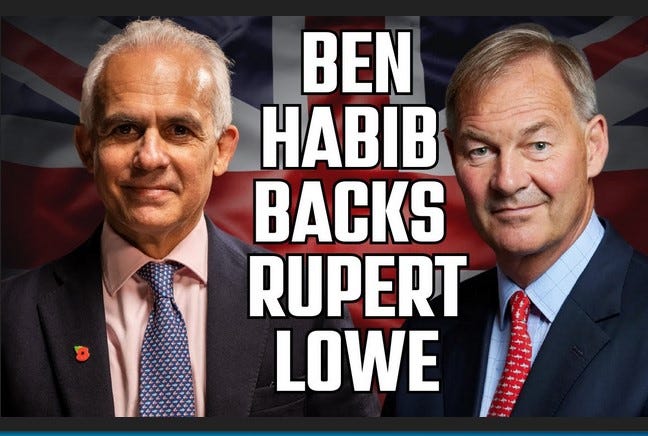
Rupert Lowe and Ben Habib should pay heed to this very relevent warning from British political history because, right now, it looks very likely that they are going to make exactly the same mistake.
Part of the problem here is the widespread tendency to confuse opinions which dominate social media echo chambers with those actually held by the majority of people in the real world.
Another, briefer, example from nationalist political history bears this out: For a full decade, from the very early 2000s, the BNP’s website was far and away the most widely viewed of any political party in Britain. All sorts of online polls and popularity contests put the party, our ideas, and me, in the lead. At no point, however, did this translate into winning levels of support in any Westminster election.
While the BNP enjoyed far more electoral success than all Britain’s nationalist parties put together, the lesson from this should be obvious: Thumbs up on social media are even cheaper than they are in real life.
Especially when it comes to voting for the next government, people vote not for who they would choose in an ideal world, but for the party which actually stand the best chance of keeping out the one they detest even more. Or for the one they think most likely to keep them in a job or to minimise their tax bill.
Such calculations might just benefit Farage and Reform next time around, but that’s as far to the right as these crucial calculations will take the electorate until 2034 at the earliest.
Lowe’s Time – Still to Come
Where does this leave Rupert Lowe and Restore? In a very good place, if the man recognises reality and makes the right decisions.
I refer him – and you – back to my Open Letter, and reiterate the fact that the only parliamentary seat he needs to fight is his own. Provided he avoids walking into a repeat of the NF’s 1979 disaster, Rupert Lowe’s time will come a year or so after the next General Election.
Even if Farage continues to pollute his own brand with carpet-bagging Tories and complacent disorganisation, Reform is set to emerge as one of the largest parties in the next parliament – quite possible, the largest.
From Nigel’s record, we can confidently predict that, within months, a growing number of those MPs will fall out with him and defect. Some, especially those in the posher seats in southern England, will go back to the Tories. But, providing Rupert is re-elected, many others will take note of public opinion and take the further step to the right.
This tendency would be even stronger if Lowe and his band of merry men get serious, and spend the next three years building not electoral castles-in-the-sky but a real grass-roots powerbase.
With the manpower and resources which a combined Restore/Advance operation would command, this could go way further, and much quicker, than the simple and low-cost Community Action programmes to which I have alluded in this series so far.
They would also be able to move straight to the physical community and advice centres which I will also propose here in due course. For the time being, I will simply suggest that, while Rupert Lowe is up in Gorton this coming week, he should get Nick Buckley to take him to the Oasis Centre there.
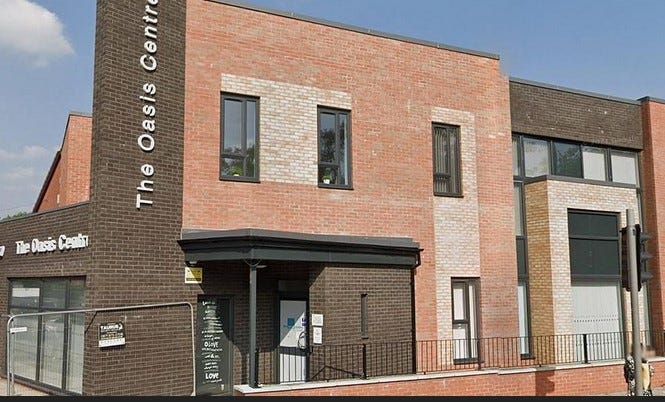
Naturally, its website makes a point of ticking a few ‘Dieversity’ boxes, but the overall theme of a Christian-inspired centre, established by volunteers and running all sorts of programmes for local people, is something infinitely more useful than losing their deposit.
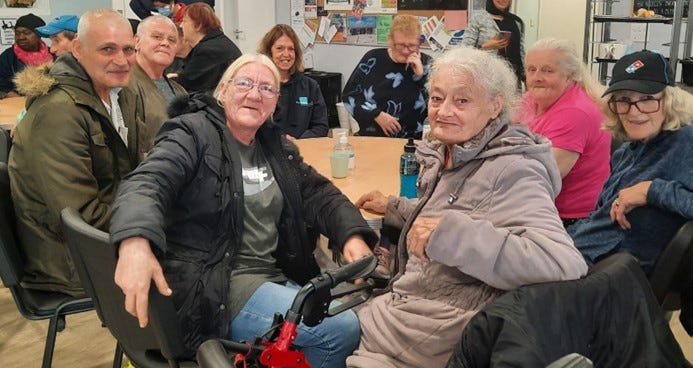
Local residents enjoy the facilities in the Gorton Oasis centre
Such centres, directly linked to the growing party, with advice centres, apprenticeship taster courses and all sorts of other very positive things on offer, would provide a concrete expression of things about which Mr. Lowe has spoken and campaigned since becoming MP for Great Yarmouth.
Done right, this would speed the process of self-organisation by British indigenous communities by ten to fifteen years. While doing so, it would build bases from which to replace Reform after its inevitable future failure. The existence of a growing network – and the experience and resources to expand it even further, would provide another compelling reason for good Reform MPs to jump ship to Restore.
To conclude, I reiterate that all this can happen – provided Rupert Lowe resists the temptation to listen to naive enthusiasm on behalf of an electoral Charge of the Light Brigade, and throws all his new party’s General Election effort into just his one seat.
He also needs to fight it properly, which means moving beyond the pitiful recommendations of Reform’s hired-in politics graduates, with their complete lack of real life experience. He shouldn’t look to the Tories either, because they’re dinosaurs.
The ones to look to are the LibDems, Labour and the Greens, because they’re the only ones who can organise a piss-up in the electoral brewery. The BNP studied the LibDems in particular, but the Greens have since leap-frogged even them. They don’t have the resources to roll out their best efforts everywhere but, when they do, their machine is a well-directed steam-roller. That’s what Restore needs to build, and it won’t do it by losing 400 deposits in 2029.
All in all, it is clear what Rupert Lowe should do. It’s what I want him to do, and I hope that, having read this, you want him to as well.
Not because he’s perfect, because he’s not. And not because electoral politics is going to “save Britain”, because it cannot and will not. But because he’s a lot better than any of the others, and his weaknesses on certain international issues won’t make any material difference.
What matters is that the eventual Reconquest of the West will not come about through elections, but from the multi-generational efforts of strong communities. This is what will give our descendants the will to hold on, the ability and resources to apply that will in reality, and the confidence and security to outbreed and out-organise “the Others”.
As we have just seen, Restore could play a crucial part in the earliest stages of this process, which would make Rupert Lowe a foundational figure of the forthcoming Resistance.
I believe that my writings and talks will also play a role in this process, but by the nature of my political baggage and having been so far ahead of the time, that may be the limit of what I can do. Mr. Lowe, on the other hand, could do far more. I certainly want him to, which is why I have devoted a considerable amount of my time – and your time – to explain both the dangers and the opportunities which he faces.
Unfortunately, things don’t happen just because we want them to. My hunch is that Rupert will not take any notice of any of this, but will blunder into repeating the NF’s fifty-year-old strategic error, lead his followers to electoral disaster, and become yet another footnote in the long history of nationalist failure.
In which case, come 2029, the serious people among us will look back and say “Nick Griffin was right about that too”, which might help somewhat as we set about making up for lost time. Let’s hope we don’t have to, but start to organise for it just in case!
https://nickgriffin544956.substack.com/p/will-rupert-lowe-seize-the-real-opportunity