
Women Ruin Everything

Years ago, during my time as an Engineering Officer in the Canadian Navy, I was responsible for the department that oversaw the ships various water systems. For those unfamiliar with water (not the substance itself but the categories), there are three types, potable, grey, and black. Potable water is drinking water; greywater is wastewater excluding toilet waste (ex. showers, dishwasher), and blackwater is wastewater containing human waste.
What I found interesting is that the difference, at least onboard ship, simply came down to parts per million or ppm. If water had less than 500 ppm of total dissolved solids (TDS) it was potable, if the number was over 2000 it was blackwater, and anything in between was greywater.
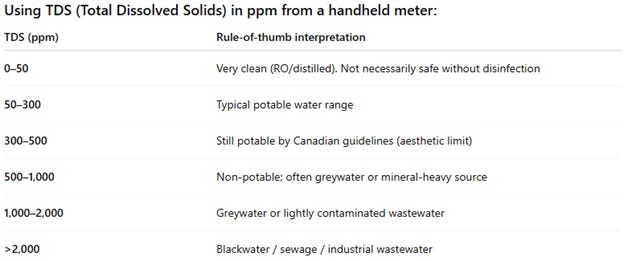
The simple, and obvious in retrospect, takeaway:
What you put into something determines what it is.
How does this apply to people?
It doesn’t.
At least not to individuals. Education/indoctrination aside.
Men are not, when brought together, converted into another type of substance.
— John Stuart Mill
Mills was right, people do not become something different when brought together. However, organizations behave differently depending on what people are brought into them.
If we combine our insight from Mills with our takeaway from the different types of water, move from this:
What you put into something determines what it is.
To this:
Who you put into an organization determines how it behaves.
This is important if we are to understand what, if any, truth there is behind two articles that came out in late 2025. The first was an opinion piece, The Great Feminization, by Helen Andrews.
Andrews’ thesis is that modern institutions have reorganized themselves around traits, norms, and constraints associated with women’s average preferences and risk profiles and that this has systemic consequences.
To give real world examples in her own words:
“Everything you think of as wokeness involves prioritizing the feminine over the masculine: empathy over rationality, safety over risk, cohesion over competition.”
“Cancel culture is simply what women do whenever there are enough of them in a given organization or field.”
There is also at least one troubling prediction:
“The field that frightens me most is the law. All of us depend on a functioning legal system, and, to be blunt, the rule of law will not survive the legal profession becoming majority female. The rule of law is not just about writing rules down. It means following them even when they yield an outcome that tugs at your heartstrings or runs contrary to your gut sense of which party is more sympathetic.”
The second article, or more precisely series of articles, delt with a New York Times interview of Andrews and her fellow conservative feminist Leah Libresco Sargeant, discussing the question “Did Liberal Feminism Ruin the Workplace?”
As the title indicates, these largely dealt with placing blame for the current state of the workplace.

So far, that last article is the only one I’ve come across that takes a reasonable approach to the topic.
“Ruined” or “changed?”
Let’s have that “conversation,” shall we?
Another Type of Substance
There are two primary phenomena at play here. Both are so obvious that it’s almost embarrassing to have to state them.
The first is that the female share of the workforce has risen over the last 75 years.
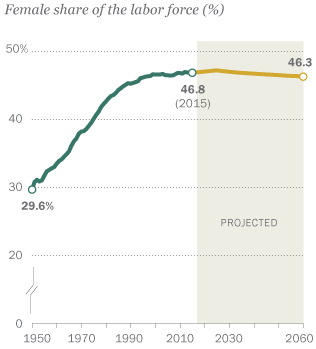
Source: https://www.pewresearch.org/short-reads/2017/01/31/women-may-never-make-up-half-of-the-u-s-workforce/?utm_source=chatgpt.com
The second is that, as “everyone” knows, men and women, on average, act and think differently. This is particularly important when looking at groups.
Note: My apology to any postmodern gender theorists reading this who’ve had their entire belief system
refutedrejected by one short sentence. Feel free to fume so long as it doesn’t hold up my Starbucks order.
If we agree that “Who you put into an organization determines how it behaves,” then we are clearly changing how the workforce functions, what is acceptable and unacceptable, and most importantly, where power resides. Some occupations have more women than others so the differences will vary between occupations – we’ll get to that later – but for now the question is “what behavioral differences are driving these changes?”
And for that we need…
The Big Five Personality Traits
For those unfamiliar with it, the Big Five is the most widely accepted framework in personality psychology. It organizes personality into five broad dimensions:
- Openness to Experience – reflects curiosity, imagination, and willingness to try new things. High scorers are creative, adventurous, and intellectually curious. Low scorers prefer routine, practicality, and the familiar.
- Conscientiousness – captures organization, responsibility, and self-discipline. High scorers are reliable, planned, and achievement-oriented. Low scorers are more spontaneous, flexible, and less focused on long-term goals.
- Extraversion – measures sociability, assertiveness, and energy in social situations. High scorers are outgoing and energized by social interaction. Low scorers (introverts) prefer solitude and find social situations draining.
- Agreeableness – reflects compassion, cooperation, and concern for social harmony. High scorers are trusting, helpful, and empathetic. Low scorers are more competitive, skeptical, and direct.
- Neuroticism – because this is the only dimension that “sounds” negative some have started to call it “Emotional Stability.” It captures the tendency to experience negative emotions like anxiety, depression, and mood swings. High scorers are more emotionally reactive and prone to stress. Low scorers are calm and emotionally resilient.
These traits are not binary but rather measured on a spectrum which is why I can prefer routine and also be intellectually curious.
When we examine variation between the sexes we begin to understand how the increase in women in the workplace, especially at higher levels of management (and HR, again, we’ll get to that later) influence behavior within organizations.
Research consistently finds small to moderate average differences between men and women on these traits, though there’s substantial overlap between the sexes:
Women tend to score higher on:
- Neuroticism (moderate difference) – more prone to anxiety and emotional reactivity
- Agreeableness (small to moderate) – particularly on aspects like compassion and politeness
- Extraversion (small difference) – specifically on warmth and gregariousness, though not necessarily assertiveness
- Certain facets of Conscientiousness – particularly orderliness
Men tend to score slightly higher on:
- Certain facets of Openness – particularly openness to ideas
- Assertiveness (a facet of extraversion)
“Legal disclaimer” – So that I don’t get accused of misogyny (it’ll happen anyway) or “Gender Essentialism” (look it up yourself), some caveats:
- These differences appear across cultures but vary in magnitude
- These are statistical averages, individual variation within each sex is far larger than the average differences between sexes, and these traits are influenced by both biological and sociocultural factors.
Put another (and simplistic) way, women tend to experience more anxiety and worry, show greater concern for interpersonal harmony and others’ wellbeing, and prioritize compassion in their decision-making. Men tend to be more emotionally stable under stress, show greater assertiveness in pursuing objectives, and emphasize fairness and impartial principles in their decision-making.
There, I just stereotyped men and women.
Come at me bro/sis!
Seriously though, stereotypes exist for a reason. No, it’s not so you can feel justified swearing at certain people in traffic or because there’s a racist/sexist cabal that meets monthly to come up with new offensive stereotypes designed to push society towards a race war in which women will remain at home barefoot and pregnant. They exist because there is (usually) some reality to them. Women are widely considered to be more nurturing because, on average, they are. Men are seen as more assertive because, on average, they are.
Note: I’m getting tired of writing “on average” so I’m not gonna anymore. If you haven’t gotten the point by now you never will.
When you look at what women “bring to the table” you might be forgiven for thinking “aside from anxiety, how could any of these be bad?”
Suicidal Empathy
There, I said it.
For those unfamiliar with the term, Suicidal empathy is a term coined by Canadian evolutionary psychologist and professor Gad Saad. It refers to “excessive, misdirected, or unregulated compassion that harms the individual, group, or society exhibiting it, by prioritizing short-term emotional appeasement or feelings for others (especially out-groups or perceived victims) over long-term survival, rationality, security, cultural cohesion, or self-interest.”
In short, a greater concern for interpersonal harmony and others’ wellbeing, and prioritizing compassion can have a downside. These explain:
- “Believe women” replacing due process
- Title IX courts for sexual assault denying the accused (man) the right to confront your accuser or to even know what the crime is
- “Harm reduction” replacing enforcing the law
- Equity trumping equality
- A desire for open borders and unchecked immigration policies
- Reluctance to enforce laws against certain groups (see California decriminalizing theft)
- Using race as a mitigating factor in sentencing (see Canada’s Gladue principles)
Granted not all of these are driven by women, but the point here is that just because something sounds good (ex. empathy) doesn’t mean prioritizing it above all else is the road to utopia.
So, what’s changed?
Women have made significant inroads in many occupations, but not all would be expected to influence corporate culture in the same way. Pharmacists for example are now 61% women but have little (read “no”) impact on the day-to-day operation of the average Fortune 500 company.
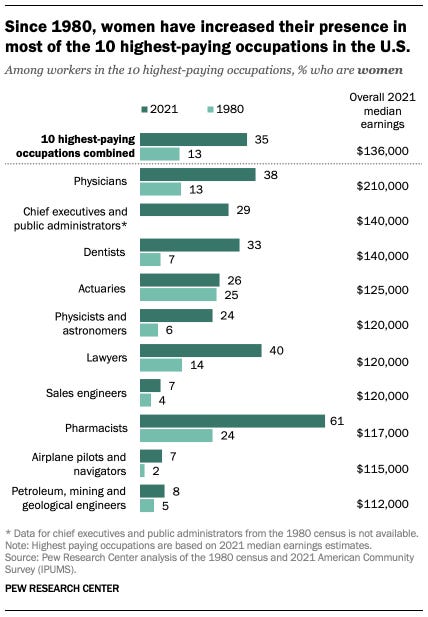
Occupations that we would expect to play a role in changing the workplace include:
- HR Professionals – Increased from 25% female in 1970s to 70-76% female in 2020s (one of the most dramatic shifts)
- Chief Executives – Have gone from 0% to 29% between 1980 and 2020.
- Managers (Overall) – Women increased from 29% of all managers in 1980 to 46% in 2023
- Lawyers (Corporate/In-house) – Increased from 14% female in 1980 to 40% by 2023.
- Medical and Health Services Managers – Women make up 74% of medical and health service managers as of 2023
It is beyond the scope of this article to identify all the ways in which the increase in women in these roles, and in the workforce in general, impact organizations, however, this table provides some insight into what changes would be expected.
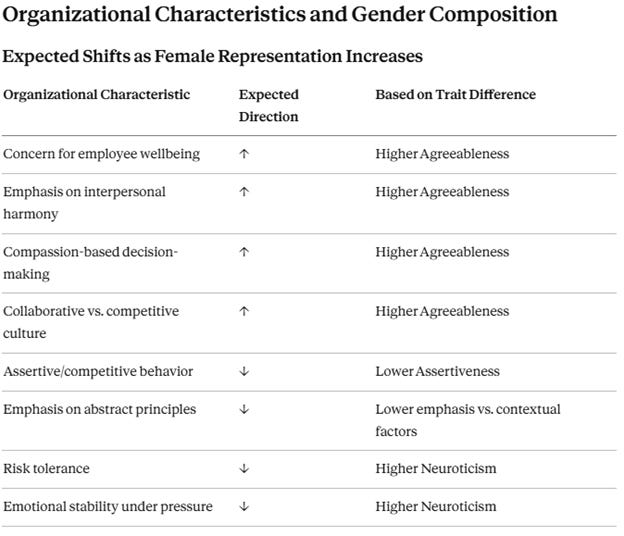
One interesting observation from research done on the Big Five personality traits is the similarity between women and progressives.
The strongest overlap is in higher Agreeableness, Openness, and Neuroticism. Studies note that the personality-ideology link is partly why women lean more liberal/progressive overall (women comprise a majority (often 55–65%+) of self-identified progressives/liberals).
Given this, one would imagine that as the percentage of women in an organization rises and in organizations that women “control,” one would expect the organization to take on progressive-like values (read “act more woke”). Is this the case?
What are the most “woke” occupations? It depends who you ask I imagine, but let’s look at a few I think we can all agree on:
Academia
- 1980: 26% of faculty (source: ERIC study)
- 2000: Estimated 35-37% based on trajectory from 32% in 1991 to 47% by 2020
- 2020: 47% of all full-time faculty
Entertainment (TV and Film)
- 1980: Fewer than 5% (only ~15 women directed commercial films 1966-1980)
- 2000: ~9-10% directors of top films
- 2020: 16% of top 250 film directors; 32% of streaming TV directors
Marketing
- 1980: Limited historical data, male-dominated field
- 2000: Estimated 30-35% based on industry reports
- 2020: 43-48% of CMO positions; 64-68% of marketing workforce overall
Publishing
- 1980: Limited data, but women concentrated in lower positions
- 2000: Estimated 40-45% workforce
- 2020: 74-77% of workforce; 56% of management; 47% of editors; >50% of published authors (first time in history)
Media/Journalism
- 1980: 22-26% of newsroom staff
- 2000: 37-40% of newsroom staff; 34% of supervisors
- 2020: 41-47% of staff (varies by organization type); 28% of top editor positions
Medical Bureaucracy
- 1980: Limited data
- 2000: 11% of CEOs; 67% of healthcare managers workforce
- 2020: 11-27% of CEO/COO/CFO roles (varies by study); 78% of healthcare workforce
This isn’t hardly what one would consider a “mike drop moment,” but it is interesting that a rise in female participation correlates with a rise in “wokeness” in these occupations. One does not see the same correlation in occupations that remain male dominated such as construction, engineering, and mining.
What’s it all mean?
Are women ruining the workplace?
Possibly in some places, but in general probably no more than men are doing it elsewhere.
Is the male dominated workplace changing to accommodate a greater percentage of women employees? Or is “toxic masculinity” just being replaced by “mean girls” culture.
Probably a little of both.
There is no recipe for the perfect workplace. It’s a game of whack-a-mole. You can set good rules but problems will arise, and when they do you need to fix them.
There is no end state for the workplace, no utopian worker’s paradise where everyone is always treated equally and all decisions make everyone happy. That doesn’t mean it shouldn’t be a goal.
“A” goal, not “the” goal.
“Guided by our Core Values, we seek in all we do, at every level of our business, to advance human rights and dignity, support social and economic justice for historically marginalized communities, and protect and restore the Earth’s natural systems.”
Wow! That’s awesome! And here I was thinking Ben & Jerry’s was an ice cream company.
Is Andrews right? Are women destined to destroy the legal system?
Maybe. I don’t predict the future. It’s certainly possible if the wrong decisions are made.
It wouldn’t be the first occupation that rotten from within. How else can we explain what we’re seeing in the medical bureaucracy? Take this recent exchange for example:
Senator Hawley: “Can men get pregnant?”
Dr. Verma (OB-GYN): “I do take care of patients with different identities. I take care of many women. I take care of people with different identities. And so that’s where I paused. I think, yeah, I wasn’t sure where you were going with that.”
Senator Hawley: “The goal is just the truth… the goal is just to establish a biological reality. You just said a moment ago that science and evidence should control, not politics. So, let’s just test that proposition, can men get pregnant?
Dr. Verma: “I take care of people with many identities… I also think yes-no questions like this are a political tool-”
For the record, the answer is “no.”
It doesn’t take a medical degree to know this. Sadly, having one may make answering the question more difficult.
And that’s a big problem.
How did this type of thinking make its way into the medical bureaucracy?
It’s hard to say, but one can’t help but notice the increase role that women now play in the occupation.
- As of 2022 62% of OB-GYNs were women, up from 38% in 2004.
- 36% of full professors in US/Canadian academic OB-GYN departments are women, up from 10% in the late 1990s.
- Women are much more prevalent at lower levels, making up roughly 71%–72.8% of instructors and 61% of assistant professors up from 33% in the 1990s.
More women gynecologists is not a bad thing. In fact, all said it probably has more positives than negatives.
But there are negatives.
“Who you put into an organization determines how it behaves.”
Are women destined to destroy the legal system?
I hope not.
But if more female lawyers mean the legal system starts behaving like the medical bureaucracy, then yes, we’re all screwed.
https://hoisttheblackflag.substack.com/p/women-ruin-everything