
World Economic Forum 2026
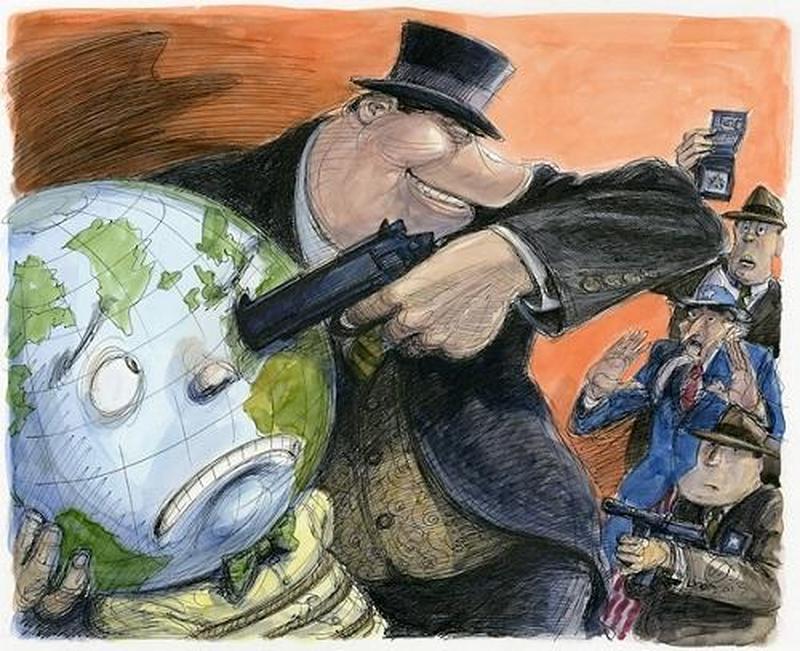
On January 19, 2026, the World Economic Forum (WEF) will reopen its doors in Davos. The global elite will gather in the Swiss mountains to discuss the future of the world and the so-called greatest global threats, or rather, to push their own agendas. This time, special attention will be given to US President Donald Trump, who will arrive with one of the largest delegations ever and will deliver a keynote speech. It will be exciting to see what he has to say to the assembled ladies and gentlemen.
The WEF’s recently published ” Global Risks Report 2026 ” serves as the usual backdrop for the gathering of self-proclaimed world leaders. In the short term, meaning the next one to two years, the experts see the greatest threats in geoeconomic confrontations —that is, economic wars—through sanctions, tariffs, and trade barriers, as well as in disinformation and social division, writes Chris Veber .
In the long run, of course, the climate will dominate again . Nothing new under the sun, you might say. Same themes, same goals. Getting smarter doesn’t seem to be a trend among WEF bureaucrats. The WEF warns of increasingly intense storms, floods, and heat waves in the long term, which are reportedly being amplified and caused by human-induced climate change.
But looking at the historical data reveals a different picture. The weather has always been changing; ice ages, warm spells, storms, and droughts existed long before industrialization. Disasters are not a modern invention.
Interestingly, despite the supposedly disastrous development, far fewer people die from natural disasters today than in the past. According to data from Our World in Data and the international disaster database EM-DAT, the number of fatalities has fallen dramatically since the beginning of the 20th century, from hundreds of victims per 100,000 inhabitants to often fewer than 0.2 victims per 100,000 inhabitants per year. Better warning systems, more stable buildings, advanced medicine, and weather adaptation: humanity has learned to cope better with change and will continue to do so, without the need for alarmism.
Technological progress and growing prosperity were the driving forces behind this positive development. Prosperous societies are resilient societies. Regarding short-term risks, the WEF sees “geoeconomic confrontation” as the greatest danger—that is, economic wars. Precisely the economic wars that the woke governments of the West themselves unleashed, particularly with the sanctions against Russia over the conflict in Ukraine. These measures have not harmed Russia, but primarily Europe. Exploding energy prices, forced deindustrialization, and economic decline are directly attributable to the policies of the EU and its subordinate national governments. The “green” energy transition and the boycott of Russian gas have brought Germany and Austria, in particular, to their knees. Those who close nuclear power plants, rely on expensive LNG, ban combustion engines, and pay hundreds of billions to wind turbine operators should not be surprised by the economic downturn.
Another point in the report is the destruction of critical infrastructure as an imminent threat. Here, it’s worth briefly examining the recent past. The Nord Stream pipelines were blown up by “allies”—Ukraine with American and Polish support. In Germany, the government is shutting down reliable nuclear power plants to achieve ideological climate goals. To ensure they are never reactivated, the government is also destroying these power plants. In Berlin, there were acts of sabotage against the electricity grid by the left-wing Antifa, an Antifa that is not only tolerated by the government but also actively promoted, paid, and supported. It seems to me that, even when it comes to destroying infrastructure, the woke Western governments are the worst enemies within themselves.
The WEF sees “social division” as another major threat. This division is actively fostered by woke governments, which act against the will of the majority in almost every relevant area. The clearest example is migration policy.
The mass immigration of culturally alien, violent people from medieval, Islamic-themed areas is proceeding against the express wishes of large segments of the population. Critics are labeled “right-wing” or “disinformation-mongers.”
This is precisely where the “war on disinformation” comes into play, which the WEF identifies as the second-greatest short-term risk. This fight isn’t so much about protecting the truth, but rather about protecting woke governments from it. It must be obscured that economic wars, energy crises, infrastructure sabotage, social division, and inflation are the results of deliberate and clearly desired policies. The self-appointed elites in Davos and Brussels want to remain in power, whatever the cost to the citizens. Even higher taxes, even more regulation and censorship, even less freedom—all in the name of the climate, Ukraine, and OurDemocracy™. Or perhaps a new plandemic, which, while less prominent than before, is still present in the WEF’s fear-mongering.
If I were to rewrite the WEF’s fear predictions, I would summarize the top five biggest threats to the freedom, prosperity, and life of citizens as follows:
- Supranational, unelected organizations such as the EU, the WEF and the WHO
- The government
- The government
- The government
- The government