
WWI + WWII = WWIII?
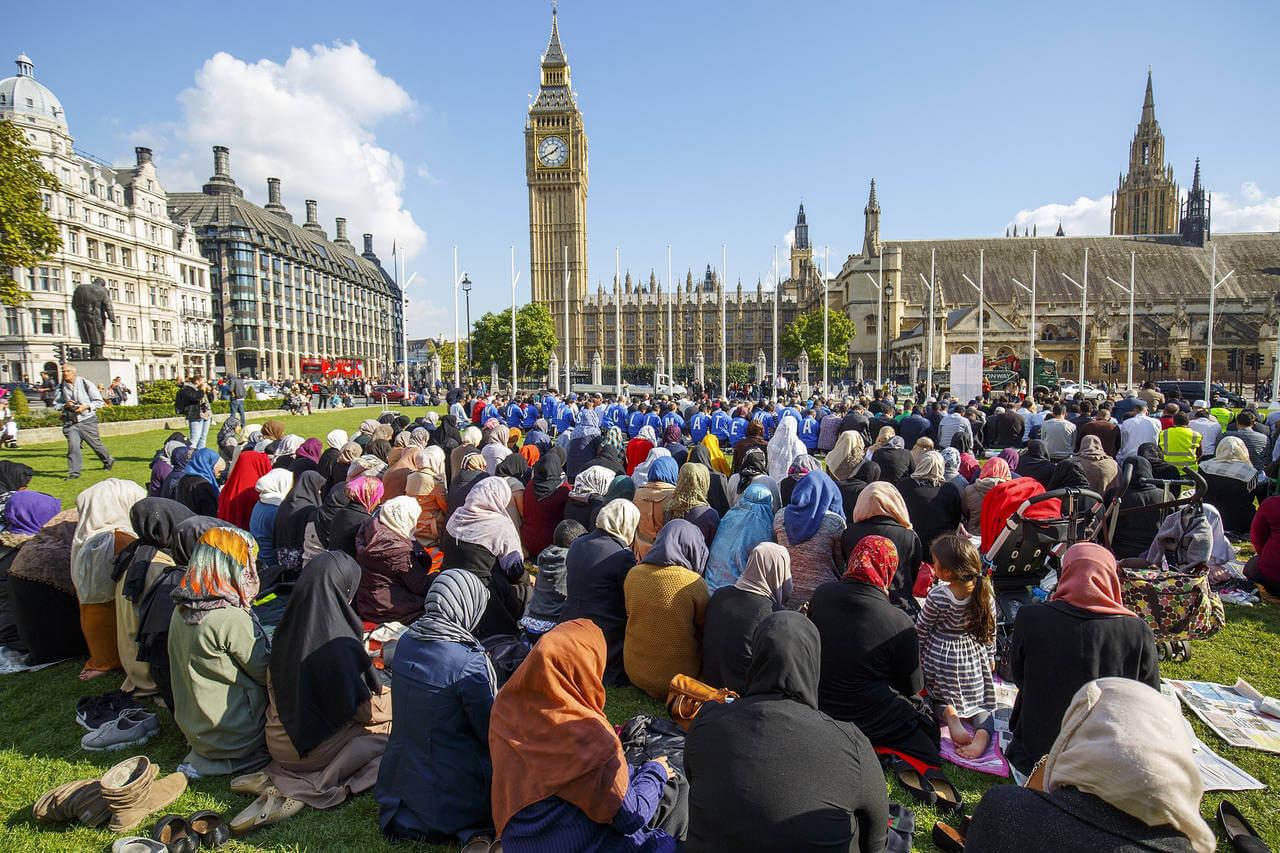
Britain’s civilizational collapse bothers me. As much as we Americans enjoy defining ourselves by the whooping our ancestors gave to the Crown, Brits and Yanks share a common language, enjoy similar beliefs, and broadly relate to one another. Rebelling against the British Empire is one thing. Watching foreign peoples conquer what’s left of that empire in another thing altogether. Every day the United Kingdom becomes less united and more likely to collapse upon itself.
The U.K.’s media Establishment used popular actor Idris Elba to promote a documentary last year entitled, “Our Knife Crime Crisis.” Elba spent twelve months trying to understand why there’s a “stabbing epidemic” in his country. He concluded that it mostly had to do with unregulated social media, corporate profits, and not enough Big Government. The actor then suggested to his countrymen that they hand over sharp kitchen knives or perhaps apply for permit licenses. Nobody had the guts to say, “Hey, maybe we should stop inviting Islamic terrorists to live inside our borders, rape our daughters, and stab and murder our people in the name of Allah.” It’s as if the U.K. Establishment is going to wait for civil war to begin before considering the possibility that its open borders policies are killing people. Or maybe civil war is what the British government wants. That’s certainly what it looks like from this side of the pond.
Everybody understands what’s happening because similar happenings are occurring throughout the civilizational West. Economic and political “elites” have spent the post WW-II decades engineering a new kind of global order. They didn’t ask for our advice or permission. We were never allowed to vote for or against their long-term plans to reshape our worlds. They just decided to topple over this thing we once affectionately called home. That malevolent cabal we often call “the powers that be” decided to end the “nation state” for good, and that’s what we’ve watched unfold for three-quarters of a century.
We’re all familiar with George Santayana’s warning — “Those who cannot remember the past are condemned to repeat it.” — but, frankly, that hasn’t stopped most of us from forgetting everything. From one generation to the next, we ignore the consequential lessons immediately behind us, as we stumble forward into similar mistakes once again.
The first generation of the twentieth century witnessed technological marvels that most thought impossible. With the advent of radio, electricity, light bulbs, and automobiles, the world turned upside down in a matter of years. Instead of enjoying the luxuries of the “modern world,” that generation endured rolling waves of death from the Great War, famines, pandemics, and economic depression. The survivors marked Armistice Day each year as a concerted reminder never to unleash so much destruction again. Twenty years later, WWII’s mechanized slaughter and annihilation of whole cities made its predecessor look small.
So what were some of the lessons that we learned from those two catastrophic global wars? We learned that “elites” walk us into big wars. They use propaganda to get us riled up and ready to fight. They are willing to sacrifice tens of millions of us for their own aims.
These aren’t great secrets. You can walk into history museums in Germany, the United Kingdom, and the United States and see colorful posters from both wars depicting enemies as animals, rapists, and murderers. You can play audio recordings of fake news stories meant to convince citizens that the citizens of other nations are evil. Most of us see and listen to these artifacts from just last century and enjoy our chance to step back in time and experience a little history. How many of us stop to wonder, “If German, British, and American leaders were willing to lie back then, what’s stopping them from lying right now?”
Military historian Hew Strachan’s magnificent first volume on the lead-up to WWI showed how military alliances, miscommunications, aristocratic egos, and legal treaties led the world to unnecessary carnage. An unmistakable argument in Strachan’s work is that mutual defense obligations between nations can turn small conflicts into huge wars. Let me repeat that: Expansive military alliances led directly to the First World War.
Given Strachan’s scholarly conclusion, I have always found it intriguing that former defense secretary and retired four-star Marine Corps General Jim Mattis has often referred to Strachan’s book as a seminal exposition on military strategy. Why? Because Mattis has also been a staunch defender of the North Atlantic Treaty Organization. How a man could love Strachan’s masterpiece while simultaneously promoting NATO’s expansion seems an inherent contradiction.
Before his death, Senator John McCain was working to fast-track the admission of little Moldova into NATO. While Moldova can provide no military support for the United States, its integration into NATO’s military alliance would have added yet another country on the Russian Federation’s border that the U.S. was obliged to defend. And while Ukraine is not a member of NATO, Europe’s NATO members continue to insist that the United States should nonetheless directly tangle with Russia today — the exact kind of nuclear power brinkmanship that we spent the entire Cold War avoiding.
This willful blindness — where prominent American leaders can recognize the dangers of foreign entanglements in one speech while arguing for new foreign entanglements in the very next speech — is confounding. If we are condemned to repeat what we cannot remember, shouldn’t we all work really hard to remember the lessons of WWI and II?
So what were two of the biggest lessons of the global wars? (1) Culturally-similar populations desire self-determination. No matter how much pressure a government places on disparate groups of people to remain a single nation, when divisions become too numerous, nations do not survive. (2) Totalitarian governments provoke bloodshed and civil unrest. When enough people feel the boot of government on their necks, the desire for revolution becomes greater than the desire for peace.
How have post-WWII Western powers used the last eighty years to transform their nations? (1) They have opened their borders and intentionally instigated the greatest mass migration of peoples in human history. (2) At the same time, Western governments have accrued more power over their national populations than ever before. They have ignored the lessons of last century’s great wars and led us back to the beginning.
Western governments promote censorship, viewpoint discrimination, and the criminalization of religious beliefs. They do this, they say, in defense of “democracy.” Western governments spy on their citizens, track their purchases, and create thousands of new bureaucratic regulations each year. They do this, they say, to “protect” the people. Western governments demonize Western civilization while promoting “multiculturalism.” They do this, they say, because “diversity is our strength.”
Meanwhile, nobody says out loud what is plain to see: The same conditions that preceded both world wars have returned with a vengeance. Western nations are overflowing with peoples from incompatible cultures. Economic stability is collapsing, as people struggle to support themselves. As governments read everything we write and watch everything we do, today’s totalitarians have far greater powers than last century’s dictators ever possessed. Instead of recognizing that the world is on the cusp of great conflict, Western governments tell us that everything is okay. In Great Britain, the Establishment would rather pretend that “knife crime” is an inexplicable crisis than admit that society is quickly deteriorating.
Westerners alive today may prefer to forget the past. It’s so much easier to live for the moment. It’s also easy to predict what our descendants will one day ask: “How on Earth did our ancestors ignore the lessons of WWI and II? Why did they sleepwalk right into WWIII?” Ignorance is bliss, but it comes with costs. Let’s hope our ignorance doesn’t end up costing us everything.
https://www.americanthinker.com/articles/2026/04/wwi_wwii_wwiii.html